- All Drug Categories
- Home
- Anti-cancer Drugs
- Healthcare Products
- Medical Information
- Statement
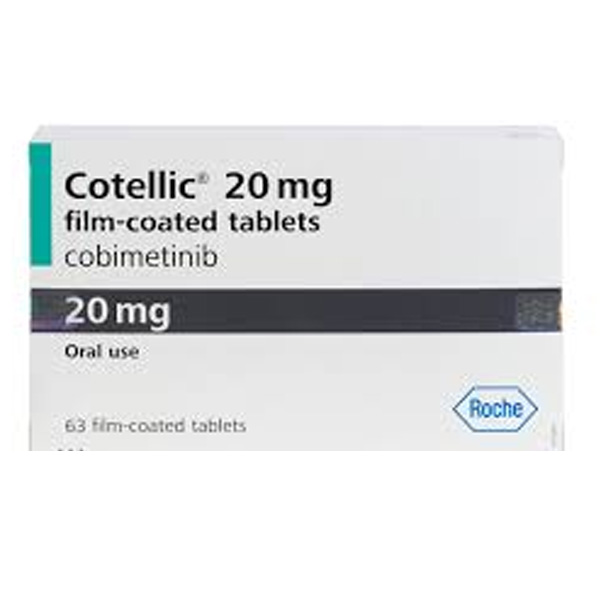
All Names: Cotellic,Cobimetinib、 考比替尼,卡比替尼
Indications:Adult patients with advanced melanoma who cannot be surgically removed.
Manufacturer:Roche, Switzerland
Customs Clearance Procedure:If the customs requires the package for customs clearance, please pay the customs clearance fee according to the content of EMS SMS and customs regulations.
Cobitinib (Cotellic) ®) It is a multi kinase inhibitor that selectively inhibits the activity of MEK1 and MEK2 kinases, blocks the RAS/RAF/MEK/ERK signaling pathway, and thus inhibits the proliferation and survival of tumor cells.
1、 Drug name
1. Common name: Cobimetinib
2. Product Name: COTELLIC
2、 Indications
1. Non resectable or metastatic melanoma: in combination with Verofenib, used to treat adult patients carrying BRAFV600E or V600K mutations.
2. Organ cell tumor: As a monotherapy, it is used to treat adult tissue cell tumor patients.
3、 Specifications and characteristics
1. Specification: 20mg/tablet.
2. Appearance: White, round, film coated tablets, with "COB" engraved on one side.
4、 Main components
Active ingredient: Cobimetinib fumarate, a kinase inhibitor.
5、 Usage and dosage
1. Recommended dosage: Take 60mg orally once daily (3 20mg tablets) for the first 21 days of each 28 day treatment cycle. Continue treatment until disease progression or unacceptable toxicity occurs.
2. Usage: Can be taken with food or on an empty stomach.
3. Omission/Vomiting Management: If one dose is missed or vomiting occurs after taking the medication, the next dose should be taken at the scheduled time without the need for supplementation.
6、 Dose adjustment
1. Dose reduction level:
Reduce to 40 milligrams for the first time, once daily; Reduce to 20 milligrams for the second time, once daily. If the dose of 20 milligrams cannot be tolerated, the medication will be permanently discontinued.
2. Adverse reaction dose adjustment:
Bleeding: Grade 3 bleeding, medication can be suspended for up to 4 weeks, and after improvement, the dosage level can be reduced by one dose level to resume medication; Grade 4 bleeding, permanent discontinuation of medication.
Cardiomyopathy: For asymptomatic left ventricular ejection fraction with an absolute decrease of more than 10% and below the lower limit of normal, medication should be suspended for 2 weeks. If it recovers after re examination, the dose level can be reduced by one dose level for recovery; For symptomatic reduction, medication can be temporarily suspended for up to 4 weeks. After symptoms and indicators recover, the dosage level can be reduced by one dose level, otherwise the medication will be permanently discontinued.
Severe skin reactions: For grade 2 (intolerable), grade 3, or grade 4 rashes, medication should be suspended or the dosage reduced.
Serous retinopathy: Suspend medication for up to 4 weeks. If there is improvement, reduce the dosage level for recovery. If there is no improvement or recurrence, permanently discontinue medication.
Retinal vein occlusion: permanent discontinuation of medication.
Hepatotoxicity/rhabdomyolysis: Depending on the severity, medication may be temporarily suspended, reduced in dosage, or permanently discontinued.
7、 Medication precautions
1. Genetic testing: Prior to treatment of melanoma, it is necessary to confirm the presence of BRAFV600E or V600K mutations in the tumor specimen.
2. Sunscreen: This product can cause severe photosensitive reactions. During treatment, avoid sun exposure, wear protective clothing when going out, and use broad-spectrum sunscreen and lipstick with sun protection factor ≥ 30.
8、 Medication for special populations
1. Pregnant women: Based on the mechanism of action and animal research, it may cause harm to the fetus. Pregnant women are prohibited from using it.
2. Breastfeeding women: It is not yet clear whether it is secreted into breast milk. Breastfeeding is not recommended during the treatment period and within 2 weeks after the last dose.
3. Women with fertility: Effective contraceptive measures should be used during treatment and within 2 weeks after the last dose.
4. Children: The safety and efficacy in patients under the age of 18 have not yet been determined.
5. Elderly patients: Clinical studies did not include a sufficient number of patients aged 65 and above to determine whether their reactions were different from those of younger patients.
6. Liver dysfunction: Patients with mild, moderate, or severe liver dysfunction do not need to adjust the starting dose.
7. Renal insufficiency: Patients with mild or moderate renal insufficiency do not need to adjust the starting dose.
9、 Adverse reactions
1. Serious Warning:
New primary malignant tumors: can occur in both skin and non skin primary malignant tumors.
Bleeding: Major bleeding events may occur.
Cardiomyopathy: Compared to monotherapy with Velocitinib, the risk increases when used in combination.
Severe skin reaction: Severe rash may occur.
Serous retinopathy and retinal vein occlusion: Regular ophthalmic examinations are necessary.
Hepatotoxicity: Liver function needs to be monitored.
Rhabdomyolysis: Monitoring of creatine phosphokinase is necessary.
Severe photosensitive reaction.
2. Common adverse reactions (for melanoma, incidence ≥ 20%):
Diarrhea, photosensitivity, nausea, fever, vomiting.
3. Common laboratory abnormalities (for tissue cell tumors, ≥ grade 3 ≥ 5%):
Elevated creatine kinase, hyponatremia, hypokalemia, elevated creatinine, elevated aspartate aminotransferase, hypocalcemia, decreased lymphocytes, decreased white blood cells, anemia.
10、 Contraindications
None.
11、 Drug interactions
1. Strong or moderate CYP3A inhibitors: Avoid co administration. If short-term use of intermediate acting CYP3A inhibitors (such as certain antibiotics) is unavoidable, the dose of cabozantinib should be reduced to 20 milligrams.
2. Strong or moderate CYP3A inducers: Avoid co administration as it may significantly reduce the blood concentration of cabozantinib and affect efficacy.
12、 Storage method
The storage temperature is below 30 ° C (86 ° F).
Cobimetinibinformation