- All Drug Categories
- Home
- Anti-cancer Drugs
- Healthcare Products
- Medical Information
- Statement
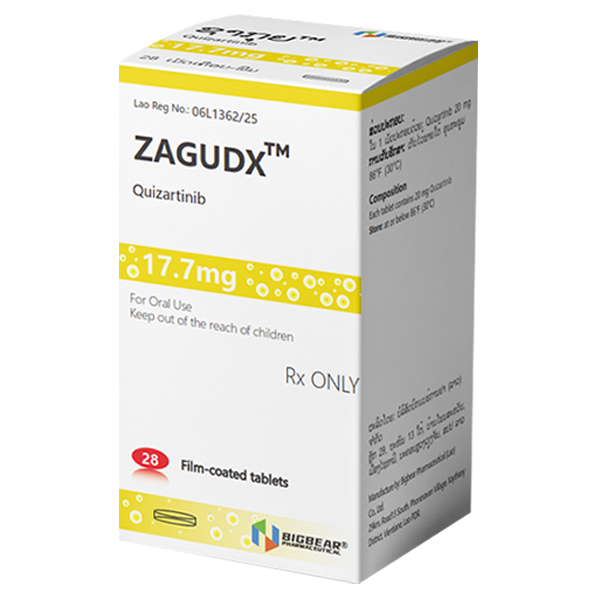
All Names: quizartinib、Vanflyta、AC220、奎扎替尼
Indications:Suitable for newly diagnosed adult patients with acute myeloid leukemia who have tested positive for FLT3-ITD through FDA approved testing.
Manufacturer:Daxiong
Customs Clearance Procedure:If the customs requires the package for customs clearance, please pay the customs clearance fee according to the content of EMS SMS and customs regulations.
Quizartinib is an oral, selective small molecule tyrosine kinase inhibitor specifically designed for acute myeloid leukemia (AML) patients with FLT3 gene mutations.
1、 Drug name
1. Common name: quizartinib
2. Product Name: VANFLYTA ®
2、 Indications
1. Induction chemotherapy with a combination of standard cytarabine and anthracycline drugs, consolidation chemotherapy with cytarabine, and monotherapy maintenance therapy after consolidation chemotherapy, for newly diagnosed adult patients with acute myeloid leukemia (AML) confirmed positive for FLT3-ITD mutation by FDA approved testing methods.
2. Usage restrictions: Not applicable for monotherapy maintenance therapy after allogeneic hematopoietic stem cell transplantation (HSCT), as overall survival benefits have not been demonstrated in this population.
3、 Specifications and characteristics
17.7mg, 26.5mg: tablets.
4、 Main components
Active ingredient: quizartinib
5、 Usage and dosage
1. Induction therapy (up to 2 cycles)
Initial dose: once daily, 35.4mg per dose, orally.
7+3 regimen: start administration on the 8th day; 5+2 regimen (second induction cycle): start administration on the 6th day.
Administer medication every week for 2 weeks (days 8-21 or 6-19).
2. Consolidation therapy (up to 4 cycles)
Once a day, 35.4mg each time, administered on the 6th to 19th day.
3. Maintenance therapy (up to 36 cycles)
Initial dose: once daily, 26.5mg each time, from day 1 to day 14.
If QTcF ≤ 450ms, increase to 53mg once daily from the 15th day onwards.
Administer daily continuously without any interval between cycles.
4. Medication instructions
Oral administration at a fixed time daily, can be taken with food or on an empty stomach.
Swallow the whole piece, do not cut, crush or chew.
6、 Dose adjustment
1. Adjustment due to adverse reactions: Based on the degree of QTcF prolongation, electrolyte abnormalities, non hematological toxicity, and decreased blood cells, dosage reduction, suspension of administration, or permanent discontinuation will be adopted. The specific adjustment gradient is 53mg → 35.4mg → 26.5mg → 17.7mg → suspension.
2. When used in combination with potent CYP3A inhibitors:
The current dose is 53mg → adjusted to 26.5mg; 35.4mg → 17.7mg; 26.5mg → 17.7mg; if the current dose is 17.7mg, the administration will be suspended.
After discontinuing the potent CYP3A inhibitor for 5 half lives, restore the original dose.
7、 Medication precautions
1. Missed administration: Take the medication as soon as possible on the same day and resume regular administration the next day; Do not take two doses on the same day.
2. Vomiting: Do not take the medication after vomiting, wait for the next scheduled administration time.
3. Monitoring requirements:
Regularly monitor electrocardiogram (QTcF), blood potassium, and blood magnesium before and during treatment.
Do not start treatment or increase dosage when QTcF>450ms.
Monitor electrocardiogram at least weekly for one month after the first administration and dose increase of maintenance therapy.
8、 Medication for special populations
1. Pregnancy: May cause fetal damage, it is recommended to inform about potential risks.
2. Breastfeeding period: It is not recommended to breastfeed during the treatment period and within one month after the last dose.
3. Women with fertility: Effective contraceptive measures should be taken during treatment and within 7 months after the last dose.
4. Male partners with fertility: Effective contraceptive measures should be taken during treatment and within 4 months after the last dose.
5. Children: Safety and efficacy have not yet been established.
6. Elderly patients: No overall safety difference was observed between patients aged 65 and above and young adult patients.
7. Renal injury: Mild to moderate injury does not require dose adjustment; Severe injuries have not been studied.
8. Liver injury: Mild to moderate injury does not require dose adjustment; Severe injuries have not been studied.
9、 Adverse reactions
1. Common adverse reactions (incidence>20%, including laboratory abnormalities): decreased lymphocytes, decreased blood potassium, decreased albumin, decreased blood phosphorus, increased alkaline phosphatase, decreased blood magnesium, febrile neutropenia, diarrhea, mucosal inflammation, nausea, decreased blood calcium, abdominal pain, sepsis, neutropenia, headache, increased creatine kinase, vomiting, upper respiratory tract infection.
2. Serious adverse reactions: QT interval prolongation, apical torsion type ventricular tachycardia, cardiac arrest, etc.
10、 Contraindications
1. Severe hypokalemia.
2. Severe hypomagnesemia.
3. Long QT syndrome.
4. History of ventricular arrhythmia or apical torsion ventricular tachycardia.
11、 Drug interactions
1. Strong CYP3A inhibitor: Increasing exposure to quinvatinib requires dose adjustment.
2. Strong or moderate CYP3A inducers: Avoid co administration (such as St. John's wort).
3. Medications that prolong the QT interval: If combined, the frequency of electrocardiogram monitoring should be increased.
12、 Storage method
1. Storage temperature: 20 ° C~25 ° C (68 ° F~77 ° F), short-term storage is allowed between 15 ° C~30 ° C (59 ° F~86 ° F).
2. Place in the original packaging bottle with the child protective cover tightly closed.
quizartinibinformation