- All Drug Categories
- Home
- Anti-cancer Drugs
- Healthcare Products
- Medical Information
- Statement
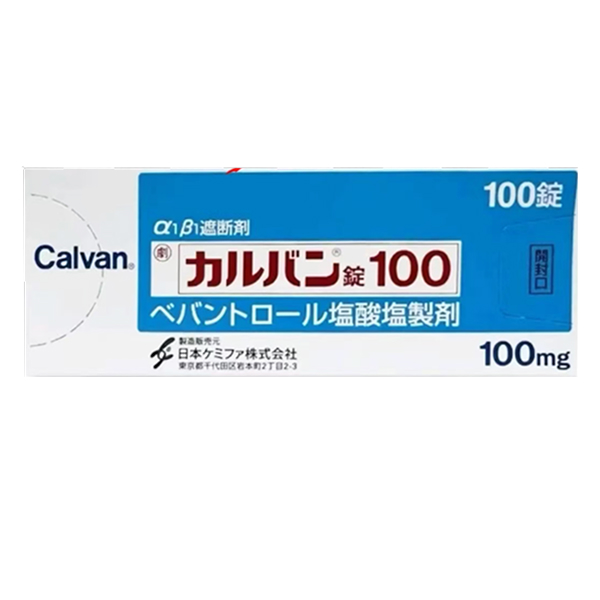
All Names: Bevantolol Hydrochloride、Carvan Tablets、カルバン錠、贝凡洛尔
Indications:Suitable for adult hypertensive patients who require medication treatment.
Manufacturer:Nippon Chemical Pharmaceutical Co., Ltd
Customs Clearance Procedure:If the customs requires the package for customs clearance, please pay the customs clearance fee according to the content of EMS SMS and customs regulations.
Bevanolol is a antihypertensive drug with multiple mechanisms of action, which selectively blocks β 1 adrenergic receptors, α 1 adrenergic receptors, and antagonizes L-type calcium channels to synergistically reduce heart rate and dilate peripheral blood vessels, thereby achieving blood pressure control.
1、 Drug name
Bevanolol Hydrochloride
2、 Indications
High blood pressure syndrome.
3、 Specifications and characteristics
1. Specification: Each tablet contains 100mg of bevanolol hydrochloride.
2. Appearance: It is a white thin film coated sheet.
4、 Main components
Active ingredient: Bevanolol hydrochloride.
5、 Usage and dosage
Usually for adults: Bevanolol hydrochloride 100mg per day, taken orally in two doses. When the effect is insufficient, it can be increased to 200mg per day. It can be adjusted appropriately according to age and symptoms.
6、 Dose adjustment
1. Poor effect: can be increased to 200mg per day.
2. Elderly people: It is recommended to start with a low dose (such as 50mg per day) and observe carefully before administering the medication.
3. Severe renal dysfunction: It is recommended to start medication at low doses.
4. Severe liver dysfunction: may have an enhancing effect, caution is needed.
7、 Medication precautions
1. Before and after meals: usually taken twice a day.
2. Missed dose: It is recommended to follow the general principle: if it is close to the next medication time, skip the missed dose and do not double the dosage.
3. Vomiting: If you vomit immediately after taking medication, you can consult a doctor to see if you need to take it again.
4. Other important notes:
Long term medication requires regular monitoring of cardiac function (pulse, blood pressure, electrocardiogram, X-ray, etc.).
When bradycardia or hypotension occurs, medication should be reduced or discontinued.
Discontinuation of medication should be gradually reduced and should not be abruptly discontinued (especially for the elderly).
It is best not to administer medication 48 hours before surgery.
May cause dizziness and unstable gait, avoid driving or dangerous mechanical operations during the initial stage of medication.
8、 Medication for special populations
1. Pregnant women: prohibited (animal experiments show fetal weight loss).
2. Breastfeeding women: weigh the pros and cons and consider whether to continue breastfeeding (animal experiments show moving to breast milk).
3. Children: No clinical trials have been conducted.
4. Elderly people: physiological function declines, starting from low doses (such as 50mg/day) and gradually reducing dosage when stopping medication.
5. Comorbidity patients:
Individuals who may experience heart failure: Administer with caution and use digitalis preparations if necessary.
Individuals at risk of bronchial asthma or bronchospasm: use with caution (with beta 2 blocking effect).
Idiopathic hypoglycemia, poorly controlled diabetes, long-term fasting: pay attention to blood sugar (easy to cover up hypoglycemia symptoms).
Brown cell tumor or paraganglioma: First use alpha blockers, then use this drug in combination, and do not use it alone.
9、 Adverse reactions
1. Major side effects (incidence rate<0.1% to unknown):
Heart failure (<0.1%), atrioventricular block (<1%), sinus node dysfunction (frequency unknown).
Asthma attacks and difficulty breathing (frequency unknown).
Other side effects (<0.1% to<1% or frequency unknown):
Mental nervous system: dizziness, headache, heaviness, drowsiness, insomnia, vertigo, and restlessness.
Circulating system: bradycardia, sinus bradycardia, palpitations, increased cardiothoracic ratio, decreased blood pressure, chest pain, syncope.
Respiratory system: cough, shortness of breath, wheezing.
Digestive system: nausea, diarrhea, constipation, dry mouth, bloating sensation in the abdomen, loss of appetite, abdominal discomfort, vomiting, stomach pressure, oral irritation.
Kidney: Elevated BUN and creatinine levels.
Liver: Abnormal liver function (elevated ALT and AST).
Allergic symptoms: rash, eczema, itching, and visual symptoms.
Urinary tract: Difficulty urinating, frequent urination, oliguria.
2. Other: Elevated uric acid, elevated total cholesterol, edema, fatigue, elevated CK, elevated potassium, increased fatigue, lower limb fatigue, facial flushing, reduced tear secretion.
10、 Contraindications
1. Diabetes ketoacidosis, metabolic acidosis.
2. Cardiogenic shock.
3. Congestive heart failure.
4. Right heart failure caused by pulmonary hypertension.
5. High bradycardia (significant sinus bradycardia), atrioventricular block (grade II, III), sinoatrial block.
6. Pregnant women or women who may become pregnant.
7. Untreated brown cell tumor or paraganglioma.
11、 Drug interactions (to be noted and used together)
1. Drugs that have inhibitory effects on the sympathetic nervous system: may enhance sympathetic nervous system inhibition, leading to bradycardia and blood pressure drop.
2. Insulin, tolbutamide and other hypoglycemic drugs: may enhance hypoglycemic effects and mask symptoms such as tachycardia caused by hypoglycemia.
3. Calcium antagonists (such as verapamil): mutually reinforcing, may lead to excessive blood pressure drop and cardiac function inhibition.
4. Clotrimazole: The rebound phenomenon may increase after discontinuing Clotrimazole; This medication should be temporarily discontinued before discontinuing clonidine.
5. Antiarrhythmic drugs (such as propafenone, procainamide, and aspirin): may excessively inhibit cardiac function.
12、 Storage method
Store at room temperature. The validity period is 3 years.
Carvaninformation