- All Drug Categories
- Home
- Anti-cancer Drugs
- Healthcare Products
- Medical Information
- Statement
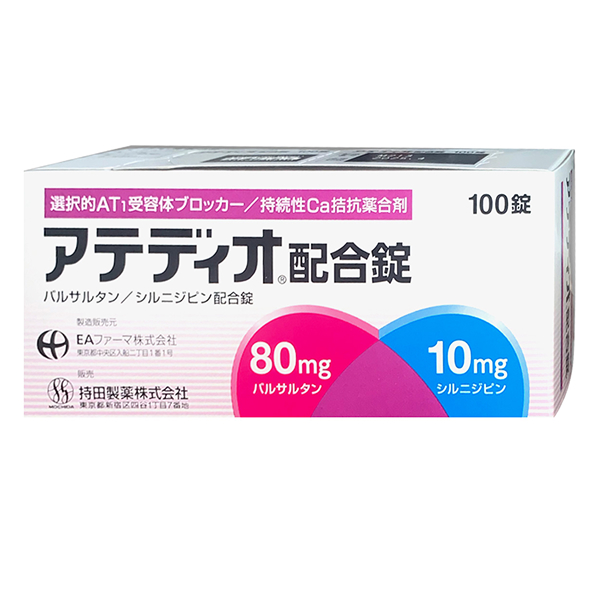
All Names: Valsartan and Clinidipine Tablets、Atedio Combination Tablets、アテディオ配合錠、缬沙坦西尼地平片
Indications:Adult hypertensive patients. Please note that it is not recommended as the initial preferred medication for the treatment of hypertension. In principle, it is applicable to patients who are currently using a combination of valsartan (80mg) and amlodipine (10mg), or using either drug alone but with insufficient blood pressure control.
Manufacturer:日本持田
Customs Clearance Procedure:If the customs requires the package for customs clearance, please pay the customs clearance fee according to the content of EMS SMS and customs regulations.
Valsartan cilnidipine tablets are a fixed dose combination of angiotensin II receptor antagonist (ARB) valsartan and dihydropyridine calcium channel blocker (DHP-CCB) cilnidipine.
1、 Drug name
Valsartan and Cilipine Tablets (Atedio) are a compound preparation of valsartan and Cilipine.
2、 Indications
Hypertension.
3、 Specifications and characteristics
Each tablet contains 80mg of valsartan and 10mg of amlodipine. It is a light yellow oval film coated tablet.
4、 Main components
Active ingredients: Valsartan 80mg, Cilipine 10mg.
5、 Usage and dosage
1. Adults take one tablet (valsartan 80mg/cilnidipine 10mg) once a day, orally after breakfast.
2. Not the preferred medication for treating hypertension.
6、 Dose adjustment
1. In principle, it is applicable to patients who have already used both valsartan 80mg and amlodipine 10mg simultaneously, or who still have insufficient blood pressure control after using one of them.
2. The regular dose of valsartan is 40-80mg/day, which can be increased to 160mg/day; The regular dose of cilnidipine is 5-10mg/day, which can be increased to 20mg/day. For severe hypertension, 10-20mg/day can be used.
7、 Medication precautions
1. Before and after meals: take orally after breakfast. Compared with fasting, postprandial administration of valsartan resulted in a decrease in blood concentration (Cmax about 0.8 times) and an increase in blood concentration of amlodipine (Cmax about 2.8 times).
2. Omission: It is recommended to follow the doctor's advice.
3. Vomiting, etc.: If there is obvious hypotension or discomfort, seek medical attention.
4. Other: It is recommended to discontinue use 24 hours before surgery; Avoid sudden discontinuation of medication (especially the compound cilnidipine), as it may worsen symptoms; After taking medication, dizziness and head heaviness may occur, and attention should be paid to high-altitude operations, driving, etc.
8、 Medication for special populations
1. Pregnant women and women at risk of pregnancy: prohibited. The use in the middle and late stages of pregnancy may lead to fetal/neonatal death, kidney failure, and underdevelopment of the head and lungs.
2. Breastfeeding women: It is best not to breastfeed (animal experiments have shown that breast milk can enter).
3. Children: No clinical trials have been conducted.
4. Elderly people: avoid excessive blood pressure reduction (which may trigger cerebral infarction, etc.); The blood concentration of valsartan may be higher in non elderly individuals.
5. Renal dysfunction:
Severe renal dysfunction (blood creatinine ≥ 3.0mg/dL): may worsen kidney damage, avoid use.
During hemodialysis, there may be a transient rapid drop in blood pressure (accompanied by loss of consciousness).
6. Liver dysfunction:
Severe liver dysfunction: Blood concentration of cilnidipine may increase.
Liver injury (especially biliary cirrhosis and cholestasis): Valsartan blood concentration may increase.
Bilateral or unilateral renal artery stenosis: Avoid use unless necessary (may rapidly worsen renal function).
Hyperkalemia patients: Avoid use unless necessary.
Patients with cerebrovascular disorders: Excessive blood pressure reduction may exacerbate cerebral blood flow insufficiency.
In strict salt reduction treatment, there may be a transient rapid decrease in blood pressure (accompanied by loss of consciousness).
History of severe side effects of calcium antagonists: Avoid use.
9、 Adverse reactions
1. Major side effects (frequency unknown): angioedema, hepatitis/liver dysfunction/jaundice, renal failure, hyperkalemia, shock/syncope/loss of consciousness, granulocytopenia/leukopenia/thrombocytopenia, interstitial pneumonia, hypoglycemia, rhabdomyolysis, toxic epidermal necrolysis (TEN)/Stevens Johnson syndrome/erythema multiforme, pemphigus/pemphigoid.
2. Other side effects (with an incidence rate of 0.5% -5% or lower): abnormal liver function, elevated ALT/AST, hyperuricemia, headache, dizziness, facial flushing (hot flashes), constipation, rash, cough, elevated blood potassium, shoulder and neck stiffness, elevated blood lipids, etc.
10、 Contraindications
1. Individuals with a history of allergies to the ingredients of this medication.
2. Pregnant women or women who may become pregnant.
3. Patients with diabetes who use aligilen (unless other antihypertensive treatment is still poor in blood pressure control).
11、 Drug interactions
1. Prohibited: Aligilen (for patients with diabetes) - increases the risk of non fatal stroke, renal dysfunction, hyperkalemia, and hypotension.
2. Cautious use:
Aligilen (non diabetes) - may cause kidney damage, high potassium and low blood pressure.
ACE inhibitors - may cause transient rapid blood pressure drop.
Potassium sparing diuretics/potassium supplements - may increase blood potassium levels.
Grapefruit juice - may increase the blood concentration of sinidipine.
Cyclosporine and trimethoprim preparations - may mutually enhance hyperkalemia.
NSAIDs (such as indomethacin) - may weaken the antihypertensive effect of valsartan or worsen renal function.
Lithium preparations - may cause lithium poisoning.
Other antihypertensive drugs - may excessively lower blood pressure.
Digoxin - may increase the blood concentration of digoxin, causing poisoning.
Cimetidine - may enhance the effect of calcium antagonists.
Rifampicin - may weaken the effect of calcium antagonists.
Azole antifungal drugs (itraconazole, miconazole, etc.) - may increase the blood concentration of sinidipine.
12、 Storage method
Usually, it needs to be stored in a dark, sealed, and room temperature dry place (refer to general drugs).
Atedioinformation