- All Drug Categories
- Home
- Anti-cancer Drugs
- Healthcare Products
- Medical Information
- Statement
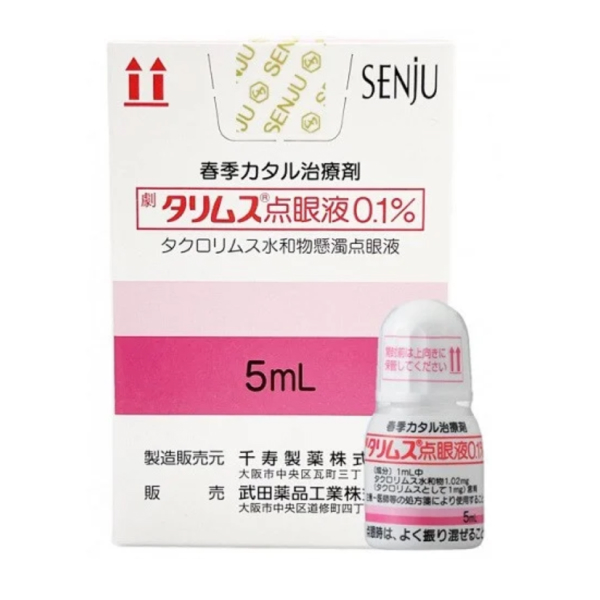
All Names: Tacrolimus Hydrate、Talymus、 他克莫司滴眼液
Indications:Used for the treatment of spring catarrhal conjunctivitis, limited to patients with poor efficacy of anti allergic drugs and accompanied by giant nipple hyperplasia of the eyelids and conjunctiva.
Manufacturer:Japan Senju Manufacturing Co., Ltd
Customs Clearance Procedure:If the customs requires the package for customs clearance, please pay the customs clearance fee according to the content of EMS SMS and customs regulations.
Tacrolimus eye drops are a local immunomodulatory agent that exerts anti-inflammatory and anti allergic effects by inhibiting the calcineurin signaling pathway, blocking T lymphocyte activation and the production of related cytokines.
1、 Drug name
Tacrolimus eye drops, trade name: Talymus (Talymus Eye Drops 0.1%)
2、 Indications
1. Spring keratoconjunctivitis (spring catarrhal) is suitable for cases where the effectiveness of anti allergic medication treatment is insufficient.
2. The premise of use is that there is significant proliferation of huge papillae in the eyelids and conjunctiva, and the efficacy of anti allergic drugs is insufficient.
3、 Specifications and characteristics
1. Specification: 0.1%.
2. Appearance: White, sterile water-based suspension eye drops.
4、 Main components
Active ingredient: Tacrolimus hydrate, containing 1.02mg per 1mL (equivalent to 1mg of tacrolimus).
5、 Usage and dosage
Shake well before use, usually 1 drop per time, 2 drops per day.
6、 Dose adjustment
If adverse reactions occur, full observation should be conducted, and medication should be stopped and appropriate measures taken in case of abnormalities.
7、 Medication precautions
1. Leakage and vomiting: The handling method for eye drops leakage or leakage after eye drops is not clearly stated. It is recommended to promptly supplement the drops according to routine medication principles. If it is close to the next medication time, skip the missed dose.
2. Other important matters: This product should be used under the guidance of a doctor familiar with the treatment of spring conjunctivitis; The use of this product may induce or worsen infections, and the risk is higher when combined with other immunosuppressants.
8、 Medication for special populations
1. Pregnant women: Use only when the benefits of treatment outweigh the risks to the fetus. Animal experiments (oral administration in rabbits) have reported teratogenicity and fetal toxicity, and oral administration in humans can be transported via the placenta.
2. Breastfeeding women: It is necessary to weigh the benefits of treatment and breastfeeding before deciding whether to continue or stop breastfeeding. Oral administration may enter breast milk.
3. Children: No clinical trials have been conducted on low birth weight infants, newborns, infants, and children under 6 years old.
4. Elderly people: generally have decreased physiological functions and should be used with caution. Glaucoma patients: Regularly measure intraocular pressure during medication as this product may increase intraocular pressure.
9、 Adverse reactions
1. The incidence rate is ≥ 5%: the incidence of eye abnormalities (such as eye heat sensation, foreign body sensation, and discomfort) and eye irritation is 21.4%.
2. Incidence rate of 0.1% to 5%: increased salivation, eye fat, eye pain, eye congestion, shyness, punctate keratitis, eye itching, eye discomfort, heavy pressure on the upper eyelid, eyelid itching, eyelid edema, blepharitis, chalazion, meibomian gland inflammation, conjunctival congestion, conjunctival edema, conjunctivitis, membrane erosion, conjunctival deposition, keratitis, corneal ulcer, corneal opacity, anterior chamber flicker, anterior chamber cells, cone melting, foggy vision, decreased vision, aggravated glaucoma, increased intraocular pressure, throat irritation, sore throat, slow pharyngeal sensation, nasal discomfort, increased AST, increased gamma GTP, increased LDH, increased/decreased white blood cells, increased/decreased neutrophils, increased/decreased monocytes, decreased lymphocytes Elevated blood uric acid levels. The incidence is unknown: contact dermatitis, herpetic keratitis, eyelid herpes, pyoderma, stye, bacterial conjunctivitis, herpes simplex virus conjunctivitis, epidemic keratoconjunctivitis, bacterial keratitis, facial heat sensation, finger numbness.
10、 Contraindications
Patients with a history of allergies to any of the ingredients in this product; Patients with eye infections.
11、 Drug interactions
When used in combination with other immunosuppressants, the risk of inducing or exacerbating infections further increases.
12、 Storage method
Refer to conventional eye drops: store at room temperature, away from light, sealed, and avoid freezing.
Talymusinformation