- All Drug Categories
- Home
- Anti-cancer Drugs
- Healthcare Products
- Medical Information
- Statement
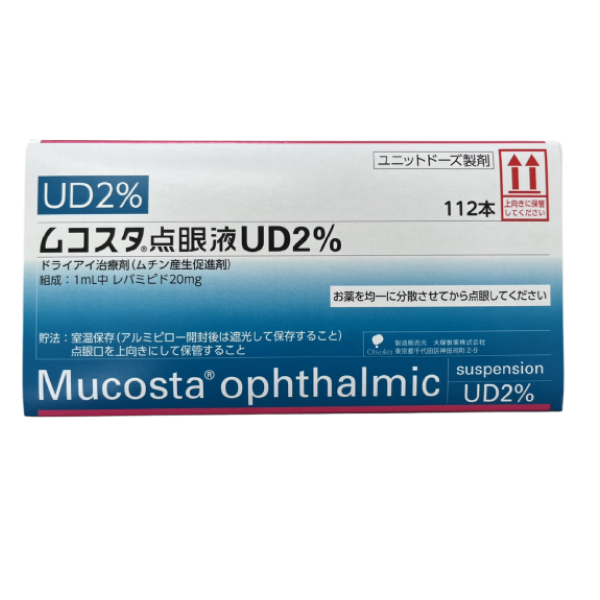
All Names: Mucosta、Rebamipide ophthalmic suspension、ムコスタ点眼液UD2%、瑞巴派特滴眼液
Indications:Suitable for patients diagnosed with dry eye syndrome and accompanied by corneal and conjunctival epithelial disorders caused by abnormal tears.
Manufacturer:Otsuka Pharmaceutical, Japan
Customs Clearance Procedure:If the customs requires the package for customs clearance, please pay the customs clearance fee according to the content of EMS SMS and customs regulations.
Mucosta eye drops promote the expression and synthesis of mucin genes in corneal epithelial cells, increase mucin production, promote corneal epithelial cell proliferation, and increase the number of conjunctival goblet cells, thereby repairing damaged corneal and conjunctival epithelium and relieving dry eye symptoms.
1、 Drug name
Rebamipide eye drops, trade name: MucostaOphthalmic Suspension UD2%, English ingredient name: Rebamipide.
II. Indications
1. Dry Eye syndrome.
2. Only for patients diagnosed with dry eye syndrome and associated with abnormal tear related corneal and conjunctival epithelial disorders.
3、 Specifications and characteristics
1. Specification: 0.35mL/vial, 112 vials per box (28 vials x 4).
2. Characteristics: White sterile aqueous suspension eye drops, pH 5.5-6.5, osmotic pressure ratio 0.9-1.1 (relative to physiological saline). Store at room temperature, with the eye drops facing upwards.
4、 Main components
1. Each 1mL contains 20mg of active ingredient: Rabeprazole.
2. Additives: Polyvinyl alcohol (partially saponified), sodium citrate hydrate, sodium chloride (isotonic agent), potassium chloride (isotonic agent), hydrochloric acid (pH regulator), sodium hydroxide (pH regulator), refined water.
5、 Usage and dosage
Usually, one eye drop is administered four times a day.
2. For eye drops only.
6、 Dose adjustment
Elderly people generally experience a decline in physiological function and should use it with caution.
7、 Medication precautions
1. Preparation before use: This product is a suspension. Before use, hold the lower part of the container and fully tap the circular protrusion to evenly disperse the drug.
2. Eye drop method: When using eye drops, be careful not to directly contact the tip of the container with the eyes. After opening the eyelids, drip into the conjunctival sac, close the eyelids for 1-5 minutes and compress the lacrimal sac, then open the eyelids. The liquid around the eyes should be wiped clean.
3. Interval with other eye drops: When using other eye drops in combination, the interval should be at least 5 minutes.
4. Single use: This product does not contain preservatives and is a disposable sterile preparation. Any remaining liquid after use must be discarded and cannot be reused.
5. Before and after meals: Eye drops are not affected by eating and do not require special consideration for use before or after meals.
6. Handling of missed doses: If one dose is missed, it is recommended to continue the next eye drop at the normal time and not double the dosage.
7. Vomiting treatment: Eye drops do not involve oral vomiting issues and can be used normally.
8. Storage and Preservation: Do not store the dropper facing downwards, otherwise it may cause the particles to be difficult to disperse. Aluminum plastic packaging should be stored away from light after opening. Store at room temperature with the eye dropper facing upwards.
9. Driving and operating machinery: Temporary blurred vision may occur after eye drops, and patients should be reminded to pay attention and avoid operating machinery or driving cars.
10. Other precautions: If there is component aggregation in the eye or tear passage, or if there is discomfort when using soft contact lenses, you should consult an ophthalmologist (Rebapart can be attached to soft contact lenses).
8、 Medication for special populations
Pregnant women: Use only when the benefits of treatment outweigh the risks.
2. Breastfeeding women: Animal experiments (oral administration to rats) show that they can enter breast milk. After considering both the benefits of treatment and breastfeeding, a decision should be made to continue or discontinue breastfeeding.
3. Children: Clinical trials for children have not been conducted, and safety has not been established yet.
4. Elderly people: generally experiencing a decline in physiological function, should be used with caution.
9、 Adverse reactions
1. Major side effects (to be cautious):
Obstruction of the lacrimal duct (incidence rate below 0.1% to 5%) and dacryocystitis (incidence rate unknown). White substance can be observed in the lacrimal passage when it occurs.
2. Other side effects:
Eye organs: eye fat, eye congestion, eye pain, foreign body sensation, irritation, blurred vision, discomfort, increased tearing, itching, eyelid inflammation, eyelid edema, conjunctivitis, dryness, corneal disorders, keratitis, ulcerative keratitis, optic disc hemorrhage, visual impairment, decreased vision, diplopia.
Allergies: rash, urticaria.
Digestive system: bitterness, stomach discomfort, nausea, vomiting, loss of appetite, dry mouth, glossitis, tongue discoloration.
3. Other: Elevated AST, ALT, γ - GTP, cholesterol, LDH, leukopenia, elevated potassium, elevated BUN, positive urine sugar, bronchitis, sinusitis, rhinitis, gingival abscess, floating dizziness, headache.
10、 Contraindications
Patients with a history of allergies to any component of this medication are prohibited from using it.
11、 Drug interactions
When used in combination with other eye drops, it should be used at least 5 minutes apart.
12、 Storage method
Store at room temperature. Place the dropper upwards, not downwards. Aluminum plastic packaging should be stored away from light after opening. The validity period is 36 months.
13、 Manufacturer
Otsuka Pharmaceutical Co., Ltd.
Mucostainformation