- All Drug Categories
- Home
- Anti-cancer Drugs
- Healthcare Products
- Medical Information
- Statement
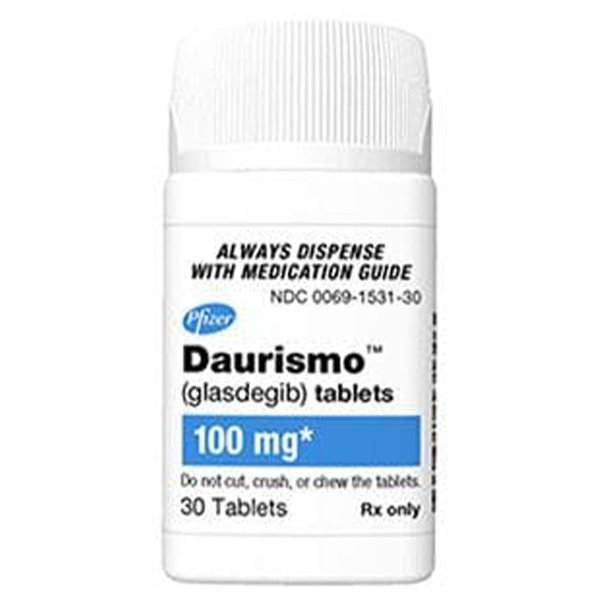
All Names: Glasdegib、Daurismo、格拉斯吉布薄膜片、格拉吉布
Indications:Suitable for adult patients with newly diagnosed acute myeloid leukemia (AML) treated in combination with low-dose cytarabine.
Manufacturer:Pfizer Inc
Customs Clearance Procedure:If the customs requires the package for customs clearance, please pay the customs clearance fee according to the content of EMS SMS and customs regulations.
Glasdegib is a small molecule SMO antagonist developed by Pfizer Inc. in the United States, mainly used to treat acute myeloid leukemia (AML), especially for elderly patients aged 75 and above, or patients who cannot receive intensive chemotherapy due to other diseases.
1、 Drug name
1. Common name: Glasdegib
2. Product Name: DAURASMO ™
3. Chinese reference name: Glass Gibb film sheet
2、 Indications
This product is used in combination with low-dose cytarabine for the treatment of newly diagnosed adult patients with acute myeloid leukemia. The applicable population is:
Age ≥ 75 years old; Or there may be comorbidities that make it impossible to receive intensified induction chemotherapy.
3、 Specifications and characteristics
1. Specification: 100mg.
2. Appearance: Round, light orange film coated sheet.
4、 Main components
Active ingredient: Glasdegib, present in the form of maleic acid salt.
5、 Usage and dosage
1. Conventional dose: once daily, 100mg per dose, orally. Every 28 days as a cycle, it is used in combination with low-dose cytarabine (20mg, subcutaneous injection, twice daily, from day 1 to day 10).
2. Administration method:
Can be taken with food or on an empty stomach.
Swallow the whole piece, do not chew, break or crush.
It is recommended to take medication at a fixed time every day.
3. Treatment cycle: If there are no intolerable toxicities, treat for at least 6 cycles to allow for clinical response time.
6、 Dose adjustment
1. Adjust dosage due to adverse reactions
(1) QTc interval prolongation:
QTc>480ms and ≤ 500ms: Evaluate electrolytes, adjust concomitant medications, and monitor electrocardiogram for at least 2 weeks per week.
QTc>500ms: Suspend medication until it returns to ≤ 480ms or within 30ms of baseline, and resume daily administration of 50mg.
Occurrence of life-threatening arrhythmia: permanent discontinuation of medication.
(2) Musculoskeletal adverse reactions:
Grade 3 or CPK elevated to 2.5-10 times the upper limit of normal: Suspend medication until symptoms improve, and restore to the original dose or reduce to 50mg; If there is a recurrence, stop taking the medication.
Level 4 or CPK elevated to more than 10 times the upper limit of normal: permanent discontinuation of medication.
(3) Hematological toxicity:
Platelet count<10Gi/L for more than 42 days (non disease related): permanent discontinuation of medication.
Neutrophil count<0.5Gi/L for more than 42 days (non disease related): permanent discontinuation of medication.
(4) Non hematological toxicity:
Level 3: Suspend medication until remission, with the original dose or reduced dosage (this product reduced to 50mg, cytarabine reduced to 15mg or 10mg) restored; If there is a recurrence, stop taking the medication.
Level 4: Permanent discontinuation of medication.
2. Adjust dosage due to concomitant medication
Combination with moderate CYP3A4 inducer:
If co administration cannot be avoided, increase the dose of this product to 200mg once daily (original dose 100mg) or 100mg once daily (original dose 50mg).
After discontinuing the inducer for 7 days, restore the original dose.
7、 Medication precautions
1. Before and after meals, it can be taken with food or on an empty stomach.
2. Handling of missed services
If missed, make up for it as soon as possible.
If it is less than 12 hours before the next medication, skip the missed dose and take the next dose according to the original plan.
Do not take two doses within 12 hours.
3. Post vomiting treatment
If vomiting occurs after taking medication, there is no need to take additional medication.
Wait for the next medication to be taken according to the original dosage.
4. Other precautions
Indivisible, chewable, or crushed tablets.
During the treatment period and for at least 30 days after the last administration, blood donation or plasma donation is prohibited.
8、 Medication for special populations
1. Pregnant women: This product can cause embryo fetal death or serious birth defects, and is contraindicated during pregnancy. Pregnant women with fertility need to undergo pregnancy testing within 7 days before taking medication.
2. Breastfeeding women: It is recommended to stop breastfeeding during treatment and for at least 30 days after the last dose.
3. Women with fertility: Effective contraceptive measures should be taken during treatment and at least 30 days after the last dose.
4. Male patients: This product may pose an exposure risk through semen. During treatment and for at least 30 days after the last administration, even if a vasectomy has been performed, condoms should still be used for contraception; During this period, it is prohibited to donate semen.
5. Children: Safety and efficacy have not yet been established. Animal experiments have shown that this product has adverse effects on the growth period bones, teeth, and testes.
6. Elderly patients: In clinical trials, 98% of patients were ≥ 65 years old, and 60% were ≥ 75 years old, with no differences found compared to younger patients.
7. Renal insufficiency:
Mild to severe renal insufficiency (eGFR15~89ml/min) does not require dose adjustment.
Patients with severe renal insufficiency (eGFR15-29ml/min) need to monitor the risk of adverse reactions such as QTc prolongation due to increased blood drug concentration.
Liver dysfunction: Mild, moderate, and severe liver dysfunction do not require dose adjustment.
8. Male fertility: Animal experiments have shown that this product can damage male reproductive function, and some changes are irreversible. It is recommended to consult fertility preservation before treatment.
9、 Adverse reactions
1. Common adverse reactions with an incidence rate of ≥ 20%:
Anemia, fatigue, bleeding, febrile neutropenia, musculoskeletal pain, nausea, edema, thrombocytopenia, dyspnea, loss of appetite, taste disorders, mucositis, constipation, rash.
2. Common laboratory abnormalities:
Elevated blood creatinine, hyponatremia, hypomagnesemia, AST, bilirubin, ALT, alkaline phosphatase, and CPK.
3. Serious adverse reactions:
The incidence of serious adverse reactions is 79%, with the most common being febrile neutropenia, pneumonia, bleeding, anemia, and sepsis.
10、 Contraindications
There are no clear contraindications.
11、 Drug interactions
1. Strong CYP3A4 inhibitors:
The combination can increase the exposure of Glasgib by about 2.4 times and increase the risk of adverse reactions (including QTc prolongation).
Suggest considering alternative drugs; If unavoidable, it is necessary to strengthen monitoring.
2. Strong and moderate CYP3A4 inducers:
The combination can reduce the exposure of Glasgib, with strong inducers reducing AUC by 70% and moderate inducers predicting a 55% reduction.
Avoid co use; If moderate inducers cannot be avoided, increase the dosage of this product according to the aforementioned dosage adjustment plan.
3. QTc prolongation drugs:
Co use may increase the risk of QTc prolongation.
Avoid co administration or choosing alternative drugs; If unavoidable, strengthen electrocardiogram monitoring.
4. Stomach acid inhibitor:
The combination with rabeprazole can reduce the peak concentration of Glasgow by 20%, but there is no significant change in total exposure.
5. In vitro studies suggest:
Glasgib is a substrate for P-gp and BCRP.
This product can inhibit P-gp, BCRP, MATE1, and MATE-2K.
12、 Storage method
1. Storage temperature: 20 ℃ to 25 ℃, allowed to fluctuate between 15 ℃ to 30 ℃.
2. Store in a dark and sealed environment.
3. Keep out of reach of children.
13、 Manufacturer
Manufacturer: Pfizer Inc.
Glasdegibinformation