- All Drug Categories
- Home
- Anti-cancer Drugs
- Healthcare Products
- Medical Information
- Statement
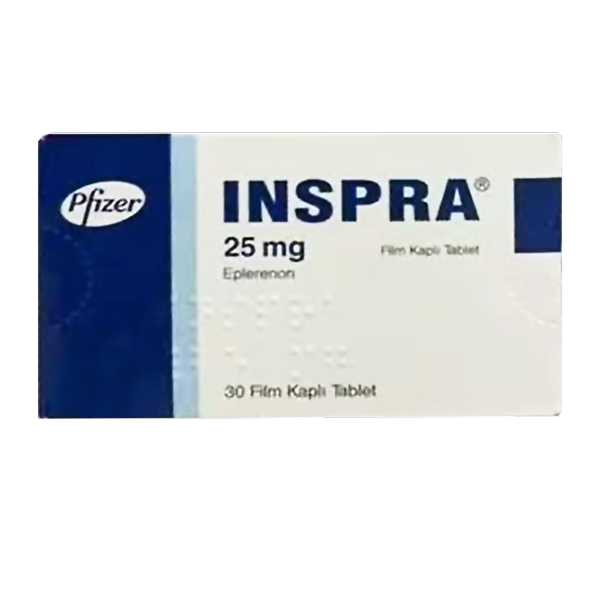
All Names: Inspra、Eplerenone、依普利酮
Indications:Adult patients with heart failure and hypertension after myocardial infarction.
Manufacturer:Pfizer,USA
Customs Clearance Procedure:If the customs requires the package for customs clearance, please pay the customs clearance fee according to the content of EMS SMS and customs regulations.
Eplerenone is a selective aldosterone receptor antagonist. It inhibits sodium ion reabsorption and potassium ion excretion by blocking the combination of aldosterone and mineralocorticoid receptor, thereby reducing water and sodium retention, lowering blood pressure, and improving cardiac function.
1、 Drug name
1. Common name: Eplerenone
2. Product Name: INSPRA
2、 Indications
1. Used to stabilize symptomatic heart failure in adult patients with reduced left ventricular ejection fraction (≤ 40%) and improve survival after acute myocardial infarction.
2. Used for the treatment of adult hypertension, lowering blood pressure to reduce fatal and non fatal cardiovascular events (mainly stroke and myocardial infarction).
3、 Specifications
Specification: 25mg
4、 Main components
Active ingredient: Eplerenone.
5、 Usage and dosage
1. Heart failure (after infarction): The initial dose is 25mg once daily, and if tolerated within 4 weeks, it can be increased to 50mg once daily.
2. Hypertension: Routine starting dose of 50mg once daily; When the blood pressure lowering effect is insufficient, it can be increased to 50mg twice a day (higher doses are not recommended).
6、 Dose adjustment (based on blood potassium levels, for heart failure patients)
1. Blood potassium<5.0mEq/L: The dosage can be increased (such as from 25mg once every other day to 25mg once daily, or from 25mg once daily to 50mg once daily).
2. Blood potassium 5.0-5.4mEq/L: No adjustment required.
3. Blood potassium 5.5-5.9mEq/L: dose downregulation (e.g. 50mg once daily to 25mg once daily, or 25mg once daily to 25mg once every other day, or 25mg once every other day).
4. Blood potassium ≥ 6.0mEq/L: Suspend medication until blood potassium drops to<5.5mEq/L and restart every other day with 25mg.
7、 Medication precautions (before and after meals, missed doses, vomiting, etc.)
1. Absorption is not affected by food and can be done before and after meals.
2. It is recommended to follow the doctor's advice or take the medication as soon as possible. If it is close to the next medication time, skip the missed dose and do not double the dosage.
8、 Medication for special populations
1. Renal function impairment: creatinine clearance rate ≤ 30mL/min is contraindicated. Patients with hypertension and creatinine clearance rate<50mL/min are prohibited from using it.
2. Liver function impairment: Moderate liver impairment (Child Pugh B grade) with increased exposure requires caution.
3. Elderly: Patients aged 65 and above have an increased risk of hyperkalemia; Patients over 75 years old with heart failure have not shown any survival benefits.
4. Children: The effectiveness and safety of treating hypertension or heart failure have not yet been established.
5. Pregnancy: Insufficient data, only used when explicitly needed.
6. Breastfeeding: Whether to breastfeed or not is unknown, and the pros and cons should be weighed.
9、 Adverse reactions
1. Heart failure patients (incidence>2% and higher than placebo): hyperkalemia, elevated serum creatinine.
2. Hypertensive patients: Adverse reactions are generally uncommon.
3. Post market experience: angioedema, rash.
4. The incidence of male breast development and abnormal vaginal bleeding increases with prolonged treatment time.
10、 Contraindications
1. For all patients:
At the beginning of treatment, blood potassium levels were above 5.5mEq/L.
Creatinine clearance rate ≤ 30mL/min.
Combination use of potent CYP3A inhibitors (such as ketoconazole, itraconazole, clarithromycin, ritonavir, etc.).
2. Additional contraindications for hypertensive patients:
Type 2 diabetes with microalbuminuria.
Male blood creatinine>2.0mg/dL, female blood creatinine>1.8mg/dL.
Creatinine clearance rate<50mL/min.
Combination use of potassium supplements or potassium sparing diuretics (such as amiloride, spironolactone, triamcinolone).
11、 Drug interactions
1. Strong CYP3A inhibitors: Do not use in combination.
2. Intermediate acting CYP3A inhibitors (such as verapamil, erythromycin, saquinamivir, fluconazole): not exceeding 25mg once daily for heart failure patients; Hypertensive patients start with 25mg once daily and up to 25mg twice daily.
3. ACEI or ARB: increases the risk of hyperkalemia and requires monitoring of blood potassium and renal function.
4. Lithium agent: may cause lithium poisoning, monitor blood lithium levels.
5. NSAIDs: May weaken blood pressure lowering effects and lead to severe hyperkalemia in patients with renal insufficiency, monitor blood pressure and blood potassium.
12、 Storage method
Stored at 25 ° C (77 ° F), with a permissible fluctuation range of 15-30 ° C (59-86 ° F).
Eplerenoneinformation