- All Drug Categories
- Home
- Anti-cancer Drugs
- Healthcare Products
- Medical Information
- Statement
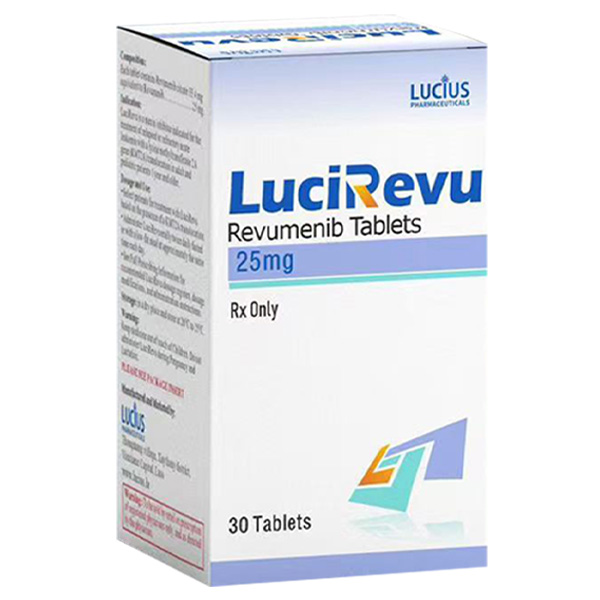
All Names: Revuforj、revumenib、瑞维美尼
Indications:Suitable for patients aged 1 year and above with KMT2A translocation positive recurrence/refractory acute leukemia (AML, ALL, MPAL).
Manufacturer:LUCIUS PHARMACEUTICAL (LAOS) CO., LTD
Customs Clearance Procedure:If the customs requires the package for customs clearance, please pay the customs clearance fee according to the content of EMS SMS and customs regulations.
Revuforj precisely blocks the interaction between KMT2A fusion protein and menin protein, inhibits abnormal activation of leukemia related genes (such as HOX and MEIS), blocks the proliferation pathway of leukemia cells, and provides a new targeted treatment option for patients with relapsed or refractory acute leukemia.
1、 Drug name
1. Common name: Revumenib Tablets
2. Product Name: Revuforj ®
2、 Indications
The following indications are applicable to adult and pediatric patients aged 1 year and above:
1. Recurrent or refractory acute leukemia with lysine methyltransferase 2A gene (KMT2A) translocation.
2. Recurrent or refractory acute myeloid leukemia with susceptible nuclear phosphoprotein 1 (NPM1) mutations and no other satisfactory treatment options.
3、 Specifications
25mg、110mg、160mg, Tablets.
4、 Main components
1. Active ingredient: Revumenib, present in the form of Revumenib citrate hydrate.
2. Administration method: Oral, twice a day, approximately 12 hours apart, taken at a fixed time.
3. Dietary requirements: Take on an empty stomach or with a low-fat meal (approximately 400 calories, fat ≤ 25%).
4. Swallowing requirements: Swallow the entire piece, do not cut or chew. Those who cannot swallow can crush and disperse in water, and take within 2 hours after preparation.
5、 Dosage plan:
1. Weight ≥ 40kg: 270mg twice daily without the use of potent CYP3A4 inhibitors; When combined with potent CYP3A4 inhibitors, take 160mg twice daily.
2. Weight<40kg: 160mg/m ² twice daily without the use of potent CYP3A4 inhibitors; When combined with potent CYP3A4 inhibitors, the dosage is 95mg/m ² twice daily (the specific dose is determined based on the body surface area according to the table).
3. Preparation before treatment: Treatment can only begin when the white blood cell count drops below 25Gi/L.
6、 Dose adjustment
1. Omission treatment: Take the medication as soon as possible within the same day, ensuring a minimum of 12 hours interval from the next dose, and resume regular medication time the next day. Do not take two doses within 12 hours.
2. Vomiting treatment: If vomiting occurs or incomplete swallowing occurs after taking medication, do not increase the dosage and wait for the next scheduled medication time.
3. Adverse reaction dose adjustment:
Differentiation syndrome: If suspected, start systemic corticosteroid treatment immediately and continue for at least 3 days; Suspend medication when severe symptoms persist for more than 48 hours or are life-threatening, and restart at the original dose after recovering to level 1 or lower.
QTc interval prolongation: Suspend administration when QTcF>480msec to 500msec, resume at the original dose after recovery to ≤ 480msec; When QTcF>500msec or increases from baseline>60msec, reduce the dose level and restart after recovery. Permanently discontinue medication in the event of ventricular arrhythmia or life-threatening arrhythmia.
Non infectious leukocytosis: Initiate hydroxyurea treatment and, if necessary, combine with leukocyte isolation surgery.
7、 Medication precautions
1. Diet: Take on an empty stomach or a low-fat meal. High fat meals can reduce exposure levels.
2. Omission: Supplement within the same day, double dosage is prohibited.
3. Vomiting: Not taking supplements.
4. Medication: Tablets of different specifications (colors) can be combined to achieve the desired dosage.
5. Continuous treatment: When there is no disease progression or unacceptable toxicity, it is recommended to treat for at least 6 months.
8、 Medication for special populations
1. Pregnancy: Based on animal data, it can cause fetal harm. Verify pregnancy status within 7 days prior to treatment. Women with fertility and male partners with fertility must use effective contraception during treatment and within 4 months after the last dose.
2. Breastfeeding period: Do not breastfeed, continue to stop breastfeeding for one week after the last dose.
3. Children: Safety and efficacy have been determined for patients aged 1 year and above; Under 1 year old has not been determined yet. If the weight is less than 40kg, the dosage should be calculated based on the body surface area. Need to monitor bone growth and development.
4. Elderly: Patients aged 65 and above have a higher incidence of QTc interval prolongation and edema, and need to strengthen monitoring.
5. Liver/kidney function injury: Mild to moderate injury does not require dose adjustment; The impact of severe injury is unknown.
9、 Adverse reactions
1. Important Warning:
Differentiation syndrome: can be fatal. Symptoms include fever, dyspnea, hypoxemia, pulmonary infiltration, pleural/pericardial effusion, rapid weight gain, peripheral edema, hypotension, and renal dysfunction.
QTc interval prolongation and apical torsion type ventricular tachycardia: concentration dependent, lethal.
Extremely common adverse reactions (≥ 20%): elevated blood phosphorus, bleeding, nausea, unclear pathogen infection, elevated aspartate aminotransferase, elevated alanine aminotransferase, elevated creatinine, musculoskeletal pain, febrile neutropenia, prolonged electrocardiogram QT, decreased blood potassium, elevated parathyroid hormone, elevated alkaline phosphatase, diarrhea, bacterial infection, elevated triglycerides, differentiation syndrome, fatigue, edema, viral infection, decreased blood phosphorus, decreased appetite, constipation.
2. Other important risks: Irreversible closure of the femoral growth plate, lens opacity, nerve fiber degeneration, and multiple organ hyperplasia were observed in animal experiments.
10、 Contraindications
None.
11、 Drug interactions
1. Strong CYP3A4 inhibitor: Combination therapy requires a reduction in the dose of rivamivir.
2. Strong or moderate CYP3A4 inducers: Avoid combination therapy (which can reduce efficacy and increase QT risk associated with active metabolite M1).
3. Drugs known to prolong QTc interval: avoid combination therapy. When unavoidable, it is necessary to strengthen electrocardiogram monitoring.
4. In vitro studies have shown that remifentanil is a substrate for OCT1, OCT2, OAT1, OAT3, and MATE1; Inhibit MATE1.
12、 Storage method
1. Tablets: stored at room temperature between 20 ° C and 25 ° C (68 ° F and 77 ° F); Allow a deviation of 15 ° C to 30 ° C (59 ° F to 86 ° F).
2. Special requirements: It must be stored in the original bottle, which contains a desiccant (moisture-proof), and the bottle cap has child safety protection function.
Revuforjinformation