- All Drug Categories
- Home
- Anti-cancer Drugs
- Healthcare Products
- Medical Information
- Statement
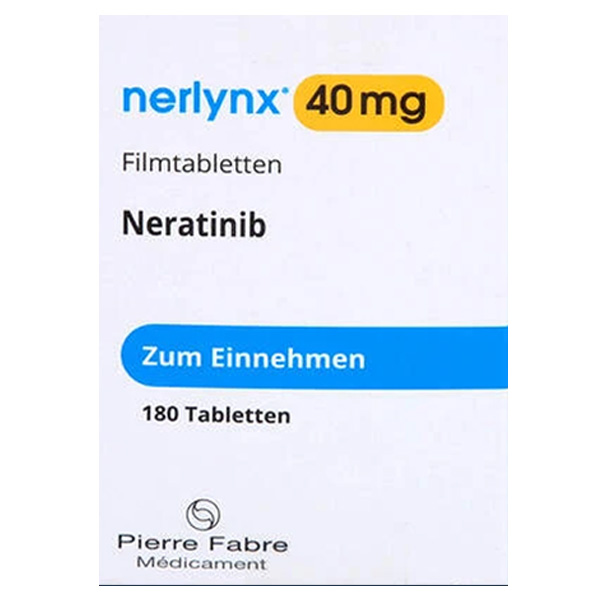
All Names: Neratinib、Hernix、Niratinib、Nerlynx、马来酸奈拉替尼片、贺俪安、来那替尼
Indications:Patients with early breast cancer and advanced or metastatic breast cancer.
Manufacturer:Pierre Fabre
Customs Clearance Procedure:If the customs requires the package for customs clearance, please pay the customs clearance fee according to the content of EMS SMS and customs regulations.
Neratinib is an oral, irreversible tyrosine kinase inhibitor used to treat HER2 positive breast cancer. It inhibits tumor growth by suppressing the autophosphorylation of EGFR, HER2, and HER4, blocking downstream signaling pathways.
1、 Drug name
1. Common name: Naratinib
2. Product Name: NERLYNX ®
2、 Indications
1. As a single drug, it is used for extended adjuvant treatment of adult patients with early HER2 positive breast cancer, and is applicable to patients who have completed adjuvant treatment of trastuzumab.
2. Combined with capecitabine, it is used to treat adult patients with advanced or metastatic HER2 positive breast cancer who have previously received two or more anti HER2 regimens in the metastatic stage.
3、 Specifications and characteristics
Specification: Each tablet contains 40mg of nalatinib (equivalent to 48.31mg of nalatinib maleate).
4、 Main components
Active ingredient: Naratinib (present in the form of maleic acid salt).
5、 Usage and dosage
1. Extended adjuvant treatment for early breast cancer: the recommended dose is 240mg (6 tablets), taken orally with a meal once a day, and continued to use until the disease relapses or the longest year.
2. Advanced or metastatic breast cancer: the recommended dose is 240mg (6 tablets), taken orally once a day with a meal, and taken from the 1st to 21st days of each 21 day cycle; Combination capecitabine (750mg/m ², twice daily orally) is taken on days 1-14 of each 21 day cycle. Treatment continues until disease progression or intolerable toxicity occurs.
3. Dose escalation plan: Dose escalation can be chosen in the first two weeks (120mg once daily in the first week, 160mg once daily in the second week, and 240mg once daily from the third week onwards) to reduce the incidence of diarrhea.
6、 Dose adjustment
Adjust the dosage according to the severity of adverse reactions:
1. Single drug treatment dose level: initial dose of 240mg once daily; Reduce to 200mg for the first time, 160mg for the second time, and 120mg for the third time.
2. Combination therapy dosage level: initial dose of 240mg once daily; Reduce to 160mg for the first time and to 120mg for the second time.
3. Diarrhea management: When persistent or severe diarrhea occurs, medication should be temporarily suspended and reduced after recovery; If grade 4 diarrhea persists or ≥ grade 2 diarrhea persists even after reducing to 120mg, the medication should be permanently discontinued.
4. Hepatotoxicity management: If there is a level 3 increase in liver enzymes or bilirubin, medication should be suspended and reduced after recovery; Grade 4 hepatotoxicity requires permanent discontinuation of medication.
5. Severe liver dysfunction: The starting dose for Child Pugh C patients should be reduced to 80mg once daily.
7、 Medication precautions
1. Medication time: Take with meals, approximately at the same time each day.
2. Omission treatment: If one dose is missed, it should not be taken again, and treatment should continue according to the original plan for the next dose.
3. Vomiting treatment: Unless otherwise specified, usually if vomiting occurs after taking medication, it should not be taken again.
4. Diarrhea prevention: If dose escalation is not used, loperamide should be used to prevent diarrhea from the first dose (taken according to the plan 56 days before treatment, and then used as needed to maintain 1-2 bowel movements per day).
5. Combination of gastric acid reducing agents: avoid combination with proton pump inhibitors; When used in combination with H2 receptor antagonists, it should be taken at least 2 hours before or at least 10 hours after taking this product; When used in combination with antacids, it should be taken at least 3 hours after taking this product.
8、 Medication for special populations
1. Liver dysfunction: Mild or moderate injury does not require dose adjustment; Severe injuries should be reduced to a starting dose of 80mg.
2. Renal insufficiency: No adjustment suggestions have been proposed.
3. Elderly patients: Patients aged 65 and above have a higher rate of discontinuation due to adverse reactions and require close monitoring.
4. Children: Safety and efficacy have not been established.
5. Pregnant women: There is a risk to the fetus, and effective contraceptive measures should be taken during treatment and within one month after the last dose.
6. Breastfeeding period: It is not recommended to breastfeed during the treatment period and for at least one month after the last dose.
7. Men and women of childbearing age: Effective contraceptive measures should be taken during the treatment period and at least 1 month after the last dose for women, and during the treatment period and 3 months after the last dose for men.
9、 Adverse reactions
1. Common adverse reactions include diarrhea, nausea, abdominal pain, fatigue, vomiting, rash, stomatitis, decreased appetite, muscle spasms, indigestion, elevated liver enzymes, abnormal nails, dry skin, bloating, nosebleeds, weight loss, urinary tract infections, etc.
2. Serious adverse reactions include severe diarrhea and dehydration, hepatotoxicity, embryonic fetal toxicity, etc.
10、 Contraindications
None.
11、 Drug interactions
1. Avoid co administration with potent CYP3A4 inhibitors.
2. Avoid co administration with P-glycoprotein and intermediate acting CYP3A4 dual inhibitors.
3. Avoid co administration with potent or moderate CYP3A4 inducers.
4. When combined with certain P-glycoprotein substrates, it is necessary to monitor the increased risk of adverse reactions in the latter.
5. Avoid co use with proton pump inhibitors; Take H2 receptor antagonists or antacids at intervals.
6. Avoid consuming grapefruit products.
12、 Storage method
1. Storage temperature: 20 ° C to 25 ° C (68 ° F to 77 ° F), allowing for short distance transportation between 15 ° C to 30 ° C (59 ° F to 86 ° F).
2. Keep out of reach of children.
Neratinibinformation