- All Drug Categories
- Home
- Anti-cancer Drugs
- Healthcare Products
- Medical Information
- Statement
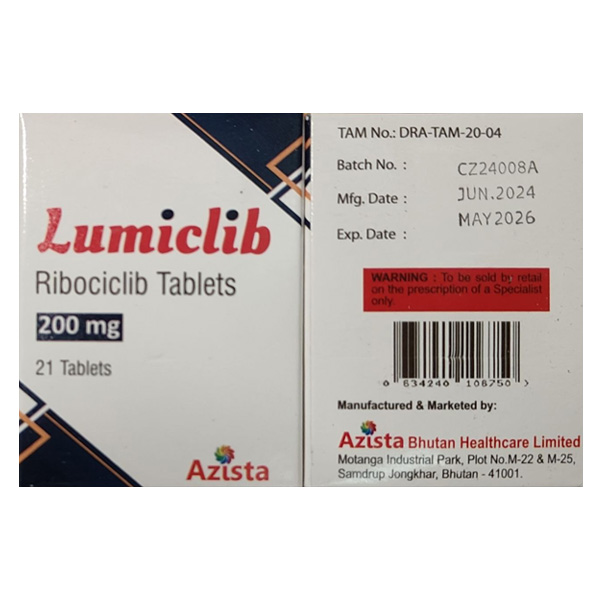
All Names: Kisqali、ribociclib、凯丽隆、琥珀酸瑞波西利片、瑞博西林、瑞博西尼、瑞博西利
Indications:Ribosilide is applicable to adult patients with HR positive and HER2 negative breast cancer, including early breast cancer patients in stage II and III, advanced or metastatic breast cancer patients, and male advanced or metastatic breast cancer patients with high risk of recurrence.
Manufacturer:Azista, India
Customs Clearance Procedure:If the customs requires the package for customs clearance, please pay the customs clearance fee according to the content of EMS SMS and customs regulations.
Ribociclib is an oral tablet that belongs to cyclin dependent kinase (CDK) 4/6 inhibitors. By selectively inhibiting CDK4/6 activity, it blocks the transition of the cell cycle from G1 phase to S phase, thereby inhibiting the proliferation of tumor cells.
1、 Drug name
1. Common name: Rippoli
2. Product Name: Kisqali ®。
2、 Indications
1. Early breast cancer: combined with aromatase inhibitor, it is used for adjuvant treatment of adult patients with stage II and III early breast cancer who are hormone receptor (HR) positive, human epidermal growth factor receptor 2 (HER2) negative, and have a high risk of recurrence.
2. Advanced or metastatic breast cancer: combined with endocrine therapy to treat adult patients with advanced or metastatic breast cancer with positive HR and negative HER2. It can be used as an initial treatment plan based on endocrine therapy (in combination with aromatase inhibitors or fluvoxetine), or when disease progression occurs after endocrine therapy (in combination with fluvoxetine).
3、 Specifications
Specification: Film coated tablets, each containing 200 milligrams of reboxil (equivalent to 254.40 milligrams of reboxil succinate).
4、 Main components
Active ingredient: Rabosinib (present in the form of Rabosinib succinate).
5、 Usage and dosage
1. Dosage regimen: Oral, once daily, for 21 consecutive days, followed by 7 days of discontinuation, forming a 28 day treatment cycle.
2. Recommended dosage:
Early breast cancer: the daily dose is 400 mg (2 200 mg tablets).
Advanced or metastatic breast cancer: daily dose is 600 mg (3 200 mg tablets).
Usage: Swallow the whole tablet, do not chew, crush or break it open. Take the medication around the same time every day, preferably in the morning. Can be taken with food or on an empty stomach.
6、 Dose adjustment
1. Dose adjustment should be made based on the severity of adverse reactions. The initial dose can be gradually reduced to 400 milligrams or 200 milligrams per day. If it needs to be reduced to below 200 milligrams per day, Kisqali should be permanently discontinued.
2. The specific adjustment plan has detailed regulations for different adverse reactions (such as interstitial lung disease, severe skin reactions, QT interval prolongation, hepatotoxicity, neutropenia, etc.), and should be executed according to medical advice.
7、 Medication precautions
1. Medication time: Take at a fixed time every day, preferably in the morning.
2. Omission or vomiting: If one dose is missed or vomiting occurs after taking the medication, it should not be taken on the same day. The scheduled dose should be taken at the next scheduled medication time.
3. Pill status: Damaged, cracked, or incomplete pills should not be taken.
8、 Medication for special populations
1. Liver dysfunction: Mild liver dysfunction does not require dose adjustment. For advanced/metastatic breast cancer patients with moderate to severe liver dysfunction, the recommended starting dose is 400 mg per day.
2. Renal insufficiency: Patients with mild to moderate renal insufficiency do not need to adjust the dosage. For patients with severe renal insufficiency, the recommended starting dose is 200 milligrams per day.
3. Elderly patients: There is no overall difference in safety and effectiveness between elderly and young patients.
4. Pregnant and lactating women: Pregnant women are prohibited from using it, which may cause harm to the fetus. Women of childbearing age should take effective contraceptive measures during treatment and at least 3 weeks after the last dose. Breastfeeding women should stop breastfeeding during the treatment period and at least 3 weeks after the last dose.
5. Children: Safety and efficacy have not yet been established in pediatric patients.
9、 Adverse reactions
1. Common adverse reactions (with an incidence rate of ≥ 20%) include abnormal laboratory indicators such as decreased lymphocytes, decreased white blood cells, decreased neutrophils, decreased hemoglobin, increased alanine aminotransferase (ALT), increased aspartate aminotransferase (AST), infection, increased muscle anhydrism, decreased platelets, headache, nausea, fatigue, etc.
2. In addition, one should be alert to serious adverse reactions such as interstitial lung disease/pneumonia, severe skin reactions, QT interval prolongation, hepatotoxicity, and neutropenia.
10、 Contraindications
1. There are no specific contraindications.
2. However, it is prohibited to use it in combination with drugs known to prolong the QT interval and potent CYP3A inhibitors, and to avoid using it in combination with tamoxifen.
11、 Drug interactions
1. CYP3A inhibitors: Avoid co administration with potent CYP3A inhibitors such as ketoconazole and clarithromycin. If it must be used in combination, the dosage of Kisqali should be reduced.
2. CYP3A inducers: Avoid co administration with potent CYP3A inducers such as rifampicin and phenytoin.
3. CYP3A substrates: Kisqali may increase the blood drug concentration of certain CYP3A substrates (such as midazolam), which should be monitored and the dosage of these drugs may need to be reduced when used in combination.
4. Medications that prolong the QT interval: Avoid combining with drugs known to prolong the QT interval, such as certain antiarrhythmic drugs.
12、 Storage method
Store at room temperature of 20 ° C to 25 ° C (68 ° F to 77 ° F), and allow for brief storage between 15 ° C to 30 ° C (59 ° F to 86 ° F). Store in the original blister packaging to prevent moisture.
Kisqalinformation