- All Drug Categories
- Home
- Anti-cancer Drugs
- Healthcare Products
- Medical Information
- Statement
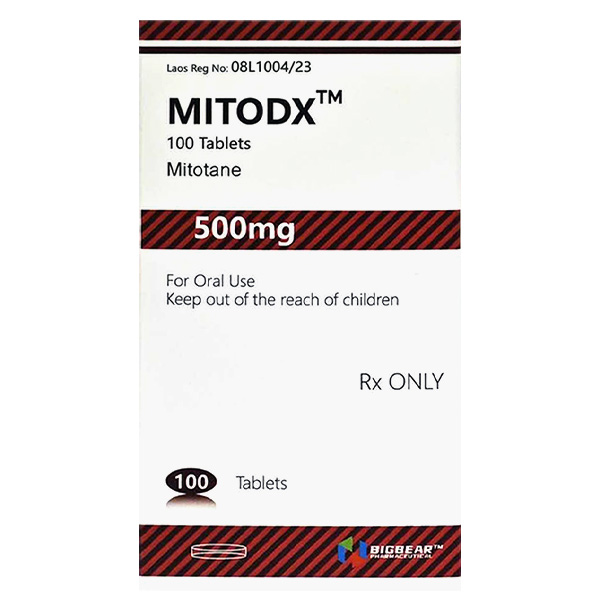
All Names: Mitotane、Lysodren、Chloditan、Chlonlithane、米托坦、密妥坦、曼托坦
Indications:Suitable for patients with unresectable, functional or non functional adrenal cortical carcinoma (ACC).
Manufacturer:Daxiong
Customs Clearance Procedure:If the customs requires the package for customs clearance, please pay the customs clearance fee according to the content of EMS SMS and customs regulations.
Mitotane is an oral cytotoxic agent for adrenal cells, and its mechanism of action is not fully understood. It mainly exerts pharmacological effects by regulating the peripheral metabolism of steroids and directly inhibiting the adrenal cortex.
1、 Drug name
1. Common name: Mitotane
2. Product Name: LYSODREN
2、 Indications
LYSODREN is suitable for treating patients with unresectable functional or non functional adrenal cortex cancer (ACC).
3、 Specifications and characteristics
1. Specification: Tablets, 500mg.
2. Characteristic: The drug is a white granular solid composed of colorless transparent crystals.
4、 Main components
Active ingredient: Mitotan.
5、 Usage and dosage
1. Initial dose: The recommended initial dose is 2000 milligrams to 6000 milligrams per day, taken orally in three to four doses.
2. Dose adjustment: Titration should be based on patient tolerance and clinical response increments to achieve plasma mitoxan levels between 14 and 20 milligrams per liter, or to the maximum tolerated dose. After the start of treatment and each dose adjustment, it may be considered to monitor the plasma level of mitoxan every 2 weeks. The target blood drug level can usually be reached within 3 to 5 months.
3. Administration method:
Swallowing the entire tablet; Do not crush, chew or split.
Take with meals. The relative time of eating must be consistent. High fat foods can enhance absorption.
If a patient misses one dose, they should take the normal dose at the next scheduled time and not double the dose.
If the patient vomits after taking the medication, the normal dose should be taken at the next scheduled time.
6、 Dose adjustment (for adverse reactions)
1. The dosage should be adjusted according to the severity of adverse reactions.
2. It is usually recommended to reduce the daily dose by 500 to 1000 milligrams.
3. The specific adjustment plan depends on the type and severity of adverse reactions (based on NCICTCAE standards), and details should refer to prescription information or consult a doctor.
4. Medication should be suspended during shock, severe trauma, or infection.
7、 Medication precautions
1. Solution: Mitotan is a dangerous drug. Nursing staff should wear disposable gloves when handling pills to avoid contact with crushed/broken pills. If skin contact occurs, it should be thoroughly washed immediately.
2. Expired/damaged drugs: Do not take any pills with signs of deterioration.
8、 Medication for special populations
1. Pregnant women: Mitotan can cause fetal harm, and women exposed to Mitotan may experience adverse pregnancy outcomes such as premature birth and early pregnancy loss. Pregnant women should be informed of potential risks to the fetus. Women with reproductive potential should use effective non hormonal contraceptive measures during treatment and when plasma levels of mitoxan are detectable after discontinuation, as mitoxan may render certain hormonal contraceptives ineffective.
2. Breastfeeding women: It is not recommended to breastfeed as mitoxan is secreted into human milk.
3. Children: The effectiveness has not yet been established. According to the case report, mitoxan may have a negative impact on the neuropsychological development of children and adolescents.
4. Elderly people: Careful dosage selection is necessary, usually starting from the lower end of the dosage range.
5. Liver dysfunction: Mitotan is metabolized by the liver, and impaired liver function may lead to elevated blood levels of Mitotan. For patients with mild to moderate liver dysfunction, it is recommended to monitor blood drug levels more frequently and adjust dosage. Not recommended for patients with severe liver dysfunction.
6. Renal insufficiency: Mitotan is eliminated by the kidneys, and renal insufficiency may lead to elevated blood levels of Mitotan. For patients with mild to moderate renal insufficiency, it is recommended to monitor blood drug levels more frequently and adjust dosage. Not recommended for patients with severe renal insufficiency.
9、 Main adverse reactions
1. The most common adverse reactions include anorexia, upper abdominal discomfort, nausea, vomiting, diarrhea, depression, dizziness, vertigo, rash, hypercholesterolemia, hypertriglyceridemia, hypothyroidism, and decreased free testosterone in male blood.
2. Serious adverse reactions (requiring close monitoring and management) include:
Adrenal insufficiency and adrenal crisis: In cases of shock, severe trauma, or infection, the use of mitoxan increases the risk of adrenal crisis and may lead to death.
Central nervous system toxicity: drowsiness, drowsiness, dizziness, etc. Plasma levels exceeding 20 milligrams per liter are associated with a higher incidence of toxicity.
Giant ovarian cyst (premenopausal women).
Hepatotoxicity.
Hematological toxicity: leukopenia, anemia, and thrombocytopenia.
Prolonged bleeding time.
Embryo fetal toxicity.
10、 Contraindications
None.
11、 Drug interactions
1. Spironolactone: can block the action of mitoxan and avoid combination therapy.
2. Certain CYP3A substrates: Mitotan is a potent CYP3A inducer that may lower its levels, leading to reduced efficacy and avoiding combination therapy. If combination therapy is necessary, the dosage should be adjusted according to the CYP3A substrate drug label.
3. Hormonal contraceptives: may fail, avoid combination use.
4. Warfarin: Mitotan can induce warfarin metabolism, reduce its level and efficacy, and avoid combination therapy. If combination therapy is necessary, INR should be monitored more frequently and warfarin dosage adjusted.
12、 Storage method
Stored at 25 ° C (77 ° F), allowing for variations between 15 ° C and 30 ° C (59 ° F and 86 ° F).
Mitotaneinformation