- All Drug Categories
- Home
- Anti-cancer Drugs
- Healthcare Products
- Medical Information
- Statement
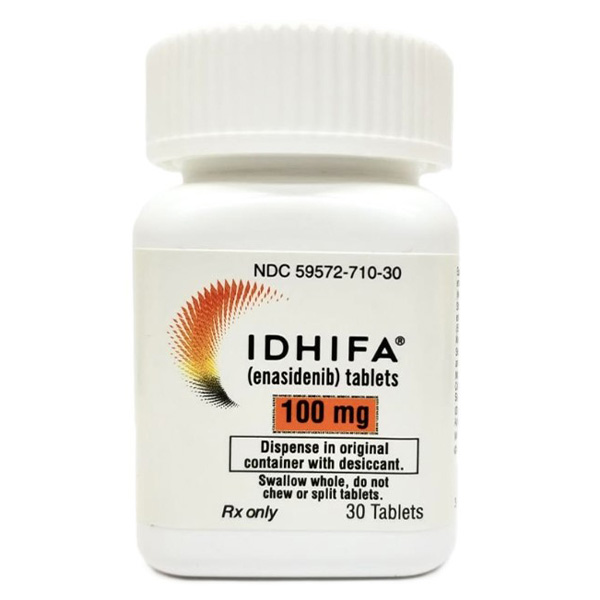
All Names: Idhifa、Enasidenib、恩西地平
Indications:Adult patients with recurrent or refractory acute myeloid leukemia (AML) who have mutations in isocitrate dehydrogenase-2 (IDH2).
Manufacturer:Celgene
Customs Clearance Procedure:If the customs requires the package for customs clearance, please pay the customs clearance fee according to the content of EMS SMS and customs regulations.
Enasidenib is an isocitrate dehydrogenase-2 (IDH2) inhibitor that reduces the production of carcinogenic metabolite 2-hydroxyglutarate (2-HG) by targeting the mutant IDH2 enzyme, thereby inducing leukemia cell differentiation and inhibiting its proliferation.
1、 Drug name
1. Common name: Enasidenib
2. Product Name: IDHIFA ®
2、 Indications
Suitable for treating adult patients with relapsed or refractory acute myeloid leukemia (AML) confirmed by FDA approved testing methods to have isocitrate dehydrogenase-2 (IDH2) mutations.
3、 Specifications and characteristics
1. Specification: 100mg/tablet
2. Appearance: 100mg is a light yellow to yellow capsule shaped film coated tablet, with "ENA" engraved on one side and "100" engraved on the other side.
4、 Main components
1. Active ingredient: Ensidipine (in the form of methanesulfonate salt)
5、 Usage and dosage
1. Recommended dosage: Take 100 milligrams orally once daily until disease progression or unacceptable toxicity occurs.
2. Medication method: Swallow the whole tablet, do not chew, break or crush. Take it at approximately the same time every day, either with food or on an empty stomach.
3. Duration of treatment: If there is no disease progression or intolerable toxicity, treatment should be continued for at least 6 months to evaluate clinical response.
6、 Dose adjustment
If the following toxic reactions occur, the dosage needs to be adjusted:
1. Differentiation syndrome: If severe pulmonary symptoms require intubation or ventilator support, and/or renal dysfunction persists for more than 48 hours, medication should be suspended until symptoms improve to level 2 or below before resuming medication.
2. Non infectious leukocytosis (white blood cell count>30 × 10 ⁹/L): If there is no improvement after treatment with hydroxyurea, the medication should be suspended until the white blood cell count is<30 × 10 ⁹/L and then restored to 100 milligrams per day.
3. Total bilirubin continues to be ≥ 3 times the upper limit of normal (ULN) for ≥ 2 weeks without elevated transaminase levels or other liver diseases: dose reduced to 50 milligrams per day; If bilirubin is restored to<2 times ULN, it can be restored to 100 milligrams per day.
4. Other treatment-related toxicities of grade 3 or above (including tumor lysis syndrome): Suspend medication until toxicity returns to grade 2 or below, then resume at a daily dose of 50 milligrams; If the toxicity returns to level 1 or below, it can be increased to 100 milligrams per day; If grade 3 or above toxicity occurs again, the medication should be permanently discontinued.
7、 Medication precautions
1. Before and after meals: Both are acceptable.
2. Missed medication: If missed or not taken on time on the same day, it should be taken as soon as possible and the normal medication time should be restored the next day; Do not take double the dose at once.
3. Vomiting: If vomiting occurs after taking medication, it is recommended to take the same daily dose as soon as possible and take the medication normally the next day.
4. Other: Regular monitoring of blood routine and biochemical indicators is required during the treatment period (at least once every 2 weeks before treatment and within the first 3 months of treatment).
8、 Medication for special populations
1. Pregnant women: May cause harm to the fetus. Effective contraceptive measures (non hormonal contraception) should be taken during the medication period and within 2 months after the last dose.
2. Breastfeeding women: It is not recommended to breastfeed. Breastfeeding should be stopped during the treatment period and within 2 months after the last dose.
3. Children: Safety and efficacy have not yet been established.
4. Elderly: No need to adjust dosage.
5. Patients with liver and kidney dysfunction: mild to moderate liver injury or renal dysfunction (creatinine clearance rate ≥ 30 mL/min) do not require dose adjustment; Insufficient data on severe liver injury.
9、 Adverse reactions
1. The most common adverse reactions (incidence ≥ 20%) are nausea, vomiting, diarrhea, elevated bilirubin, and decreased appetite.
2. Serious adverse reactions: differentiation syndrome (life-threatening), leukocytosis, tumor lysis syndrome, etc.
3. Other common reactions include taste disorders, hypocalcemia, hypokalemia, hypophosphatemia, etc.
10、 Contraindications
There are no clear contraindications.
11、 Drug interactions
1. Should avoid co administration with the following drugs: CYP1A2, CYP2C19, CYP3A, OATP1B1/OATP1B3/BCRP substrates.
2. Combining with CYP3A substrates (such as certain antifungal drugs and hormonal contraceptives) may reduce their efficacy, and it is recommended to switch to non hormonal contraceptive methods.
3. Adverse reactions need to be monitored when combined with P-gp substrates.
4. During medication, it is recommended to reduce caffeine intake (as empagliflozin can enhance the effects of caffeine).
12、 Storage method
1. Storage temperature: 20 ° C-25 ° C (68 ° F-77 ° F), short-term storage at 15 ° C-30 ° C (59 ° F-86 ° F) is allowed.
2. Storage requirements: Keep the bottle cap tightly closed and place it in the original bottle (including desiccant) to prevent moisture.
Enasidenibinformation