- All Drug Categories
- Home
- Anti-cancer Drugs
- Healthcare Products
- Medical Information
- Statement
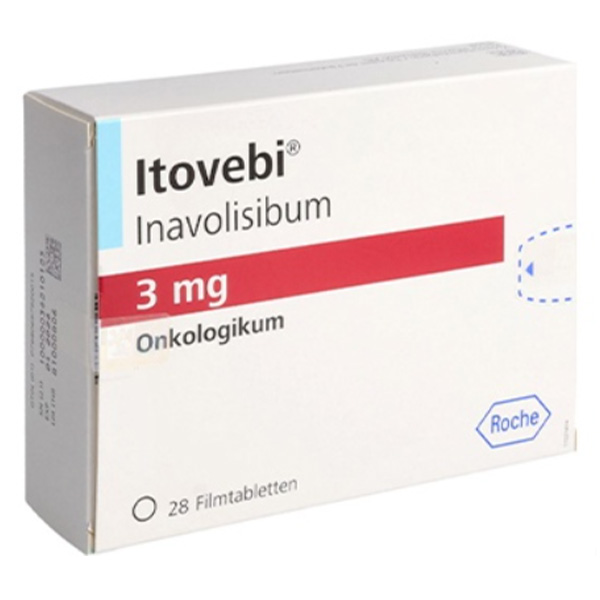
All Names: Itovebi、Inavolisib、伊那利塞、伊赫莱
Indications:Combined with Pabosinib and Fluvastatin, it is used to treat adult patients with PIK3CA mutation, hormone receptor (HR) positive, human epidermal growth factor receptor 2 (HER2) negative, locally advanced or metastatic breast cancer confirmed by FDA approved detection methods.
Manufacturer:Roche, Switzerland
Customs Clearance Procedure:If the customs requires the package for customs clearance, please pay the customs clearance fee according to the content of EMS SMS and customs regulations.
Inavolisib is an oral, selective phosphatidylinositol 3-kinase α (PI3K α) inhibitor. It is used in combination with the downstream cyclin dependent kinase 4/6 (CDK4/6) inhibitor palbociclib and the estrogen receptor down-regulation agent fulvestrant to form a targeted combined treatment scheme for specific molecular subtypes of breast cancer.
1、 Drug name
1. Drug name: Inavolisib, English name Inavolisib
2. Product Name: ITOVEBI
2、 Indications
1. This product is used in combination with Palbiclib and Fulvestrant to treat adult patients with locally advanced or metastatic breast cancer with endocrine resistance, PIK3CA mutation, positive hormone receptor, and negative human epidermal growth factor receptor 2.
2. Suitable for patients who experience recurrence after completing adjuvant endocrine therapy.
3、 Specifications and characteristics
1. Specification: This product is a film coated tablet.
2. Appearance: 3mg tablet: red, round, convex, with "INA3" engraved on one side.
4、 Main components
Active ingredient: Inavolisib.
5、 Usage and dosage
1. Patient selection: Prior to use, FDA approved testing methods must be used to confirm the presence of PIK3CA mutations in plasma samples.
2. Recommended dosage: Take 9mg orally once daily until disease progression or unacceptable toxicity occurs. It is recommended to take it at approximately the same time every day.
3. Usage: The whole tablet should be swallowed, and should not be chewed, crushed, or broken open.
4. Combination therapy: It should be used in combination with piperacillin and fluvoxetine. Please refer to the instructions of these two drugs for the specific dosage.
5. Pre administration evaluation: Before starting treatment, it is necessary to evaluate fasting blood glucose and glycated hemoglobin levels, and optimize blood glucose control.
6、 Dose adjustment
1. Adverse reaction dose adjustment:
The recommended dose reduction plan is to first reduce to 6mg once daily; Reduce to 3mg once daily for the second time.
If the dose of 3mg cannot be tolerated, it should be permanently discontinued.
2. Dose adjustment for renal insufficiency:
For patients with moderate renal impairment, the recommended starting dose is adjusted to 6mg once daily.
7、 Medication precautions
1. Taken with meals: can be taken with food or on an empty stomach.
2. Omission treatment: If missed, makeup can be taken within 9 hours after the missed period. If it exceeds 9 hours, the current dose should be skipped and taken at the regular time the next day. Do not take double the dose.
3. Vomiting treatment: If vomiting occurs after taking medication, no additional medication should be taken on the same day. The next dose should be taken at the regular time the next day.
8、 Medication for special populations
1. Pregnant women: According to animal experiments and the mechanism of action, this product may cause harm to the fetus. Pregnant women are prohibited from using.
2. Breastfeeding women: It is recommended to stop breastfeeding during the treatment period and within one week after the last dose.
3. Women and men with reproductive potential:
Effective non hormonal contraceptive measures must be used during the treatment period and within one week after the last dose.
Before treatment, it is necessary to confirm that the pregnancy status is negative.
4. Children: The safety and efficacy in pediatric patients have not yet been determined.
5. Elderly patients: The number of patients aged 65 and above in clinical studies is limited, and no significant differences have been found compared to younger patients. However, the incidence of dose adjustments caused by adverse reactions is higher.
6. Renal function impairment: Mild impairment does not require dose adjustment; Moderate damage requires adjustment of the starting dose; Severe damage has not been studied.
9、 Adverse reactions
1. Common adverse reactions: Adverse reactions with an incidence rate of ≥ 20% include laboratory abnormalities such as neutropenia, hemoglobin reduction, elevated fasting blood glucose, thrombocytopenia, and lymphopenia; As well as conditions such as stomatitis, diarrhea, fatigue, nausea, rash, decreased appetite, COVID-19 infection, headache, etc.
2. Serious Warning: This product may cause severe or fatal hyperglycemia (including ketoacidosis), severe stomatitis, and severe diarrhea. Close monitoring is required during the treatment period.
10、 Contraindications
There are no specific contraindications.
11、 Drug interactions
1. This product has not been found to have clinically significant interactions when used in combination with proton pump inhibitors (such as omeprazole) and other gastric acid modulators.
2. In vitro studies have shown that enalisex is a substrate of P-glycoprotein and breast cancer resistant protein, but not an inhibitor of these transporters. The specific interaction research is limited.
12、 Storage method
1. Store at room temperature between 20 ° C and 25 ° C, allowing short-term fluctuations between 15 ° C and 30 ° C.
2. Please keep the medication out of reach of children.
Inavolisibinformation