- All Drug Categories
- Home
- Anti-cancer Drugs
- Healthcare Products
- Medical Information
- Statement
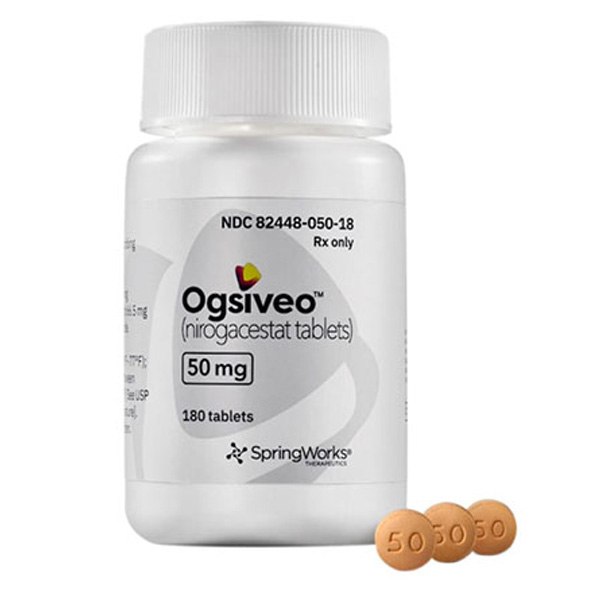
All Names: Ogsiveo、nirogacestat、奥格西韦奥
Indications:Adult patients with progressive fibroadenoma requiring systemic treatment.
Manufacturer:SpringWorks
Customs Clearance Procedure:If the customs requires the package for customs clearance, please pay the customs clearance fee according to the content of EMS SMS and customs regulations.
Ogsiweio is a gamma secretase inhibitor that blocks signaling pathways associated with tumor growth by inhibiting the proteolytic activation of Notch receptors.
1、 Drug name
1. Product Name: Ogsiveo
2. Common name: Nirogacetat
2、 Indications
Suitable for adult patients with progressive fibroadenoma who require systemic treatment.
3、 Specifications and characteristics
1. Specification: 50mg film coated tablets.
2. Appearance: Round, coated with orange film, with "50" engraved on one side.
4、 Main components
Active ingredient: Nirogacetat (present in the form of Nirogacetat hydrobromide).
5、 Usage and dosage
1. Usage: Can be taken with food or on an empty stomach. The pill should be swallowed whole and should not be broken, crushed, or chewed.
2. Omission or vomiting: If vomiting or missing one dose occurs, the next dose should be taken at the regular medication time without the need to double the dose.
6、 Dose adjustment (for adverse reactions)
For serious adverse reactions, it is recommended to adjust the dosage:
1. Diarrhea: For grade 3 or 4 diarrhea that persists for ≥ 3 days with maximum medical support, medication should be suspended until it returns to ≤ grade 1 or baseline levels, and then resumed at a dose of 100 milligrams twice daily.
2. Elevated liver enzymes (ALT/AST): For grade 2 elevation, administration is suspended until recovery, and then resumed at a dose of 100 milligrams twice daily; For grade 3 or 4 elevation, the medication should be permanently discontinued.
3. Electrolyte abnormalities (hypophosphatemia/hypokalemia): For grade 3 or 4 hypophosphatemia or hypokalemia that persists for ≥ 3 days with maximum supplementation support, administration should be suspended until it returns to ≤ grade 1 or baseline levels, and then resumed at a dose of 100 milligrams twice daily.
7、 Medication precautions
1. Before and after meals: can be taken with food or on an empty stomach.
2. Vomiting/Omission: No need for supplementation, take the next dose according to the original schedule.
8、 Medication for special populations
1. Pregnant women: According to animal research results, it may cause harm to the fetus and is not recommended for use.
2. Breastfeeding women: It is recommended not to breastfeed during treatment and for one week after the last dose.
3. Women and men with fertility:
Before medication, it is necessary to confirm the pregnancy status.
Effective contraceptive measures must be used during the treatment period and within one week after the last dose.
May impair fertility (including ovarian toxicity and impact on spermatogenesis).
4. Children: Safety and efficacy have not been determined, and there have been reports of epiphyseal growth plate widening in pediatric patients with unclosed epiphyses.
5. Elderly patients: The number of patients aged 65 and above in clinical studies is insufficient to determine whether their reactions are different from those of younger patients.
9、 Adverse reactions
1. Common adverse reactions (incidence rate ≥ 15%): diarrhea, ovarian toxicity (such as ovarian failure, amenorrhea), rash, nausea, fatigue, stomatitis, headache, abdominal pain, cough, hair loss, upper respiratory tract infection, difficulty breathing.
2. Common laboratory abnormalities (incidence ≥ 15%): decreased blood phosphorus, increased urine sugar, increased urine protein, increased AST, increased ALT, decreased blood potassium.
3. Serious adverse reactions: may include severe diarrhea, ovarian toxicity, liver toxicity, non melanoma skin cancer, electrolyte abnormalities, etc.
10、 Contraindications
None.
11、 Drug interactions
1. Strong or moderate CYP3A inhibitors: Co administration should be avoided (as it may increase exposure to nilamide and increase the risk of adverse reactions).
2. Strong or moderate CYP3A inducers: Co administration should be avoided (as it may reduce the efficacy of nifedipine).
3. Gastric acid reducing agents (proton pump inhibitors, H2 receptor antagonists): should be avoided in combination. If it is not possible to avoid the use of antacids, the medication time should be staggered (Ogsiweio should be taken 2 hours before or 2 hours after taking antacids).
4. CYP3A substrates: Co administration should be avoided, especially for drugs that may cause serious adverse reactions with small changes in concentration (such as Ogdesivir, which may increase its exposure).
5. CYP2C19 substrate: Co administration should be avoided as it may significantly reduce the efficacy of such drugs.
12、 Storage method
1. Store at room temperature of 20 ℃ -25 ℃ (68 ℉ -77 ℉). Allow short distance temperature fluctuations between 15 ℃ -30 ℃ (59 ℉ -86 ℉).
2. Store in the original packaging and keep out of reach of children.
Ogsiveoinformation