- All Drug Categories
- Home
- Anti-cancer Drugs
- Healthcare Products
- Medical Information
- Statement
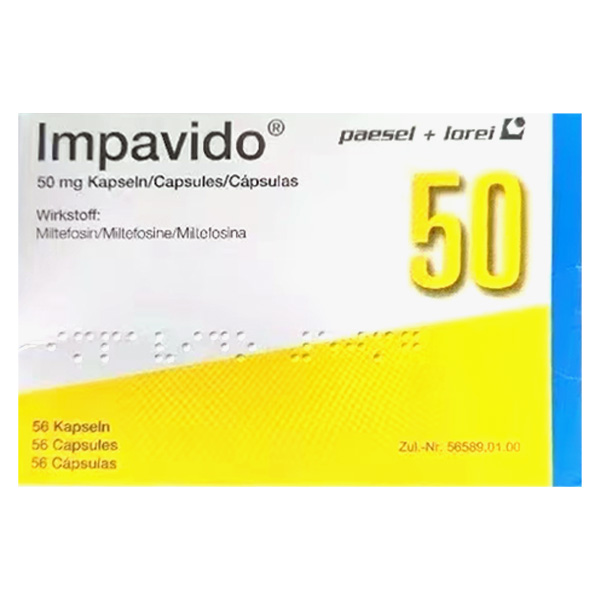
All Names: Miltefosine、Impavido、米替福新
Indications:Suitable for adult and pediatric patients aged 12 and above with a weight of ≥ 30 kilograms, treating visceral leishmaniasis caused by Leishmania donovani, cutaneous leishmaniasis caused by Leishmania brasiliensis/Leishmania guiana/Leishmania panama, and mucosal leishmaniasis caused by Leishmania brasiliensis; The use is limited to the types of Leishmania parasites involved in clinical studies based on epidemiological data. The clinical response of the same Leishmania parasite species may vary in different geographical regions, and the efficacy for other Leishmania parasite species has not been evaluated.
Manufacturer:德国Paesel+Lorei
Customs Clearance Procedure:If the customs requires the package for customs clearance, please pay the customs clearance fee according to the content of EMS SMS and customs regulations.
Miltefosine is an orally active alkyl phospholipid anti Leishmania drug that induces apoptosis like death by interfering with the parasite's phospholipid metabolism and cell signaling.
1、 Drug name
1. Common name: Miltefosine
2. Product Name: Impavido
2、 Indications
This product is an anti Leishmania drug suitable for adult and pediatric patients aged 12 years and above with a body weight of 30 kilograms (66 pounds) or more. It is used to treat the following diseases:
1. Visceral leishmaniasis: caused by Leishmania donovani.
2. Skin leishmaniasis: caused by Leishmania parasites in Brazil, Guyana, and Panama.
3. Mucosal leishmaniasis: caused by Leishmania parasites in Brazil.
4. Usage restrictions: The species of Leishmania parasites evaluated in clinical trials are based on epidemiological data, and the response of the same species may vary in different geographical regions. The efficacy of this product in other Leishmania species has not been evaluated.
3. Specifications
Specification: Each capsule contains 50 milligrams of Metformin.
4、 Main components
Active ingredient: Miltefosine.
5、 Usage and dosage
1. Duration of treatment: Take continuously for 28 days.
2. Usage: Take with meals to alleviate gastrointestinal adverse reactions. Capsules should be swallowed whole and should not be chewed or opened.
3. Recommended dosage (based on weight):
30 kg to 44 kg: 50 milligrams (one pill) each time, twice a day (taken with breakfast and dinner).
45 kilograms and above: 50 milligrams (one pill) each time, three times a day (taken with breakfast, lunch, and dinner).
6、 Dose adjustment
1. Omission treatment: If one dose is missed, the missed dose should be skipped and the next dose should be taken at the next regular medication time. Do not take two doses at the same time.
2. Vomiting treatment: The material does not explicitly mention the method of supplementing after vomiting, but as vomiting and diarrhea are common and may affect the absorption of oral contraceptives, it is recommended to consult medical professionals.
7、 Medication precautions
1. Vomiting/Diarrhea: Nausea, vomiting, and diarrhea are extremely common. Patients should be encouraged to consume sufficient fluids to prevent dehydration and kidney function damage.
2. Take with food: Be sure to take with meals to alleviate gastrointestinal reactions.
3. The impact on contraceptive measures: If vomiting and/or diarrhea occur during medication, it may affect the absorption of oral contraceptives and lead to contraceptive failure. At this time, additional non oral effective contraceptive measures should be added.
8、 Medication for special populations
1. Pregnant women: prohibited for pregnant women. Based on animal data, this product may cause fetal injury, including death and deformities.
2. Breastfeeding women: It is not recommended to breastfeed during the treatment period and within 5 months after the last dose.
3. Women and men with fertility:
Pregnancy test: Before starting treatment, it is necessary to verify the pregnancy status.
Contraception: Women with fertility must use effective contraceptive measures during treatment and within 5 months after the last dose.
Fertility impairment: Based on animal and human data, this product may impair the fertility of both males and females. Men may experience a decrease in sperm quality, sperm concentration, and ejaculation volume, and some of these effects may persist.
4. Children's medication: The safety and efficacy of medication for patients under 12 years old have not been determined.
5. Medication for the elderly: Clinical studies did not include a sufficient number of patients aged 65 and above to determine whether their reactions were different from those of younger subjects.
6. Renal dysfunction: No pharmacokinetic studies have been conducted in patients with renal dysfunction. Clinical trials excluded patients with serum creatinine or blood urea nitrogen levels greater than or equal to 1.5 times the upper limit of normal.
7. Liver dysfunction: No pharmacokinetic studies have been conducted in patients with liver dysfunction. Clinical trials excluded patients with transaminase levels greater than or equal to 3 times the upper limit of normal or bilirubin levels greater than or equal to 2 times the upper limit of normal.
9、 Adverse reactions
1. Very common adverse reactions (incidence greater than or equal to 2%): nausea, vomiting, diarrhea, headache, decreased appetite, dizziness, abdominal pain, itching, drowsiness, elevated transaminase levels, and elevated creatinine levels.
2. Serious Warning and Precautions:
Embryo fetal toxicity: See contraindications.
Fertility impairment: see medication for special populations.
Renal function impact: Serum creatinine should be monitored during the treatment period and within 4 weeks after the end of treatment.
Liver function impact: transaminase and bilirubin need to be monitored during treatment.
Thrombocytopenia: During the treatment of visceral leishmaniasis, platelet count needs to be monitored.
Eye complications: may lead to keratitis, corneal lesions, acute scleritis, anterior uveitis/iritis, and in severe cases, can cause vision loss or even permanent blindness. Once adverse reactions occur in the eyes, the medication should be stopped immediately and an ophthalmologist should be consulted.
Stevens Johnson syndrome: If severe skin reactions occur, medication should be stopped immediately.
10、 Contraindications
1. Pregnancy.
2. Sj ö gren Larsson syndrome (ichthyosis like erythroderma spastic paralysis intellectual disability syndrome).
3. Individuals who are allergic to Mifepristone or any excipients.
11、 Drug interactions
1. Cytochrome P450 enzyme: In vitro and animal studies have shown that mifepristone does not significantly induce or inhibit the activity of major human cytochrome P450 enzymes.
2. Drug transporters: The potential for interaction between Mifepristone and drug transporters has not been evaluated.
3. Oral contraceptive pills: Please refer to the medication precautions for details.
12、 Storage method
1. Temperature: Store at room temperature of 20 ° C to 25 ° C (68 ° F to 77 ° F), allowing for brief fluctuations to 15 ° C to 30 ° C (59 ° F to 86 ° F).
2. Moisture proof: Store against moisture.
3. Original packaging: Only distributed in the original paper box.
Impavidoinformation
No information yet!!!