- All Drug Categories
- Home
- Anti-cancer Drugs
- Healthcare Products
- Medical Information
- Statement
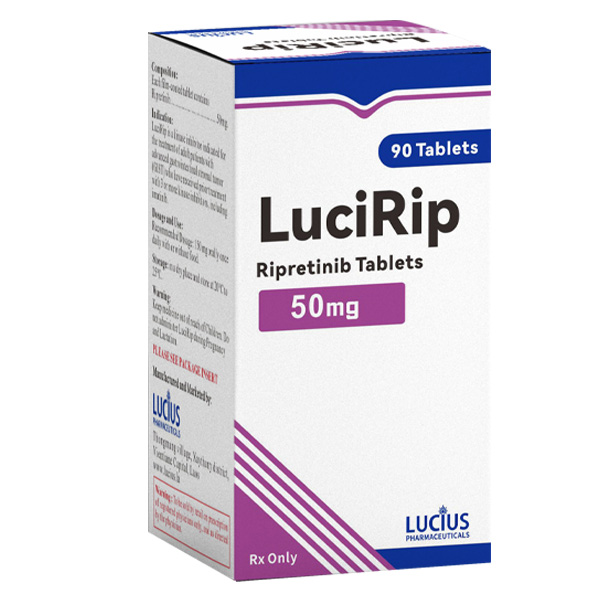
All Names: Ripretinib、Qinlock、瑞派替尼
Indications:Suitable for adult patients with advanced gastrointestinal stromal tumors (GIST) who have previously received treatment with three or more kinase inhibitors, including imatinib.
Manufacturer:LUCIUS PHARMACEUTICAL (LAOS) CO., LTD
Customs Clearance Procedure:If the customs requires the package for customs clearance, please pay the customs clearance fee according to the content of EMS SMS and customs regulations.
Ripretinib is a small molecule tyrosine kinase inhibitor that blocks tumor cell proliferation signaling pathways by targeting wild-type and various mutant forms of KIT and PDGFRA (platelet-derived growth factor receptor alpha), including primary and secondary mutations.
1、 Drug name
1. Common name: Ripretinib
2. Product Name: Qinlock
2、 Indications
This product is suitable for treating adult patients with advanced gastrointestinal stromal tumors (GIST) who have been treated with three or more kinase inhibitors, including imatinib.
3. Specifications
Specification: 50mg/tablet.
4、 Main components
Active ingredient: Ripretinib.
5、 Usage and dosage
1. Recommended dosage: 150mg per dose, once daily, orally. Can be taken with or without meals. Continue treatment until disease progression or unacceptable toxicity occurs.
2. Usage: Swallow the whole tablet.
3. Medication time: It is recommended to take the medication at the same time every day.
4. Missing service handling: If the time to missed service is less than 8 hours, it should be replenished as soon as possible; If it exceeds 8 hours, the missed dose should be skipped and the next regular dose should be taken according to the plan.
5. Vomiting treatment: If vomiting occurs after taking medication, no additional supplements should be taken, and the next regular dose should continue to be taken according to the plan.
6、 Dose adjustment
1. Adverse reaction dose adjustment:
First dose reduction: Reduce the dosage to 100 milligrams per dose, once daily.
Permanent discontinuation: If the dose of 100 milligrams per dose, once daily, cannot be tolerated, it should be permanently discontinued.
2. Special Adverse Reaction Management:
Palmoplantar redness and swelling sensation syndrome (PPES): Suspend administration based on severity (grade 2 or 3), and resume administration at the same or reduced dose after recovery to grade 1 or baseline levels.
Hypertension: Grade 3 hypertension requires medication to be temporarily suspended until symptoms are relieved and blood pressure is controlled, and then restored at the same or reduced dose. Permanent discontinuation of medication for grade 4 hypertension.
Left ventricular systolic dysfunction: Grade 3 or 4 requires permanent discontinuation of medication.
7、 Medication precautions
Combination with CYP3A inducers/inhibitors:
1. Strong CYP3A inhibitors: Co administration may increase the risk of adverse reactions and require more frequent monitoring.
2. Strong/moderate CYP3A inducers: should be avoided in combination. If it is not possible to avoid the use of intermediate acting inducers, the frequency of administration should be increased to 150 milligrams per dose, twice a day (a total of 300 milligrams per day), and once a day should be resumed after stopping the inducer for 14 days.
3. Risk of wound healing: Medication should be suspended for at least one week before elective surgery, and should not be administered for at least two weeks after major surgery or until the wound has fully healed.
4. Photosensitivity: During medication and at least one week after discontinuation, direct UV exposure should be restricted, and sunscreen and protective clothing should be used.
8、 Medication for special populations
1. Pregnant women: Based on animal studies, this product can cause fetal harm (cardiovascular and skeletal malformations, etc.). Pregnant women should be informed of potential risks to the fetus.
2. Contraception: Women with fertility must use effective contraceptive measures during treatment and within one week after the last dose. Male partners with fertility should also use effective contraceptive measures during this period.
3. Breastfeeding women: Breastfeeding is not recommended during treatment and within one week after the last dose.
4. Pediatric medication: Safety and efficacy have not yet been established.
5. Medication for the elderly: There is insufficient data in clinical studies on patients aged 65 and above to determine whether their reactions are different from those of younger patients.
6. Liver function impairment: Patients with mild, moderate, or severe liver function impairment do not need to adjust the dosage.
7. Renal dysfunction: Patients with mild to moderate renal dysfunction do not need to adjust the dosage. The impact of severe renal dysfunction has not been studied.
9、 Adverse reactions
1. The most common adverse reactions (incidence greater than or equal to 20%): hair loss, fatigue, nausea, abdominal pain, constipation, muscle pain, diarrhea, decreased appetite, palmar and plantar redness and swelling sensation syndrome (PPES), vomiting.
2. The most commonly reported severe (grade 3 or 4) laboratory abnormalities (with an incidence rate greater than or equal to 4%) are elevated lipase and decreased phosphate.
3. Other significant adverse reactions:
New primary skin malignancies: including squamous cell carcinoma, keratoconus, and melanoma. Regular dermatological evaluations should be conducted during the treatment period.
Hypertension: Blood pressure should be monitored regularly during medication.
Cardiac dysfunction: including heart failure and decreased ejection fraction. The ejection fraction should be evaluated before and during treatment.
Photogenic reaction.
10、 Contraindications
None.
11、 Drug interactions
1. Strong CYP3A inhibitors (such as itraconazole): increase exposure to ripitinib and its active metabolites, and increase the risk of adverse reactions.
2. Strong/moderate CYP3A inducers (such as rifampicin, efavirenz): Reducing exposure to ripitinib and its active metabolites may decrease anti-tumor efficacy. It should be avoided to use it together.
3. In vitro studies suggest that repatinib and its active metabolite are inhibitors of P-glycoprotein (P-gp) and breast cancer resistant protein (BCRP), which may affect related substrate drugs.
12、 Storage method
1. Original packaging: It must be stored in the original bottle and kept with desiccants to prevent moisture and light.
2. Temperature: Store at room temperature of 20 ° C to 25 ° C (68 ° F to 77 ° F), allowing for brief fluctuations to 15 ° C to 30 ° C (59 ° F to 86 ° F).
3. Moisture proof: Be sure to tightly cap the bottle after each opening.
Ripretinibinformation