- All Drug Categories
- Home
- Anti-cancer Drugs
- Healthcare Products
- Medical Information
- Statement
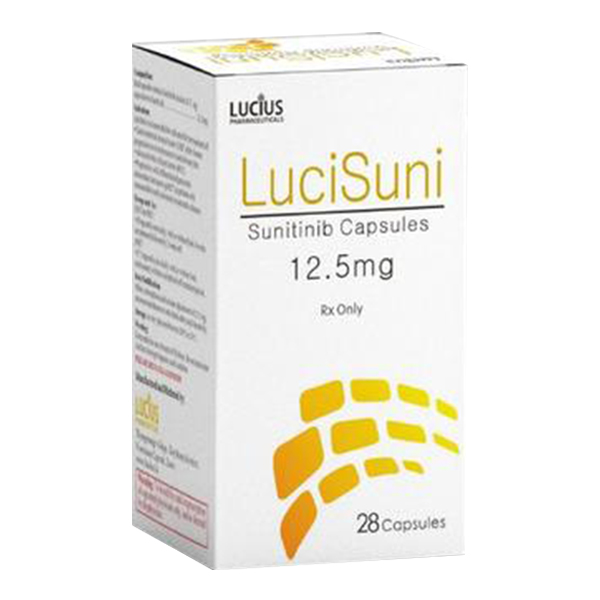
All Names: sunitinib、Sutent、Sunitix、舒尼替尼、舒尼替尼苹果酸盐、索坦
Indications:Suitable for adult patients diagnosed with gastrointestinal stromal tumors, advanced renal cell carcinoma, high recurrence risk renal cell carcinoma (postoperative adjuvant therapy), or progressive pancreatic neuroendocrine tumors.
Manufacturer:LUCIUS PHARMACEUTICAL (LAOS) CO., LTD
Customs Clearance Procedure:If the customs requires the package for customs clearance, please pay the customs clearance fee according to the content of EMS SMS and customs regulations.
Sunitinib is a multi-target tyrosine kinase inhibitor (TKI) that selectively inhibits signaling pathways such as platelet-derived growth factor receptor (PDGFR α/β), vascular endothelial growth factor receptor (VEGFR1/2/3), stem cell factor receptor (KIT), and Fms like tyrosine kinase-3 (FLT3) to block tumor angiogenesis and cell proliferation.
1、 Drug name
Common name: sunitinib
Product Name: SUTENT ®。
2、 Indications
Gastrointestinal stromal tumor (GIST): Used to treat disease progression or intolerance in adult patients after the use of imatinib mesylate.
Advanced renal cell carcinoma (RCC): used to treat adult patients with advanced renal cell carcinoma.
Adjuvant therapy for renal cell carcinoma: Used as an adjuvant therapy for adult renal cell carcinoma patients at high risk of recurrence after nephrectomy.
Advanced pancreatic neuroendocrine tumor (pNET): Used to treat advanced, well differentiated adult patients with unresectable locally advanced or metastatic pancreatic neuroendocrine tumors.
3、 Specifications and characteristics
Capsule dosage form, specifications include:
12.5 milligrams, 25 milligrams, 50 milligrams.
4、 Main components
Active ingredient: sunitinib malate.
5、 Usage and dosage
GIST and late stage RCC: The recommended dose is 50 milligrams, taken orally once daily, and stopped for 2 weeks after 4 weeks of medication (4/2 regimen).
Adjuvant treatment for RCC: The recommended dose is 50 milligrams, taken orally once a day, and stopped for 2 weeks after 4 weeks of medication (4/2 regimen), with a maximum of 9 cycles.
PNET: The recommended dosage is 37.5 milligrams, taken orally once daily, and continued until disease progression or unacceptable toxicity occurs.
Medication time: can be taken with food or on an empty stomach.
6、 Dose adjustment
Adverse reaction dose adjustment: Depending on the severity of the adverse reaction, the initial dose can be reduced to 37.5 milligrams or 25 milligrams once daily.
Drug interaction dose adjustment:
When combined with strong CYP3A4 inhibitors, GIST and RCC can be considered to be reduced to 37.5 milligrams, and pNET can be considered to be reduced to 25 milligrams.
When combined with strong CYP3A4 inducers, GIST and RCC can be considered to increase to 87.5 milligrams, and pNET can be considered to increase to 62.5 milligrams.
7、 Medication precautions
Before and after meals: can be taken without specific requirements.
Leakage treatment: If the leakage time is less than 12 hours, it should be immediately replenished; If it exceeds 12 hours, skip the dose and take the next dose as planned.
Vomiting treatment: If vomiting occurs after taking medication, there is no need to take the next dose according to the original plan.
Other precautions:
During medication, regular monitoring of liver function, blood pressure, thyroid function, blood routine, and other indicators is necessary.
Timely intervention is necessary when common adverse reactions such as hand foot syndrome and hypertension occur.
8、 Medication for special populations
Elderly patients: The incidence of grade 3 or 4 adverse reactions is higher in patients aged 65 and above (67% compared to 60%).
Liver injury patients: Mild or moderate liver injury patients do not require dose adjustment, and severe liver injury patients have not been studied.
Renal injury patients: Mild to severe renal injury patients do not require dose adjustment.
Pregnant women: Prohibited, may cause harm to the fetus.
Breastfeeding women: Stop breastfeeding during treatment and for at least 4 weeks after the last dose.
9、 Adverse reactions
The most common adverse reactions (with an incidence rate of ≥ 25%) include: fatigue/weakness, diarrhea, oral mucositis/stomatitis, nausea, loss of appetite/anorexia, vomiting, abdominal pain, hand foot syndrome, hypertension, bleeding events, taste disorders/changes, indigestion, and thrombocytopenia.
10、 Contraindications
None.
11、 Drug interactions
Strong CYP3A4 inhibitors (such as ketoconazole) may increase the blood concentration of sunitinib.
Strong CYP3A4 inducers (such as rifampicin) may reduce the blood concentration of sunitinib.
The combination of drugs that prolong the QT interval may increase the risk of arrhythmia.
12、 Storage method
Stored at 20 ° C to 25 ° C (68 ° F to 77 ° F), allowing fluctuations within the range of 15 ° C to 30 ° C (59 ° F to 86 ° F).
sunitinibinformation