- All Drug Categories
- Home
- Anti-cancer Drugs
- Healthcare Products
- Medical Information
- Statement
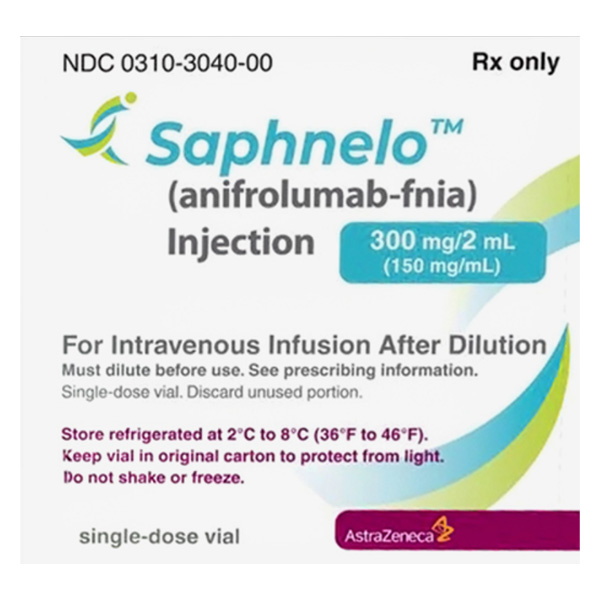
All Names: Anifrolumab-fnia、Saphnelo、安尼鲁单抗
Indications:Suitable for adult patients with moderate to severe systemic lupus erythematosus who are receiving standard treatment. This drug aims to reduce disease activity and is typically used in combination with existing treatment options such as corticosteroids, antimalarials, or immunosuppressants. The efficacy of ranibizumab in patients with severe active lupus nephritis or severe active central nervous system lupus has not been evaluated and is not recommended for use in these situations.
Manufacturer:AstraZeneca
Customs Clearance Procedure:If the customs requires the package for customs clearance, please pay the customs clearance fee according to the content of EMS SMS and customs regulations.
Anifrumab is a fully human immunoglobulin G1 kappa (IgG1 kappa) monoclonal antibody that acts as a type I interferon (IFN) receptor antagonist by specifically binding to subunit 1 of the IFN receptor (IFNAR1), blocking the transmission of the type I IFN signaling pathway.
1、 Drug name
1. Product Name: Saphnelo
2. Common name: anifrumab fnia
2、 Indications
1. This product is suitable for treating adult patients with moderate to severe systemic lupus erythematosus who are receiving standard treatment.
2. Usage restrictions: It has not been evaluated for efficacy in patients with severe active lupus nephritis or severe active central nervous system lupus, and is not recommended for use in these situations.
3、 Specifications and characteristics
1. Specification: 300mg/2mL (150mg/mL), single dose penicillin bottle.
2. Appearance: Clear to milky, colorless to slightly yellow sterile, preservative free solution.
4、 Main components
Active ingredient: anifrumab fnia
5、 Usage and dosage
1. Recommended dosage: 300mg each time, intravenous infusion for 30 minutes, once every 4 weeks.
2. Preparation requirements: It must be diluted before use. Take out 2mL of the solution from a 50mL or 100mL 0.9% sodium chloride injection infusion bag and discard it. Then add 2mL of this product and mix gently (without shaking).
3. Infusion requirements: Sterile, low protein binding 0.2 to 15 micron online or additional filters should be used for infusion. After infusion, rinse the infusion tube with 25mL of physiological saline to ensure complete dose infusion.
4. Pre infusion inspection: Before administration, visually inspect the medication for any particles or discoloration. If the solution is cloudy, discolored, or visible particles are present, they should be discarded.
6、 Dose adjustment
1. Omission treatment: If a scheduled infusion is missed, it should be replenished as soon as possible and ensure that there is at least a 14 day interval between the two infusions.
2. Treatment during infection: If a patient develops a new infection during treatment and does not respond to anti infection treatment, it should be considered to interrupt treatment with this product until the infection subsides.
7、 Medication precautions
1. Before infusion: This product needs to be diluted by medical staff and administered intravenously. For patients with a history of allergic reactions or infusion reactions, pre medication may be considered.
2. During infusion: It should be performed in a medical environment that is prepared to manage allergic reactions (including allergic reactions). If a serious infusion reaction or allergic reaction occurs, the infusion should be immediately interrupted and appropriate treatment should be taken.
3. Storage after preparation: The diluted solution can be stored at room temperature (15 ° C to 25 ° C) for up to 4 hours, or refrigerated (2 ° C to 8 ° C) for up to 24 hours. Do not freeze, store away from light. After refrigeration, it needs to be restored to room temperature before administration.
4. Compatibility contraindication: It is prohibited to infuse other drugs simultaneously through the same infusion tube.
5. Vaccination: During treatment, live or attenuated vaccines should be avoided.
8、 Medication for special populations
1. Pregnancy: Limited data is available for use during pregnancy. It is known that IgG monoclonal antibodies can be transported through the placenta, and fetal exposure may be higher in late pregnancy.
2. Breastfeeding: It is not yet clear whether it is secreted by human milk. The benefits of breastfeeding and the mother's medication needs should be balanced before deciding whether to stop breastfeeding or discontinue medication.
3. Children: The safety and efficacy in patients under the age of 18 have not yet been determined.
4. Elderly: The number of patients aged 65 and above in clinical studies is limited, and no differences have been suggested compared to younger patients.
5. Liver/kidney dysfunction: Based on population pharmacokinetic analysis, mild to moderate kidney dysfunction and abnormal liver function biomarkers (ALT, AST ≤ 2-fold ULN) have no clinically significant effect on drug clearance rate. It has not been studied in patients with severe renal impairment or end-stage renal disease.
9、 Adverse reactions
1. Common adverse reactions (incidence rate ≥ 5%): nasopharyngitis, upper respiratory tract infection, bronchitis, infusion related reactions, herpes zoster, cough.
2. Serious adverse reactions: severe infections (including pneumonia, COVID-19, occasionally fatal), allergic reactions (including rapid allergic reactions and angioedema), malignant tumors.
3. Laboratory examination: Treatment may reduce anti dsDNA antibody titers and increase complement levels.
10、 Contraindications
Individuals with a history of allergic reactions to anifrumab fnia are contraindicated.
11、 Drug interactions
1. Other biological agents: It is not recommended to use them in combination with other biological therapies (including B-cell targeted therapy) as they have not been studied.
2. The impact of co administration of drugs: Based on population PK analysis, the combination of oral corticosteroids, antimalarials, immunosuppressants, NSAIDs, and other drugs had no significant effect on the pharmacokinetics of ranibizumab.
3. Live vaccines: Avoid using them in combination with live vaccines or attenuated live vaccines.
12、 Storage method
Unopened bottle: Refrigerate at 2 ° C to 8 ° C (36 ° F to 46 ° F) and store in the original packaging paper box away from light. Do not freeze, do not shake.
Saphneloinformation