- All Drug Categories
- Home
- Anti-cancer Drugs
- Healthcare Products
- Medical Information
- Statement
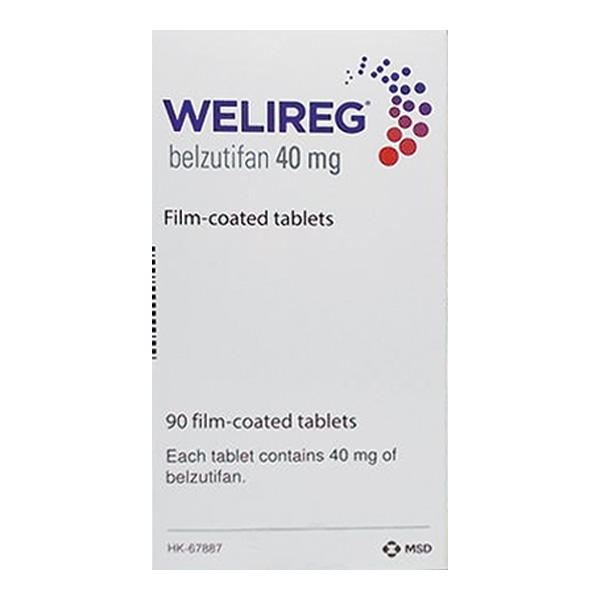
All Names: belzutifan、Welireg、贝组替凡、维利瑞
Indications:Adult patients with renal cell carcinoma, central nervous system hemangioblastoma, or pancreatic neuroendocrine tumors.
Manufacturer:Merck, USA
Customs Clearance Procedure:If the customs requires the package for customs clearance, please pay the customs clearance fee according to the content of EMS SMS and customs regulations.
Belzutifan is an oral small molecule hypoxia inducible factor-2 alpha (HIF-2 alpha) inhibitor that targets and inhibits the activity of HIF-2 alpha, blocking its interaction with HIF-1 β and reducing the transcriptional expression of downstream angiogenic, cell proliferation, and tumor growth related factors.
1、 Drug name
1. Product Name: Welireg ®
2. Common name: Belzutifan
3. Dosage form: Film coated tablets
2、 Indications
1. Used for the treatment of adult von Hippel Lindau (VHL) disease-related renal cell carcinoma, central nervous system hemangioblastoma, or pancreatic neuroendocrine tumors without the need for immediate surgery.
2. Used for the treatment of advanced renal cell carcinoma (clear cell component) in adults who have progressed after treatment with process specific death receptor-1 (PD-1) or programmed death ligand-1 (PD-L1) inhibitors and vascular endothelial growth factor tyrosine kinase inhibitors (VEGF-TKI).
3. Used for the treatment of locally advanced, unresectable, or metastatic pheochromocytoma or paraganglioma in children and adults aged 12 years and above.
3、 Specifications and characteristics
1. Specification: 40mg/tablet.
2. Appearance: Blue, oval shaped film coated tablets, with "177" engraved on one side and no lettering on the other side.
4、 Main components
Active ingredient: Belzutifan.
5、 Usage and dosage
1. Adults: 120mg, once daily, orally.
2. Children aged 12 and above:
Weight ≥ 40kg: 120mg, once daily.
Weight<40kg: 80mg, once daily.
3. Can be taken with food or on an empty stomach. Swallow the whole piece, do not chew, crush or divide.
4. Continue medication until disease progression or intolerable toxicity occurs.
6、 Dose adjustment
Adjust the dosage based on adverse reactions, as follows:
1. First dose reduction: 80mg, once daily.
2. Second dose reduction: 40mg, once daily.
3. Third dose reduction: permanent discontinuation of medication.
4. Anemia: If hemoglobin is less than 8g/dL or blood transfusion is required, the medication should be suspended until hemoglobin is ≥ 8g/dL, restored to the same or reduced level, and continued, or permanently discontinued.
5. Hypoxia: If there is hypoxia at rest, pause until it subsides and then reduce and restore; If life-threatening or recurrent symptomatic hypoxia occurs, permanently discontinue medication.
7、 Medication precautions
1. Dosage: Take at a fixed time every day, either with food or on an empty stomach.
2. Missing service handling: If missed, it can be replenished as soon as possible on the same day; The regular dose should be restored the next day and cannot be doubled for supplementation.
3. Vomiting treatment: If vomiting occurs after taking the medication, do not take it again and take the next dose at the regular time.
8、 Medication for special populations
1. Pregnant women: Based on animal research, this product can cause fetal damage. Prohibited during pregnancy. Women with fertility need to confirm their pregnancy status before treatment, and use effective non hormonal contraceptive measures during the treatment period and one week after the last dose.
2. Breastfeeding women: It is recommended to stop breastfeeding during the treatment period and within one week after the last dose.
3. Women and men with fertility: Effective contraceptive measures should be used during treatment and one week after the last dose. This product may damage fertility.
4. Children: Safety and efficacy have been established for children aged 12 and above in pheochromocytoma or paraganglioma; The use of children under 12 years old has not been established.
5. Elderly: In patients with advanced renal cell carcinoma, the proportion of dose interruption and reduction is higher in patients aged 65 and above; No overall differences were observed in other indications.
6. Renal dysfunction: No dose adjustment is required, but severe renal dysfunction patients need to strengthen adverse reaction monitoring.
7. Liver function impairment: Mild to moderate impairment does not require dose adjustment; Moderately impaired individuals have a 1.5-fold increase in drug exposure and need to strengthen monitoring; Severe damage has not been studied yet.
8. UGT2B17 and CYP2C19 dual weak metabolic types: significantly increased drug exposure, requiring close monitoring of adverse reactions.
9、 Adverse reactions
1. VHL disease (incidence ≥ 25%): decreased hemoglobin, fatigue, increased creatinine, headache, dizziness, elevated blood sugar, nausea.
2. Advanced renal cell carcinoma (incidence ≥ 25%): decreased hemoglobin, fatigue, musculoskeletal pain, increased creatinine, decreased lymphocytes, increased ALT, decreased sodium, increased potassium, and increased AST.
3. Pheochromocytoma or paraganglioma (incidence ≥ 25%): Anemia, fatigue, musculoskeletal pain, decreased lymphocytes, elevated ALT, elevated AST, elevated blood calcium, difficulty breathing, elevated blood potassium, decreased white blood cells, headache, elevated alkaline phosphatase, dizziness, nausea.
4. Serious adverse reactions: anemia (may require blood transfusion), hypoxia (may require aerobic therapy or hospitalization).
10、 Contraindications
None.
11、 Drug interactions
1. UGT2B17 or CYP2C19 inhibitors: can increase exposure to bevacizumab, anemia and hypoxia monitoring should be strengthened, and dosage should be reduced as recommended.
2. CYP3A4 substrate: Betamethasone can reduce the concentration of CYP3A4 substrate and avoid combination with sensitive CYP3A4 substrates; If unavoidable, increase the substrate dosage.
3. Hormonal contraceptive pills: Betamethasone can reduce its efficacy and may lead to contraceptive failure or breakthrough bleeding. It is recommended to use non hormonal contraceptive measures.
12、 Storage method
1. Storage temperature: 20 ° C to 25 ° C, allowing fluctuations between 15 ° C and 30 ° C.
2. Packaging: 90 tablets/bottle, including child safety bottle cap, with two packs of desiccant (not edible) inside.
13、 Manufacturer
Merck Sharp&Dohme LLC (Merck&Dohme, USA).
Belzutifaninformation