- All Drug Categories
- Home
- Anti-cancer Drugs
- Healthcare Products
- Medical Information
- Statement
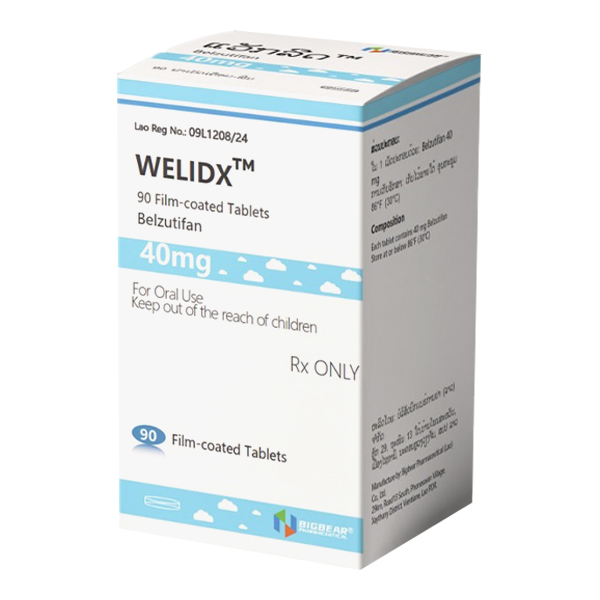
All Names: belzutifan、Welireg、贝组替凡、维利瑞
Indications:Adult patients with renal cell carcinoma, central nervous system hemangioblastoma, or pancreatic neuroendocrine tumors.
Manufacturer:Daxiong
Customs Clearance Procedure:If the customs requires the package for customs clearance, please pay the customs clearance fee according to the content of EMS SMS and customs regulations.
Belzutifan is an oral small molecule hypoxia inducible factor-2 alpha (HIF-2 alpha) inhibitor that targets and inhibits the activity of HIF-2 alpha, blocking its interaction with HIF-1 β and reducing the transcriptional expression of downstream angiogenic, cell proliferation, and tumor growth related factors.
1、 Drug name
1. Common name: Belzutifan
2. Product Name: WELIREG ™
2、 Indications
Used to treat adult von Hippel Lindau (VHL) disease patients who require treatment for related renal cell carcinoma (RCC), central nervous system (CNS) hemangioblastoma, or pancreatic neuroendocrine tumor (pNET) and do not require immediate surgery.
3、 Specifications and characteristics
Beizu Tifan tablets are 40mg oval shaped thin film coated tablets.
4、 Main components
1. Each tablet contains 40mg of Betamethasone.
2. Accessories include: cross-linked carboxymethyl cellulose sodium, hydroxypropyl methyl cellulose acetate succinate, magnesium stearate, mannitol, microcrystalline cellulose, and silica.
3. The film coating contains: FD&C Blue No.2 Aluminum Lake, Polyethylene Glycol, Polyvinyl Alcohol, Talc Powder, and Titanium Dioxide.
5、 Usage and dosage
1. The recommended dosage is 120mg orally once daily, which can be taken with food or on an empty stomach.
2. It should be swallowed whole and should not be chewed, crushed, or opened.
3. If one dose is missed, it can be taken as soon as possible on the same day and the next day according to the original plan, without the need for additional supplementation.
4. If vomiting occurs after taking the medication, there is no need to take it again. Follow the original plan to take the medication the next day.
6、 Dose adjustment
Adjust the dosage according to the severity of adverse reactions:
1. The first dose should be reduced to 80mg once daily, the second dose to 40mg once daily, and the third dose should be permanently discontinued.
2. Anemia (hemoglobin<9g/dL or requiring blood transfusion): Suspend medication until hemoglobin ≥ 9g/dL, reduce dosage or discontinue medication upon recovery.
3. Hypoxia (blood oxygen saturation<88% during exercise or<88% at rest): Suspend medication according to severity, reduce dosage or discontinue medication after recovery.
4. Other grade 3 adverse reactions: pause until recovery to ≤ grade 2 and reduce dosage; Grade 4 adverse reactions require permanent discontinuation of medication.
7、 Medication precautions
1. Medication time: Take medication at a fixed time every day, unaffected by food.
2. Swallowing requirements: Swallow the entire tablet without damaging its structure.
3. Omission treatment: Take the medication as soon as possible within the same day, and take the medication according to the original plan the next day.
4. Vomiting treatment: No need to take additional medication after vomiting, take the medication according to the original plan the next day.
5. Regular monitoring of hemoglobin and blood oxygen saturation is required before and during treatment.
6. Avoid co administration with UGT2B17 or CYP2C19 inhibitors as it may increase the risk of adverse reactions.
8、 Medication for special populations
1. Pregnant women: have embryonic fetal toxicity and require effective non hormonal contraceptive measures.
2. Breastfeeding women: Breastfeeding is prohibited during the treatment period and within one week after the last dose.
3. Children: Safety and efficacy have not yet been established.
4. Elderly people: Data is limited and should be used with caution.
5. Renal insufficiency: No dose adjustment is needed for mild to moderate cases, and there is insufficient data for severe cases.
6. Liver dysfunction: Mild cases do not require dose adjustment, data for moderate to severe cases is insufficient.
7. UGT2B17 and CYP2C19 slow metabolizers: increased exposure and need to be closely monitored for adverse reactions.
9、 Adverse reactions
1. Common adverse reactions (incidence ≥ 25%) include: decreased hemoglobin, anemia, fatigue, elevated creatinine, headache, dizziness, elevated blood sugar, and nausea.
2. Serious adverse reactions include: severe anemia (requiring blood transfusion), severe hypoxia (requiring oxygen therapy or hospitalization), allergic reactions, retinal detachment, and central retinal vein occlusion.
10、 Contraindications
There are no clear contraindications.
11、 Drug interactions
1. UGT2B17 or CYP2C19 inhibitors: may increase exposure to bevacizumab, anemia and hypoxia symptoms need to be monitored and dosage adjusted.
2. Sensitive CYP3A4 substrate: Betamethasone may reduce its concentration, leading to a decrease in efficacy, and should be avoided in combination or substrate dosage should be adjusted.
3. Hormonal contraceptive pills: may fail or cause breakthrough bleeding, non hormonal contraceptive measures should be used.
12、 Storage method
1. Store in an environment of 20 ° C to 25 ° C (68 ° F to 77 ° F), with short-term storage allowed at 15 ° C to 30 ° C (59 ° F to 86 ° F).
2. The medicine bottle contains a desiccant and is not edible.
Belzutifaninformation
No information yet!!!