- All Drug Categories
- Home
- Anti-cancer Drugs
- Healthcare Products
- Medical Information
- Statement
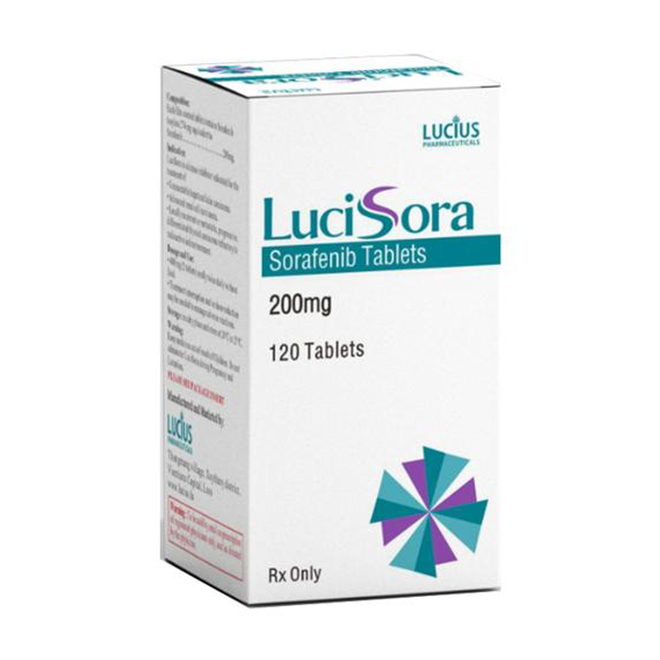
All Names: Sorafenib、Sorafenat、Soranib、Soranix、Nexavar、多吉美、索拉非尼
Indications:Patients with advanced renal cell carcinoma who cannot undergo surgery, patients with hepatocellular carcinoma who cannot undergo surgery or have distant metastasis, and patients with locally recurrent or metastatic progressive radioactive iodine resistant differentiated thyroid cancer.
Manufacturer:LUCIUS PHARMACEUTICAL (LAOS) CO., LTD
Customs Clearance Procedure:If the customs requires the package for customs clearance, please pay the customs clearance fee according to the content of EMS SMS and customs regulations.
In November 2007, sorafenib was approved by the FDA for unresectable hepatocellular carcinoma, and in November 2013, it was approved by the FDA for the treatment of metastatic differentiated thyroid cancer.
1、 Drug name
1. Common name: Sorafenib
2. Product Name: NEXAVAR
2、 Indications
1. Unresectable hepatocellular carcinoma (HCC).
2. Advanced renal cell carcinoma (RCC).
3. Localized recurrent or metastatic differentiated thyroid cancer (DTC) that is unresponsive to radioactive iodine therapy.
3、 Specifications and characteristics
200mg film coated tablets.
4、 Main components
Each tablet contains 200mg sorafenib.
5、 Usage and dosage
1. Recommended dosage: 400mg orally, twice daily (with an interval of about 12 hours), taken on an empty stomach (1 hour before or 2 hours after meals).
2. Continue medication until there is no clinical benefit or intolerable toxicity.
6、 Dose adjustment
1. First dose reduction: For HCC/RCC patients, reduce to 400mg once daily; DTC patients are adjusted to take 400mg in the morning and 200mg in the evening.
2. Secondary reduction: For HCC/RCC patients, reduce to 200mg once daily or 200mg twice daily; Reduce DTC patients to 200mg once daily.
3. Serious adverse reactions (such as cardiac ischemia, hypertension, bleeding, etc.) require permanent discontinuation of medication.
7、 Medication precautions
1. Medication time: It must be taken on an empty stomach to avoid food affecting absorption.
2. Missed dose: If missed, there is no need to take the next dose according to the original plan.
3. Vomiting: If vomiting occurs after taking medication, there is no need to take it again. Please take the planned dose next time.
4. Wound healing: Stop medication for at least 10 days before elective surgery, and resume medication at least 2 weeks after surgery and wound healing.
8、 Medication for special populations
1. Pregnant women: Prohibited, may cause fetal damage, effective contraception is required during medication and within 6 months after discontinuation.
2. Breastfeeding period: Breastfeeding is prohibited.
3. Children: Safety has not been established.
4. Elderly: No need to adjust dosage, but close monitoring of adverse reactions is necessary.
9、 Adverse reactions
1. Common (≥ 20%):
Diarrhea, fatigue, infection, hair loss, hand and foot skin reactions, rash, weight loss, decreased appetite, nausea, abdominal pain, hypertension, bleeding.
2. Serious adverse reactions:
Cardiovascular events (myocardial ischemia/infarction), bleeding, hypertensive crisis, gastrointestinal perforation, QT interval prolongation, liver injury, etc.
10、 Contraindications
1. Individuals with severe allergies to sorafenib or excipients.
2. Patients with squamous cell lung cancer are prohibited from using carboplatin/paclitaxel in combination.
11、 Drug interactions
1. Strong CYP3A4 inducers (such as rifampicin): Avoid combination therapy as it may reduce the efficacy of sorafenib.
2. Warfarin: increases bleeding risk, INR needs to be closely monitored.
3. QT prolongation medication: caution should be exercised when using it in combination, monitoring electrocardiogram and electrolytes.
12、 Storage method
Not explicitly stated, it is recommended to refer to the packaging label. Usually, it should be kept away from light, moisture, and stored at room temperature.
Sorafenibinformation