- All Drug Categories
- Home
- Anti-cancer Drugs
- Healthcare Products
- Medical Information
- Statement
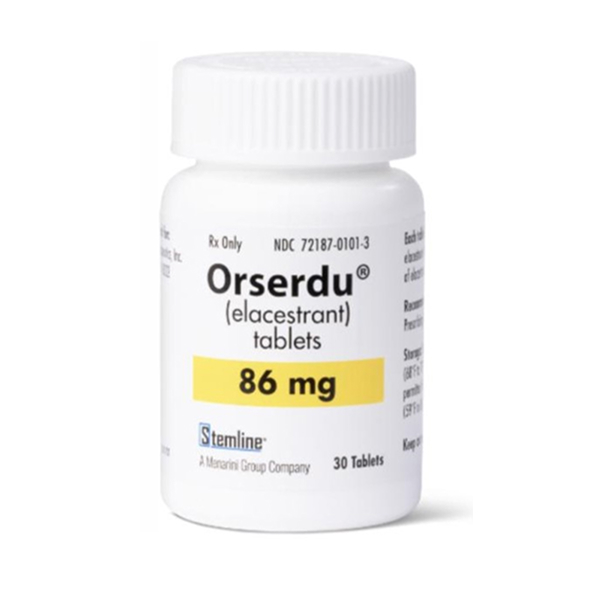
All Names: Orserdu、elacestrant、艾拉司群、依拉司群
Indications:It is applicable to postmenopausal women or adult men, and meets the following conditions: advanced or metastatic breast cancer with ER positive, HER2 negative, ESR1 mutation, and disease progression after at least one endocrine therapy.
Manufacturer:Stemline制药
Customs Clearance Procedure:If the customs requires the package for customs clearance, please pay the customs clearance fee according to the content of EMS SMS and customs regulations.
1、 Drug name
Elacestrant, product name: ORSERDU.
2、 Indications
It is used for postmenopausal women or adult men with ER positive, HER2 negative, ESR1 mutation and advanced or metastatic breast cancer who have disease progression after receiving at least first-line endocrine therapy.
3、 Specifications and characteristics
345mg tablets: light blue, oval shaped, film coated, double convex tablets, with "MH" printed on one side and blank on the other side.
86m g tablets: light blue, round, film coated, double convex tablets, with "ME" printed on one side and blank on the other side.
4、 Main components
The active ingredient is elacestrant (existing in the form of elacestranth hydrochloride). 345mg tablets contain 400mg of gelacestrand hydrochloride (approximately equivalent to 345mg of elacestrant free base); The 86mg tablet contains 100mg of gelacestrand hydrochloride (approximately equivalent to 86mg of elacestrant free base). Accessories include: colloidal silica, cross-linked polyvinylpyrrolidone, magnesium stearate (non bovine), microcrystalline cellulose, silicified microcrystalline cellulose, Opadry II Blue (containing polyvinyl alcohol, titanium dioxide, polyethylene glycol, etc.) FD&CBlue#1、 Talc powder).
5、 Usage and dosage
Recommended dose: 345mg, once daily, taken orally with meals until disease progression or intolerable toxicity occurs.
Take at approximately the same time every day.
Swallow the entire tablet, do not chew, crush, or pry open. Do not take pills that are damaged, broken, or have abnormal appearance.
6、 Dose adjustment
First dose reduction: 258mg (once daily, equivalent to three tablets of 86mg).
Second dose reduction: 172mg (once daily, two tablets of 86mg).
If further reduction below 172mg once daily is required, it will be permanently discontinued.
Grading treatment of adverse reactions:
Level 1: Continue with the current dosage.
Level 2: Consider suspending medication until it returns to ≤ Level 1 or baseline, and then continue with the original dose.
Level 3: Suspend medication until it returns to ≤ Level 1 or baseline, and then resume at the lower dose level below; If grade 3 toxicity recurs, reduce the dosage level by another level to restore.
7、 Medication precautions (before and after meals, missed doses, vomiting, etc.)
Taken with meals, it can alleviate nausea and vomiting.
If the missed dose exceeds 6 hours or vomiting occurs, skip the dose and take the next dose as scheduled the next day.
8、 Medication for special populations
Pregnant women: may cause harm to the fetus. Avoid using.
Breastfeeding women: It is not recommended to breastfeed during the treatment period and within one week after the last dose.
Women with fertility: Confirm pregnancy status before treatment and use effective contraceptive measures during treatment and within one week after the last dose.
Male (with female partners of childbearing age): Use effective contraceptive measures during treatment and within one week after the last dose.
Liver function impairment:
Mild (Child Pugh A): No dose adjustment required.
Moderate (Child Pugh B): The dose is reduced to 258mg once daily.
Severe (Child Pugh C): Avoid use.
Children: Safety and efficacy are uncertain.
Elderly individuals (≥ 65 years old): There is no overall difference compared to younger patients; Insufficient data on patients aged 75 and above.
9、 Adverse reactions
The most common (>10%) adverse reactions and laboratory abnormalities include: musculoskeletal pain, nausea, elevated cholesterol, elevated AST, elevated triglycerides, fatigue, decreased hemoglobin, vomiting, elevated ALT, decreased sodium, increased creatinine, decreased appetite, diarrhea, headache, constipation, abdominal pain, hot flashes, and indigestion.
Serious adverse reactions (>1%): musculoskeletal pain (1.7%), nausea (1.3%).
Lethal adverse reactions (1.7%): cardiac arrest, septic shock, diverticulitis, unknown cause.
Adverse reactions leading to permanent discontinuation of medication (>1%): musculoskeletal pain (1.7%), nausea (1.3%).
10、 Contraindications
None.
11、 Drug interactions
Strong/moderate CYP3A4 inducers: Avoid co administration (reduce exposure to Elastizumab, which may weaken efficacy).
Strong/moderate CYP3A4 inhibitors: Avoid co administration (increasing exposure to Elastizumab may increase the risk of adverse reactions).
P-gp substrate: If a small change in substrate concentration can cause serious or life-threatening adverse reactions, the dose of P-gp substrate should be reduced (Ailasetran inhibits P-gp).
BCRP substrate: If a small change in substrate concentration can cause serious or life-threatening adverse reactions, the dose of BCRP substrate should be reduced (Elastin inhibits BCRP).
12、 Storage method
Store at 20 ° C to 25 ° C (68 ° F to 77 ° F); Allow deviation between 15 ° C and 30 ° C (59 ° F and 86 ° F) (USP room temperature control).
30 tablets/bottle, with child safety bottle cap.
elacestrantinformation