- All Drug Categories
- Home
- Anti-cancer Drugs
- Healthcare Products
- Medical Information
- Statement
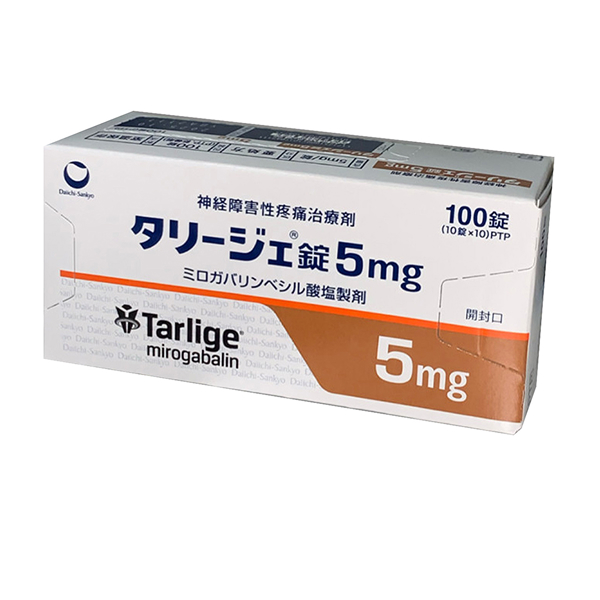
All Names: Tarlige、Mirogabalin、苯磺酸米洛沙巴林、美洛加巴林
Indications:Mainly used for neuropathic pain in adult patients.
Manufacturer:Daiichi Sankyo Company Limited,Japan
Customs Clearance Procedure:If the customs requires the package for customs clearance, please pay the customs clearance fee according to the content of EMS SMS and customs regulations.
Mirogabalin Besilane is a novel voltage-gated calcium channel α 2 δ -1 subunit ligand independently developed by Daiichi Sankyo, Japan. It is an optimized derivative of gabapentin drugs.
1、 Drug name
1. Common name: Mirogabalin Besilante
2. Product Name: Tarlige
2、 Indications
1. Neuropathic pain.
3、 Specifications and characteristics
1. Ordinary tablets (film coated):
5mg: Red white, oval shaped, with scratches.
4、 Main components
Active ingredient: Milosabalin benzenesulfonate.
5、 Usage and dosage
1. Routine starting: 5mg once, twice a day, orally.
2. Gradual method: Increase by 5mg at intervals of more than 1 week each time.
3. Maintenance dose: 15mg once, twice a day.
4. It can be adjusted within the range of 10mg to 15mg once and twice a day according to age and symptoms.
6、 Dose adjustment (for patients with renal insufficiency)
1. Mild (CLcr90~60mL/min): Total dose of 10-30mg per day, starting at 5mg twice a day, minimum effective dose of 10mg once a day twice a day, recommended once at 15mg twice a day.
2. Moderate (CLcr60~30mL/min): The total daily dose is 5-15mg, with a starting dose of 2.5mg twice a day and a minimum effective dose of 5mg once a day twice a day. It is recommended to take 7.5mg once a day twice a day.
3. Severe (including hemodialysis, CLcr<30mL/min): The total daily dose is 2.5-7.5mg, with an initial dose of 2.5mg once a day.
7、 Medication precautions
1. Dietary effects: Taking after meals can reduce Cmax by about 18%, delay Tmax by 0.5 hours, and decrease AUC by about 6%.
2. Omission handling: Not clearly stated, it is recommended to follow the principle of regular supplementation (skip if it is close to the next medication time).
3. After vomiting: unspecified.
4. Important reminder:
May cause dizziness, drowsiness, loss of consciousness, and dangerous operations such as driving are prohibited during medication.
Possible weight gain, regular monitoring is necessary.
To provide targeted treatment, it is necessary to also treat the underlying cause.
Sudden discontinuation of medication may lead to withdrawal symptoms such as insomnia, nausea, diarrhea, and decreased appetite, which should be gradually reduced.
Possible visual impairment (amblyopia, visual abnormalities, foggy vision, diplopia).
8、 Medication for special populations
1. Pregnant women: Use only when the benefits outweigh the risks (animal experiments have shown that it can pass through the placenta).
2. Breastfeeding period: After weighing the benefits, decide whether to breastfeed (animal experiments have shown that it can enter breast milk).
3. Children: No clinical trials have been conducted.
4. Elderly people: renal function often declines, dosage needs to be adjusted according to CLCr; Easy to cause falls and fractures due to dizziness, drowsiness, etc.
9、 Adverse reactions
1. Common (≥ 5%): drowsiness, floating dizziness.
2. More common (<5%): positional dizziness, insomnia, loss of consciousness, headache, tremor, sensory delay, foggy vision, diplopia, constipation, bloating, dry mouth, weight gain, edema, etc.
3. Serious (frequency unknown):
Dizziness, drowsiness, and loss of consciousness (can cause falls and fractures).
Liver function impairment (elevated AST and ALT).
Renal dysfunction.
10、 Contraindications
Patients with a history of allergies to any component of this medication.
11、 Drug interactions
1. Probenecid: May enhance the efficacy of this drug (inhibit OAT1, OAT3, and UGT).
2. Cimetidine: May enhance the efficacy of this drug (inhibit MATE1, MATE2-K).
3. Lorazepam and alcohol: may increase the risk of decreased attention and balance function.
4. Note: This drug does not inhibit or induce major CYP enzymes, nor does it inhibit transporters such as OCT1 and OATP1B1.
12、 Storage method
1. Store at room temperature.
2. Validity period: 3 years.
3. OD tablets should be moisture-proof after opening.
4. PTP packaging (including desiccant).
13、 Manufacturer
Daiichi Sankyo Co., Ltd.
Tarligeinformation