- All Drug Categories
- Home
- Anti-cancer Drugs
- Healthcare Products
- Medical Information
- Statement
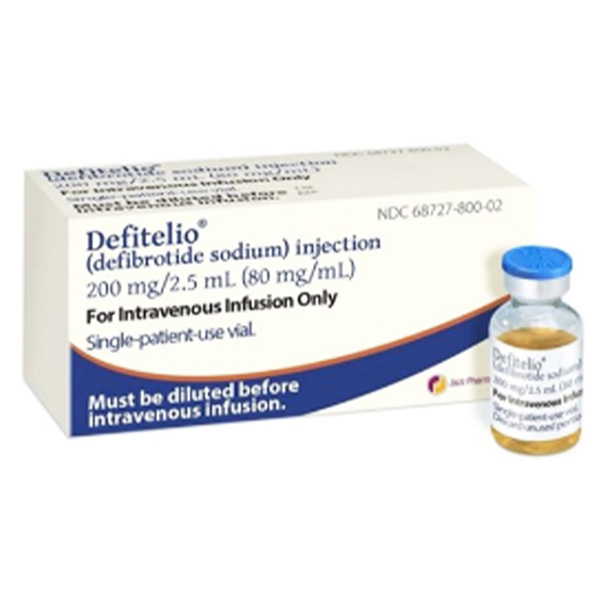
All Names: Defibrotide、Defitelio、defiteli、去纤苷、去纤维钠、去纤苷钠
Indications:Used for adult and pediatric patients (1 month to 72 years old), specifically for patients with hepatic vein occlusion disease (VOD/SOS) who have undergone hematopoietic stem cell transplantation (HSCT) and developed renal or pulmonary dysfunction.
Manufacturer:Jazz Pharmaceuticals
Customs Clearance Procedure:If the customs requires the package for customs clearance, please pay the customs clearance fee according to the content of EMS SMS and customs regulations.
Defitelio is a mixture of oligonucleotides for intravenous injection.
1、 Drug name
1. Defibrotide.
2. Product Name: DEFITELIO.
2、 Indications
Used to treat hepatic sinus obstruction syndrome with renal or pulmonary dysfunction after hematopoietic stem cell transplantation in adults and children.
3、 Specifications and characteristics
Injection: Each bottle of 2.5mL solution contains 200mg of sodium fibrinogen at a concentration of 80mg/mL. A sterile, preservative free solution that is clear, light yellow to brown in color.
4、 Main components
Active ingredient: Sodium Defibrillate (a mixture of oligonucleotides with pro fibrinolytic properties).
5、 Usage and dosage
1. Dosage: The recommended dosage for both adult and pediatric patients is 6.25mg/kg once every 6 hours.
2. Usage: It must be diluted and administered via intravenous infusion, with each infusion lasting for 2 hours.
3. Course of treatment: At least 21 days of treatment. If the symptoms do not improve after 21 days, treatment should continue until the symptoms improve, up to a maximum of 60 days.
4. Dose basis: The dose should be calculated based on the baseline body weight of the patient before receiving the hematopoietic stem cell transplantation pre-treatment plan.
6、 Dose adjustment
Adjust according to toxicity or invasive procedures:
1. Bleeding: In the event of persistent, severe, or potentially life-threatening bleeding, medication should be temporarily suspended; After the bleeding stops and the patient's hemodynamics stabilize, it may be considered to resume treatment with the same dose. If severe bleeding occurs repeatedly, the medication should be permanently discontinued.
2. Hypersensitivity reaction: In the event of a serious or life-threatening hypersensitivity reaction (such as anaphylactic shock), the medication should be permanently discontinued.
3. Invasive operation: Infusion should be stopped at least 2 hours before the planned operation. After the risk of bleeding related to the operation is relieved, medication should be resumed as soon as possible.
7、 Medication precautions
1. Confirmation before infusion: Before administration, it is necessary to confirm that the patient has no clinically significant bleeding and stable hemodynamics (up to one vasopressor drug can be used).
2. Dilution and infusion: It must be diluted to a final concentration of 4-20mg/mL in 5% glucose injection or 0.9% sodium chloride injection. An infusion set with a 0.2 micron online filter is required for infusion. Other drugs cannot be administered simultaneously through the same venous pathway.
3. Stability: The diluted solution can be stored for 4 hours at room temperature and for 24 hours under refrigeration.
4. Missed/delayed administration: Please follow the doctor's advice.
5. Vomiting: Please follow the doctor's advice.
8、 Medication for special populations
1. Pregnant women: There is currently no human data available. Animal experiments have shown embryonic fetal toxicity, which may increase the risk of miscarriage. Pregnant women should be informed of the potential risks.
2. Breastfeeding women: It is recommended to pause breastfeeding during treatment as medication may enter the breast milk and cause serious adverse reactions (such as bleeding) to the baby.
3. Children: Safety and effectiveness have been established.
4. Elderly: Limited clinical research data.
5. Renal insufficiency: Patients with severe renal insufficiency or end-stage renal disease have increased exposure, but studies have shown that it does not affect safety and tolerability.
9、 Adverse reactions
1. Serious adverse reactions:
Bleeding: The incidence of bleeding events of any type and grade is 59%, with alveolar bleeding being a common serious adverse reaction.
Hypersensitivity reactions: with an incidence rate of less than 2%, including rash, urticaria, angioedema, and rare anaphylactic shock.
2. Common adverse reactions (incidence ≥ 10%):
Hypotension (37%), diarrhea (24%), vomiting (18%), nausea (16%), and nosebleeds (14%).
10、 Contraindications
1. Used in conjunction with systemic anticoagulant or fibrinolytic therapy.
2. Known to be allergic to fibrinogen or any of its excipients.
11、 Drug interactions
1. Co administration with antithrombotic drugs or fibrinolytic drugs (such as heparin and alteplase) may increase the risk of bleeding, and simultaneous use is prohibited.
2. At therapeutic doses, no pharmacokinetic interactions are expected to occur.
12、 Storage method
Stored at 20 ° C to 25 ° C, short-term storage at 15 ° C to 30 ° C is allowed.
Defibrotideinformation