- All Drug Categories
- Home
- Anti-cancer Drugs
- Healthcare Products
- Medical Information
- Statement
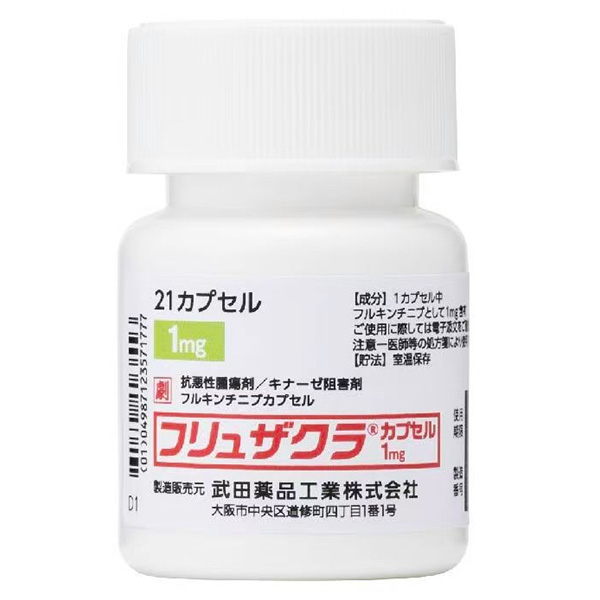
All Names: Fruzaqla、Fruquintinib、呋喹替尼、爱优特
Indications:Suitable for adult patients who have been diagnosed with metastatic colorectal cancer (mCRC) and have completed chemotherapy based on fluoropyrimidines, oxaliplatin, and irinotecan, as well as anti VEGF treatment; RAS wild-type and medically appropriate individuals have completed anti EGFR treatment.
Manufacturer:Takeda,Japan
Customs Clearance Procedure:If the customs requires the package for customs clearance, please pay the customs clearance fee according to the content of EMS SMS and customs regulations.
Fruquintinib is a novel, oral, and highly selective inhibitor of vascular endothelial growth factor receptor (VEGFR) tyrosine kinase.
1、 Drug name
1. Common name: Fruquintinib
2. Product Name: FRUZAQLA ®
2、 Indications
Used to treat adult metastatic colorectal cancer patients who have previously received fluoropyrimidine, oxaliplatin, and irinotecan chemotherapy, as well as anti vascular endothelial growth factor therapy, and if RAS wild-type or medically applicable, have received anti epidermal growth factor receptor therapy.
3、 Specifications and characteristics
Capsules are available in two sizes: 1mg and 5mg.
1. 1mg capsule: No. 3 hard gelatin capsule, yellow opaque cap, white opaque body, with "HM013" and "1mg" printed on the bottle body in black ink.
2. 5mg Capsule: Hard gelatin capsule No.1, red opaque cap, white opaque body, with "HM013" and "5mg" printed in black ink on the bottle body.
4、 Main components
1. Active ingredient: Fruquintinib.
2. Accessories (capsule contents): corn starch, microcrystalline cellulose, talc powder.
5、 Usage and dosage
1. Usage: Oral administration, once a day, whole pill swallowed.
2. Dosage: The recommended dosage is once daily, 5mg each time.
3. Medication cycle: Every 28 days is a treatment cycle, taking medication daily for 21 consecutive days, followed by a 7-day cessation of medication. Continue treatment until disease progression or intolerable toxicity occurs.
6、 Dose adjustment
To manage adverse reactions, dosage adjustments are necessary. The first dose should be reduced to 4mg per day; if it is still intolerable, the second dose should be reduced to 3mg per day. If it is still intolerable to 3mg per day, the medication will be permanently discontinued. The specific dosage adjustments for adverse reactions are as follows:
1. Hypertension: If grade 3 hypertension occurs and persists after optimal antihypertensive treatment, medication should be suspended. If there is complete remission or recovery to level 1, restart at a reduced dose level. If grade 4 hypertension occurs, the medication will be permanently discontinued.
2. Bleeding event: If a level 2 bleeding event occurs, medication should be temporarily discontinued until the bleeding completely subsides or returns to level 1, and then restarted at a reduced dose level. If a grade 3 or 4 bleeding event occurs, the medication will be permanently discontinued.
3. Hepatotoxicity: If alanine aminotransferase or aspartate aminotransferase is greater than 3 times the upper limit of normal, or bilirubin is greater than 1.5 times the upper limit of normal, medication should be suspended and monitored until it returns to level 1 or baseline level, and then resumed at a reduced dose level.
4. Proteinuria: If the 24-hour urine protein is ≥ 2 grams, medication should be temporarily discontinued until proteinuria completely subsides or<1 gram/24 hours, and then restarted at a reduced dose level. If nephrotic syndrome occurs or proteinuria does not recover to<1 gram/24 hours, the medication will be permanently discontinued.
7、 Medication precautions
1. Before/after meals: can be taken with food or on an empty stomach, approximately at the same time each day.
2. Omission: If missed and within 12 hours of regular medication, it can be immediately replenished. If it exceeds 12 hours, skip the dose and take the next dose at the regular time. Do not take twice the dose on the same day.
3. Vomiting: If vomiting occurs after taking medication, additional doses should not be taken. The next dose should be taken at the regular time.
4. Surgery: Patients planning major surgery should discontinue use of this product at least 2 weeks prior to surgery. Medication should not be administered at least 2 weeks after major surgery and until the wound has fully healed.
8、 Medication for special populations
1. Pregnant women: Based on animal data and mechanism of action, this product is harmful to the fetus. Pregnant women should be informed of potential risks to the fetus.
2. Breastfeeding women: It is recommended that women do not breastfeed during the treatment period and within 2 weeks after the last dose.
3. Women/Men with Fertility Potential: Women should undergo pregnancy testing before starting treatment. Women and men with female partners should take effective contraceptive measures during treatment and within 2 weeks after the last dose.
4. Elderly individuals: No overall differences were observed in safety and efficacy compared to younger patients.
5. Patients with liver dysfunction: Mild liver dysfunction patients do not need to adjust the dosage. There is insufficient research data on patients with moderate liver dysfunction. Not recommended for patients with severe liver dysfunction.
6. Children: The safety and efficacy of patients under 18 years old have not been established.
9、 Adverse reactions
1. The most common adverse reactions (incidence rate ≥ 20%) are hypertension, skin reactions on hands and feet, proteinuria, difficulty speaking, abdominal pain, diarrhea, and fatigue.
2. Serious adverse reactions/warnings:
Hypertension (can cause hypertensive crisis), bleeding events (can be fatal), increased risk of infection (including fatal infections), gastrointestinal perforation (can be fatal), hepatotoxicity (can be fatal), proteinuria, hand foot skin reactions, reversible posterior encephalopathy syndrome, wound healing disorders, arterial thromboembolism events, allergic reactions to FD&C Yellow 5 (Lemon Yellow) and Yellow 6 (Sunset Yellow FCF) (especially 1mg capsules), embryo fetal toxicity.
10、 Contraindications
None.
11、 Drug interactions
Strong or moderate CYP3A inducers (such as rifampicin) should be avoided in combination. Combination therapy can significantly reduce the blood concentration of fipronil, which may decrease its therapeutic effect.
12、 Storage method
1. Store at room temperature of 20 ° C to 25 ° C (68 ° F to 77 ° F), and allow for brief storage in an environment of 15 ° C to 30 ° C (59 ° F to 86 ° F).
2. Keep dry and away from moisture.
3. Keep out of reach of children.
Fruquintinibinformation