- All Drug Categories
- Home
- Anti-cancer Drugs
- Healthcare Products
- Medical Information
- Statement
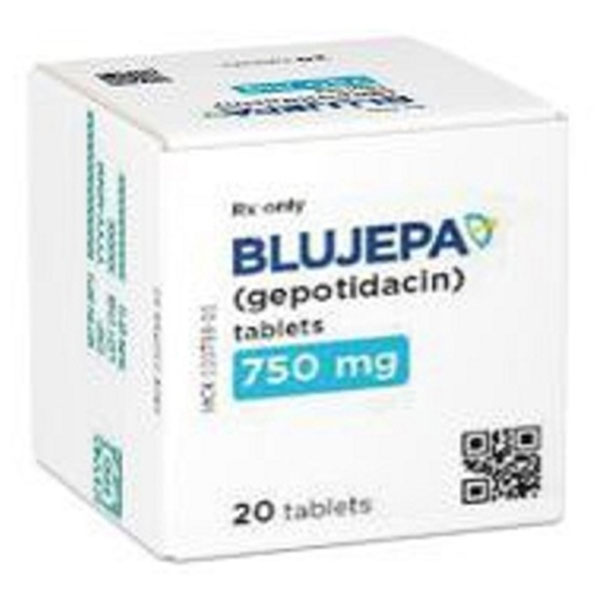
All Names: Blujepa、gepotidacin、吉泊达星
Indications:Suitable for female adult and pediatric patients aged 12 and above, weighing at least 40 kilograms (for the treatment of uncomplicated urinary tract infections), as well as adult and pediatric patients aged 12 and above, weighing at least 45 kilograms and with limited or no alternative treatment options (for the treatment of uncomplicated urogenital gonorrhea).
Manufacturer:GSK
Customs Clearance Procedure:If the customs requires the package for customs clearance, please pay the customs clearance fee according to the content of EMS SMS and customs regulations.
Blujepa is a type II topoisomerase inhibitor for triazene bacteria. It inhibits bacterial DNA gyrase (encoded by gyrA and gyrB genes) and topoisomerase IV (encoded by parC and parE genes), blocking bacterial DNA replication and exerting bactericidal effects.
1、 Drug name
1. Common name: Gepotidacin
2. Product Name: BLUJEPA
2、 Indications
Used to treat non complex urinary tract infections caused by the following sensitive microorganisms:
1. Escherichia coli, Klebsiella pneumoniae, Pseudomonas aeruginosa complex, Staphylococcus aureus, and Enterococcus faecalis.
2. Target audience: Female patients aged 12 and above, weighing at least 40 kilograms.
3、 Specifications and characteristics
1. Specification: Each tablet contains 750 milligrams of gemcitabine (equivalent to 910.7 milligrams of gemcitabine methanesulfonate).
2. Appearance: Yellow film coated tablets, capsule shaped, with "GSGU3" engraved on one side and flat on the other side.
4、 Main components
1. Active ingredient: Jiboda Star Methanesulfonate.
2. Accessories: colloidal silica, cross-linked carboxymethyl cellulose sodium, magnesium stearate, microcrystalline cellulose, polyethylene glycol, polyvinyl alcohol, talc powder, titanium dioxide, iron oxide yellow.
5、 Usage and dosage
1. Recommended dosage: 1500 milligrams per dose (i.e. 2 tablets of 750 milligrams), orally, twice daily (with an interval of about 12 hours), for 5 consecutive days.
2. Usage: Take after meals to reduce gastrointestinal discomfort.
6、 Dose adjustment (in cases where no adjustment is required)
1. Mild renal insufficiency (eGFR60-89mL/min) or moderate renal insufficiency (eGFR30-59mL/min) patients do not require dose adjustment.
2. Mild or moderate liver dysfunction (Child Pugh A/B grade) patients do not require dose adjustment.
7、 Medication precautions
1. After meals: It is recommended to take after meals to alleviate gastrointestinal reactions.
2. Omission treatment: If missed, it should be taken as soon as possible and not double the dosage.
3. Vomiting treatment: If vomiting occurs after taking medication, it is not recommended to take the next dose as planned.
8、 Medication for special populations
1. Renal insufficiency: It is contraindicated for patients with severe renal insufficiency (eGFR<30mL/min) or dialysis.
2. Liver dysfunction: It is contraindicated for patients with severe liver dysfunction (Child Pugh C grade).
3. Pregnant women: There is no medication data available for pregnant women, and it is recommended to avoid pregnancy during medication.
4. Breastfeeding women: Jibodacin may be secreted with breast milk, and the pros and cons should be weighed during medication.
5. Children: Only applicable to female patients aged 12 and above, weighing ≥ 40 kilograms.
6. Elderly: Patients aged 65 and above do not need to adjust their dosage, but their kidney function should be monitored.
9、 Adverse reactions
1. Common adverse reactions (≥ 1%): diarrhea, nausea, abdominal pain, bloating, headache, soft stool, dizziness, vomiting, vulvovaginal candidiasis.
2. Serious adverse reactions: QT interval prolongation, acetylcholinesterase inhibition (such as dysarthria), allergic reactions (including anaphylactic shock), and Clostridium difficile infection.
10、 Contraindications
Individuals with a history of severe allergies to Kepuda or any of its ingredients are prohibited from using this product.
11、 Drug interactions
1. Avoid co administration with potent CYP3A4 inhibitors (such as itraconazole) or potent CYP3A4 inducers (such as rifampicin).
2. Avoid co administration with drugs that are metabolized by CYP3A4 and have a narrow therapeutic window, such as quinidine and cyclosporine.
3. When used in combination with digoxin, it is recommended to monitor the blood concentration of digoxin.
4. Avoid co administration with drugs that may prolong the QT interval.
5. Caution should be exercised when using acetylcholinesterase inhibitors, anticholinergic drugs, or neuromuscular blockers in combination.
12、 Storage method
1. Stored in an environment of 20 ° C to 25 ° C (68 ° F to 77 ° F), short-term exposure to 15 ° C to 30 ° C (59 ° F to 86 ° F) is allowed.
2. Avoid light and moisture, and keep out of reach of children.
13、 Manufacturer
Manufacturer: GlaxoSmithKline
Blujepainformation