- All Drug Categories
- Home
- Anti-cancer Drugs
- Healthcare Products
- Medical Information
- Statement
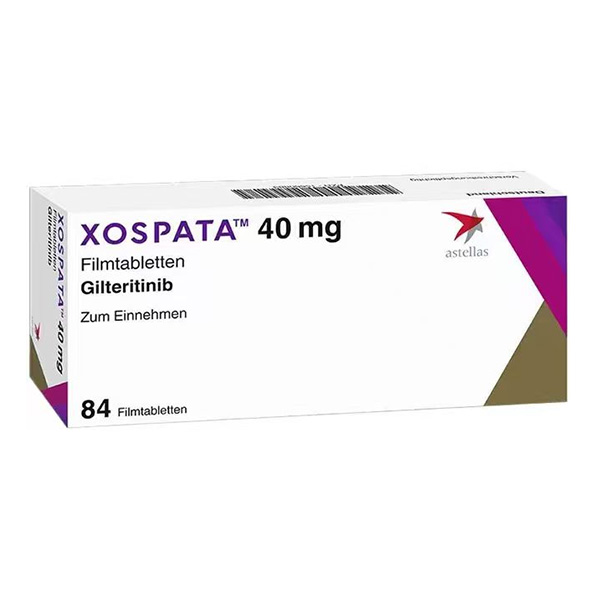
All Names: Xospata、Gilteritinib、吉瑞替尼、富马酸吉瑞替尼片、吉列替尼、适加坦
Indications:Suitable for patients with relapsed or refractory AML in adults (with no upper age limit and clear restrictions, including patients aged ≥ 75 in clinical studies) and confirmed by FDA approved testing to have FLT3 mutations; The safety and efficacy of pediatric patients have not yet been established.
Manufacturer:Astellai
Customs Clearance Procedure:If the customs requires the package for customs clearance, please pay the customs clearance fee according to the content of EMS SMS and customs regulations.
Gilteritinib is an oral small molecule tyrosine kinase inhibitor that exerts anti-tumor effects by selectively inhibiting the activity of FMS like tyrosine kinase 3 (FLT3).
1、 Drug name
1. Common name: Girotinib
2. Product Name: XOSPATA ®
3. English name: Gilteritinib
2、 Indications
Used to treat adult patients with relapsed or refractory acute myeloid leukemia (AML) confirmed to have FLT3 mutations through testing methods approved by the US Food and Drug Administration (FDA).
3、 Specifications and characteristics
1. Specification: Each tablet contains 40 milligrams of Girotinib (calculated as free base).
2. Appearance: A light yellow circular film coated piece with Astellas logo and "235" engraved on one side.
4、 Main components
1. Active ingredient: Girotinib fumarate salt.
2. Accessories: Iron oxide, hydroxypropyl cellulose, hydroxypropyl methylcellulose, low substituted hydroxypropyl cellulose, mannitol, magnesium stearate, polyethylene glycol, talcum powder, titanium dioxide.
5、 Usage and dosage
1. Recommended starting dose: once daily, 120mg each time (i.e. three 40mg tablets), can be taken with or without meals.
2. Usage: Swallow the whole tablet, do not break, crush or chew. It should be taken orally at approximately the same time every day.
3. Treatment recommendation: In the absence of disease progression or unacceptable toxicity, it is recommended to treat for at least 6 months to allow for clinical response time.
6、 Dose adjustment
1. General principle: Suspend administration or reduce dosage based on toxicity reactions. After reduction, it usually returns to 80 milligrams per day.
2. Differentiation syndrome: If suspected, immediately initiate systemic corticosteroid treatment and monitor hemodynamics. If severe signs/symptoms persist for more than 48 hours after starting corticosteroid treatment, gefitinib should be temporarily suspended until symptoms improve to grade 2 or below before resuming medication.
3. Reversible posterior encephalopathy syndrome: Once it occurs, permanent discontinuation of gefitinib is necessary.
4. QT interval prolongation: If QTcF>500 milliseconds, discontinue administration; After QTc returns to within 30 milliseconds of baseline or ≤ 480 milliseconds, resume medication with 80 milligrams per day. If QTc increases by more than 30 milliseconds on the 8th day of treatment, consider reducing it to 80 milligrams per day after confirmation.
5. Pancreatitis: Suspend medication when pancreatitis occurs, and resume medication at a daily dose of 80 milligrams after relief.
6. Other treatment-related toxicities ≥ grade 3: Suspend administration until toxicity is relieved or improved to grade 1, then resume medication at a daily dose of 80 milligrams.
7、 Medication precautions
1. Dietary impact: Taking it with a high-fat meal may slightly reduce drug exposure and delay peak time, but it does not have clinical significance, so it can be taken with food or on an empty stomach.
2. Omission treatment: If missed or not taken at the regular time, it should be taken as soon as possible on the same day, and it should be ensured that there is at least a 12 hour interval between the next scheduled administration time, and the normal medication time should be restored the next day. Do not take double the dose within 12 hours.
3. Vomiting after taking medication: not explicitly stated in the instructions. If vomiting occurs, it is recommended to contact a doctor to assess whether it is necessary to take additional medication, and self medication should not be taken.
8、 Medication for special populations
1. Pregnant women: Based on animal research and its mechanism of action, this product has potential risks to the fetus. It is recommended that women with fertility take effective contraceptive measures during treatment and within 6 months after the last dose; Male patients who have a female partner with fertility should take effective contraceptive measures during the treatment period and within 4 months after the last dose. It is recommended to conduct a pregnancy test on women with fertility before treatment.
2. Breastfeeding women: It is recommended not to breastfeed during the treatment period and within 2 months after the last dose.
3. Children: Safety and efficacy have not yet been established.
4. Elderly: No overall differences in efficacy or safety were observed between patients aged 65 and above and younger patients in clinical studies.
5. Patients with liver/kidney dysfunction: Mild or moderate liver/kidney dysfunction has no clinically significant impact on pharmacokinetics. The impact of severe liver/kidney dysfunction is unknown.
9、 Adverse reactions
1. Serious adverse reactions: including differentiation syndrome (fatal), reversible posterior encephalopathy syndrome, QT interval prolongation, pancreatitis.
2. Common adverse reactions: The most common (≥ 20%) adverse reactions include elevated transaminase levels, muscle/joint pain, fatigue/weakness, fever, mucositis, edema, rash, non infectious diarrhea, dyspnea, nausea, cough, constipation, eye disease, headache, dizziness, low blood pressure, vomiting, and renal dysfunction.
10、 Contraindications
Patients with a history of hypersensitivity reactions to gefitinib or any excipients are contraindicated.
11、 Drug interactions
1. Medications that should be avoided in combination: avoid using P-glycoprotein and potent CYP3A inducers in combination; Avoid combination therapy with drugs that act on 5HT2B receptors or non-specific receptors (such as escitalopram, fluoxetine, sertraline) unless necessary.
2. Medications that require caution when used in combination: Strong CYP3A inhibitors (such as itraconazole) can increase exposure to gefitinib, and alternative therapies should be chosen as much as possible. If combined use is necessary, more frequent monitoring of adverse reactions is required. When combined with P-glycoprotein, breast cancer resistant protein or organic cation transporter 1 substrate, it may increase the exposure and adverse reaction risk of these substrates, so it should be considered to reduce the substrate dose or adjust the administration frequency.
12、 Storage method
1. Store at room temperature of 20 ° C to 25 ° C (68 ° F to 77 ° F), and allow for brief storage between 15 ° C to 30 ° C (59 ° F to 86 ° F).
2. Keep in the original packaging container until distribution, avoiding light, moisture, and dampness.
Gilteritinibinformation