- All Drug Categories
- Home
- Anti-cancer Drugs
- Healthcare Products
- Medical Information
- Statement
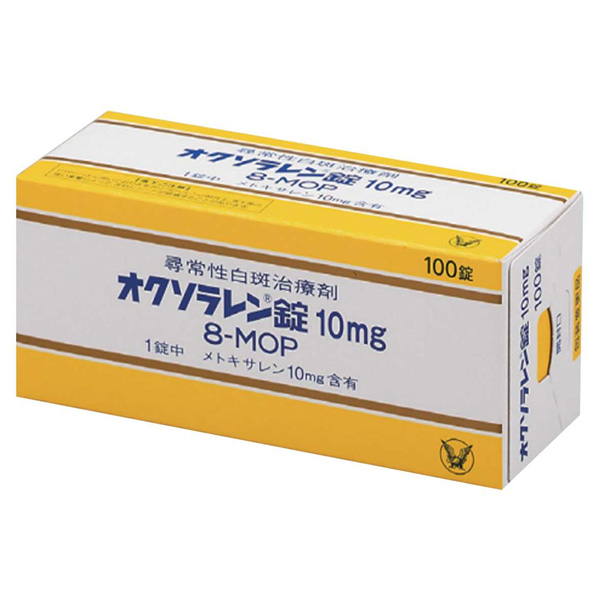
All Names: Methoxsalen、Oxoralen Tablets、甲氧沙林片
Indications:Patients diagnosed with vitiligo vulgaris and suitable for PUVA therapy. This includes adults, children aged 7-12 (subject to careful evaluation), and children under 6 years old (subject to strict evaluation). Not applicable to patients with contraindications.
Manufacturer:日本大正制药
Customs Clearance Procedure:If the customs requires the package for customs clearance, please pay the customs clearance fee according to the content of EMS SMS and customs regulations.
Oxoralen tablets are oral formulations of the photosensitizer Methoxsalen, mainly used in conjunction with long wave ultraviolet (UVA) irradiation for PUVA therapy to treat vitiligo vulgaris.
1、 Drug name and manufacturer
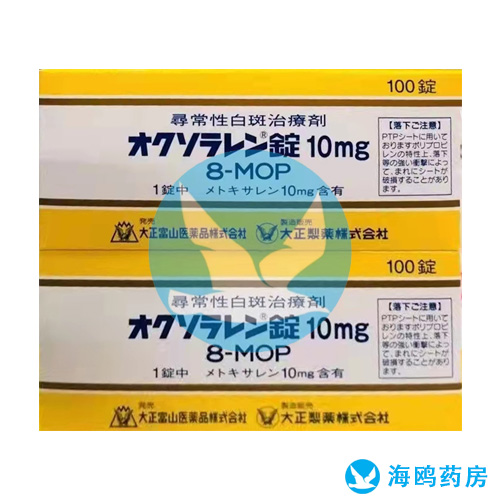
1. Drug name: Methoxsalen tablets, English name Methoxsalen, trade name Oxoralen.
2. Manufacturer: manufactured and sold by Taisho Pharmaceutical Co., Ltd.
2、 Indications
This product is mainly used to treat common vitiligo.
3、 Specifications and characteristics
1. Specification: Each tablet contains 10mg of methoxysarin.
2. Appearance: This product is a white sugar coated ingot. Its external dimensions are approximately 8 millimeters in diameter, 4.6 millimeters in thickness, and weigh approximately 240 milligrams. The tablet is printed with the identification code "T130".
4、 Main components
Active ingredient: Methoxsalen, also known as 8-methoxypsoralen.
5、 Usage and dosage
1. Conventional dosage:
Adults: usually take 2 tablets orally per day (equivalent to 20mg of methoxysarin).
Children aged 7 to 12: Take 1 to 2 tablets (10-20mg) orally daily.
Children under 6 years old: Take one tablet (10mg) orally daily.
It can be adjusted according to the symptoms.
2. Phototherapy combination:
After taking the medication orally for 2 hours, sunbathing or artificial ultraviolet irradiation should be performed.
It is recommended to use a black light source with a peak wavelength of approximately 360nm.
3. Initial exposure:
To prevent dermatitis, the first irradiation should start below the minimum erythema dose.
Sunbathing is recommended to start from 5 minutes; It is recommended to start artificial ultraviolet radiation at a distance of 20-30cm from the light source for 1 minute, and then adjust according to skin reactions.
6、 Medication precautions
1. Timing of administration and irradiation: It is necessary to strictly time for 2 hours after taking the medication before exposure to light.
2. Eye protection: When exposed to ultraviolet radiation, it is necessary to wear blackout glasses to prevent eye damage.
3. Normal skin protection: During irradiation, cover normal skin with black cloth or other materials to prevent the occurrence of phototoxic dermatitis.
4. Duration of photosensitivity: After taking medication, the skin's UV sensitivity can last for 6 to 8 hours, during which non therapeutic exposure to sunlight should be avoided.
5. Dose adjustment principle: The appropriate dose should be based on the appearance of mild and persistent pale pink erythema on the irradiated area the next day.
7、 Medication for special populations
1. Pregnant women: Use only when the benefits of treatment outweigh the risks. Animal experiments have shown that drugs can enter the fetus's body.
2. Breastfeeding women: It is necessary to weigh the pros and cons before deciding whether to breastfeed. Animal experiments have shown that drugs can enter breast milk.
3. Children: Systematic clinical trials have not yet been conducted for children, and medication should be taken with caution under the guidance of a doctor.
4. Elderly people: Physiological functions usually decline, and attention should be paid to adjusting treatment plans and closely observing medication.
5. Patients with liver function impairment: Prohibited for liver disease patients due to reports of worsening liver disease.
8、 Adverse reactions
1. Digestive system: May cause abdominal pain, nausea, loss of appetite, and discomfort in the stomach.
2. Skin reactions: may include flushing, swelling, blisters (usually caused by excessive dosage or exposure to light), itching, skin pain, pigmentation or loss.
2. The nervous system may experience dizziness, insomnia, depression, and headaches.
4. Other: Possible facial swelling, chest tightness, and liver dysfunction. Long term medication is recommended to have liver function checked once a month.
9、 Contraindications
1. Patients with or having a history of skin cancer.
2. Patients with photosensitive diseases such as porphyria, lupus erythematosus, pigmentary dry skin syndrome, and polymorphic solar rash.
3. Patients with liver disease.
10、 Drug interactions
1. Photosensitizer drugs: When used in combination with drugs known to cause photosensitivity such as tetracyclines, sulfonamides, and thiazide diuretics, it may enhance the photosensitivity response.
2. Foods containing furanocoumarin: Avoid consuming in large quantities with celery, lime, carrots, parsley, figs, mustard, and other foods to prevent increased photosensitivity.
3. CYP2A6 substrate drugs: This product can inhibit the hepatic enzyme CYP2A6, which may lead to an increase in blood concentration of drugs metabolized by this enzyme such as letrozole and pilocarpine, and enhance their effects.
4. Metabolic enzyme information: This product itself can be metabolized by enzymes such as CYP1A1, CYP1A2, CYP2A6, etc.
11、 Storage method
1. Storage conditions: It should be stored at room temperature.
2. Packaging usage: PTP packaging is used. Please remove the tablets from the aluminum foil plate before taking. Do not directly swallow the aluminum foil board to avoid sharp edges puncturing the esophageal mucosa and causing serious complications such as mediastinitis.
12、 Important Warning and Precautions
1. Carcinogenic risk: PUVA therapy has been reported to induce skin cancer, and the higher the accumulation of ultraviolet radiation, the greater the risk may be. Patients should be fully informed before treatment, avoid prolonged and arbitrary treatment during the treatment period, and closely observe the skin condition.
2. Overtreatment: If skin redness, swelling, or blisters are caused by excessive exposure or light, treatment should be stopped immediately. When treating again, it is necessary to reduce or decrease the light dose.
Oxoraleninformation