- All Drug Categories
- Home
- Anti-cancer Drugs
- Healthcare Products
- Medical Information
- Statement
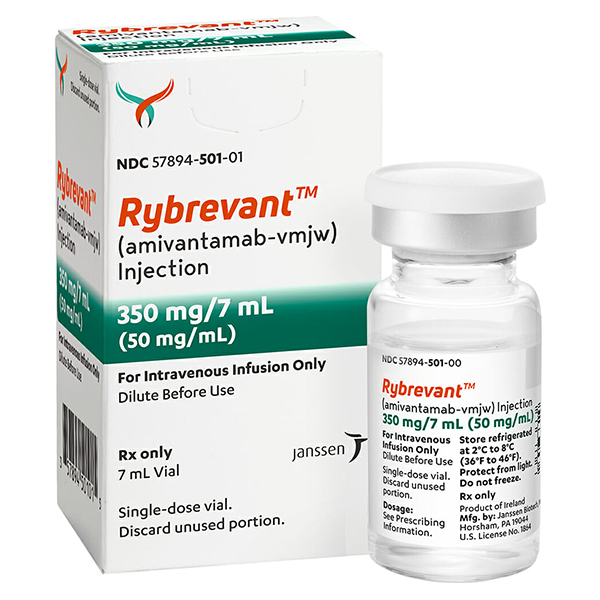
All Names: amivantamab,Rybrevant、埃万妥单抗
Indications:Adult patients with metastatic non-small cell lung cancer (NSCLC) who have experienced disease progression after failed platinum based chemotherapy and have insertion mutations in exon 20 of the epidermal growth factor receptor (EGFR) gene.
Manufacturer:Janssen Pharmaceuticals, USA
Customs Clearance Procedure:If the customs requires the package for customs clearance, please pay the customs clearance fee according to the content of EMS SMS and customs regulations.
Amivantamab is a bispecific antibody that targets epidermal growth factor receptor (EGFR) and mesenchymal transition factor (MET). It inhibits tumor cell proliferation and induces immune-mediated cytotoxicity by blocking ligand binding, promoting receptor degradation, and antibody dependent cytotoxicity (ADCC) mechanisms.
1、 Drug name
1. Common name: Evantazumab
2. English name: Amivantamab
3. Product Name: RYBREVANT ®
4. English alias: amivantamab vmjw
2、 Indications
Evantomab is a bispecific (targeting EGFR and MET receptors) antibody suitable for the treatment of locally advanced or metastatic non-small cell lung cancer (NSCLC) in adult patients, with specific indications as follows:
1. The combination of lazertinib is used for first-line treatment of patients confirmed by FDA approved testing methods to have EGFR exon 19 deletion or exon 21L858R substitution mutation.
2. Combination therapy of carboplatin and pemetrexed is used to treat patients with disease progression after treatment with EGFR tyrosine kinase inhibitors, who carry EGFR exon 19 deletion or exon 21L858R substitution mutation.
3. The combination of carboplatin and pemetrexed is used for first-line treatment of patients confirmed by FDA approved testing methods to have EGFR exon 20 insertion mutations.
4. Monotherapy is used to treat patients confirmed by FDA approved testing methods to have EGFR exon 20 insertion mutations and disease progression after receiving platinum based chemotherapy.
3、 Specifications and characteristics
1. Specification: Each 7mL injection bottle contains 350mg of bevacizumab (concentration 50mg/mL).
2. Appearance: Aseptic, preservative free, colorless to pale yellow solution.
4、 Main components
Active ingredient: amivantamab vmjw.
5、 Usage and dosage
1. Administration route: intravenous infusion, using an infusion device equipped with a flow regulator and an online sterile, pyrogen free, low protein bound polyether sulfone filter (pore size 0.2 microns).
2. Dose based on baseline weight:
(1) Combination therapy with razetinib or monotherapy: The recommended dose for individuals with a body weight<80kg is 1050mg; for those with a body weight ≥ 80kg, it is 1400mg. The infusion should be given on the first and second days of the first week, once a week from the second to the fifth week, and not given in the sixth week. Starting from the seventh week, it should be given every two weeks.
(2) Combination of carboplatin and pemetrexed: The recommended dose for individuals with a body weight<80kg is 1400mg; for those with a body weight ≥ 80kg, it is 1750mg. The infusion should be given twice a day on the first and second day of the first week, once a week from the second to the fourth week, and not given in the fifth to sixth weeks. Starting from the seventh week, the dose should be given every three weeks.
(3) Infusion rate: Inject according to the prescribed rate in the instructions based on body weight and treatment duration. The initial infusion rate is slow, but if there are no infusion related reactions, it can be increased after 2 hours.
(4) Duration of treatment: Continue medication until disease progression or intolerable toxicity occurs.
6、 Dose adjustment
1. Dose reduction level: Adjust the dose according to the severity of adverse reactions.
2. Principle of adverse reaction dose adjustment:
(1) Infusion related reactions (IRR): Discontinue infusion, reduce infusion rate, or permanently discontinue medication based on grading.
(2) Interstitial lung disease (ILD)/pneumonia: If suspected, medication will be temporarily suspended; if diagnosed, medication will be permanently discontinued.
(3) Venous thromboembolic events (VTE, only in combination with razetinib): Discontinue combination therapy based on grading, consider restoring the original dose after initiating anticoagulant therapy, and discontinue bevacizumab if recurrence occurs.
(4) Skin adverse reactions: Suspend, reduce or permanently discontinue medication based on severity, and provide supportive treatment.
(5) Other grade ≥ 3 adverse reactions: Suspend medication until recovery, and decide whether to restore the original dose, reduce dosage, or permanently stop medication based on the recovery time.
7、 Medication precautions
1. Medication before infusion: To reduce the risk of infusion related reactions, antihistamines, antipyretics, and corticosteroids should be used for pre-treatment before each infusion.
2. Infusion route: It is recommended to use peripheral intravenous infusion in the first and second weeks to reduce the risk of IRR, followed by central venous infusion.
3. Skin care: To reduce adverse skin reactions, oral antibiotics (such as doxycycline) should be taken for the first 12 weeks during treatment, followed by the use of antibiotic washes to care for the scalp for the next 9 months; Apply non acne moisturizing cream daily to the face and whole body (excluding scalp); Wash hands and feet daily with 4% chlorhexidine solution; Limit sun exposure and use sunscreen.
4. Combination therapy sequence:
(1) Combined with Lazetanib: After oral administration of Lazetanib, it can be infused with bevacizumab at any time.
(2) Combination of carboplatin and pemetrexed: administration sequence is pemetrexed → carboplatin → bevacizumab.
(3) If you miss the appointment for infusion, please contact medical staff as soon as possible to reschedule.
(4) Vomiting: If vomiting occurs after medication, there is no need to take additional medication. Follow the original plan for the next dose.
8、 Medication for special populations
1. Pregnant women: Due to the potential harm to the fetus caused by the mechanism of action, the pregnancy status should be verified before medication. Effective contraception should be taken during the treatment period and within 3 months after the last dose.
2. Breastfeeding period: It is recommended not to breastfeed during the treatment period and within 3 months after the last dose.
3. Children: Safety and effectiveness have not yet been established.
4. Elderly patients: There was no clinically significant safety difference observed between patients aged 65 years or older and younger patients.
5. Liver and kidney dysfunction: Patients with mild to moderate liver injury or mild to moderate renal dysfunction do not require dose adjustment; There is a lack of data on patients with severe renal insufficiency or moderate to severe liver injury.
9、 Adverse reactions
1. Common adverse reactions (≥ 20%):
(1) Combined with razetinib: rash, paronychia, infusion related reactions, edema, musculoskeletal pain, stomatitis, venous thromboembolism, sensory abnormalities, fatigue, diarrhea, constipation COVID-19、 Dry skin, bleeding, decreased appetite, itching, and nausea.
(2) Combination of carboplatin and pemetrexed: rash, paronychia, infusion related reactions, fatigue, nausea, stomatitis, constipation, edema, decreased appetite, musculoskeletal pain, vomiting COVID-19。
(3) Single drug treatment: rash, infusion related reactions, paronychia, musculoskeletal pain, dyspnea, nausea, fatigue, edema, stomatitis, cough, constipation, vomiting.
2. Serious adverse reactions:
Infusion related reactions (including allergic reactions), interstitial lung disease/pneumonia, venous thromboembolic events, severe skin reactions (including toxic epidermal necrolysis), ocular toxicity.
10、 Contraindications
There are no known contraindications.
11、 Drug interactions
Attention should be paid to increasing the risk of venous thromboembolism when combined with razetinib, and anticoagulation prevention is recommended for the first 4 months.
12、 Storage method
Store in original packaging, avoid light, and refrigerate at 2 ° C to 8 ° C (36 ° F to 46 ° F). Cannot be frozen.
13、 Manufacturer
Manufacturer: Janssen Biotech, Inc. (USA)
amivantamainformation