- All Drug Categories
- Home
- Anti-cancer Drugs
- Healthcare Products
- Medical Information
- Statement
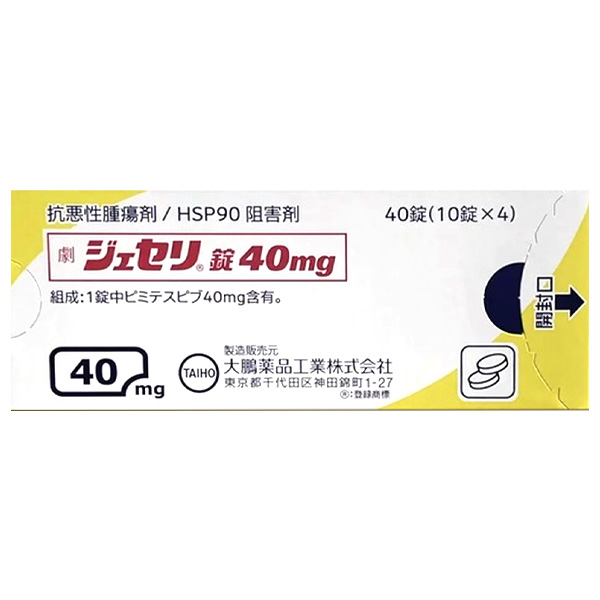
All Names: Pimitespib、Jeselhy、匹米替比
Indications:Suitable for adult patients with unresectable or metastatic gastrointestinal stromal tumors who have progressed after previous treatment with imatinib, sunitinib, and regorafenib.
Manufacturer:TAIHO,Japan
Customs Clearance Procedure:If the customs requires the package for customs clearance, please pay the customs clearance fee according to the content of EMS SMS and customs regulations.
Pimitesib is a drug used to treat gastrointestinal stromal tumors (GISTs) that progress after cancer chemotherapy. It exerts its anti-tumor effects by inhibiting the function of HSP90, reducing the expression levels of tumor associated proteins, and inducing cell apoptosis through various mechanisms.
1、 Drug name
1. Pimitesib
2. Product Name: Jeselly Tablets
3. Common name: Vimitenib
2、 Indications
Used for gastrointestinal stromal tumors that have progressed after previous treatment with imatinib, sunitinib, and regorafenib.
3、 Specifications and characteristics
This product is a white film coated tablet, with a specification of 40mg of Vimitinib per tablet.
4、 Main components
Active ingredient: Vimitenib 40mg/tablet.
5、 Usage and dosage
1. Dosage: The recommended dosage for adults is 160mg once daily (i.e. 4 40mg tablets).
2. Usage: Must be taken on an empty stomach. Adopting a periodic dosing regimen of "taking medication for 5 days, stopping medication for 2 days", that is, taking oral medication continuously for 5 days and resting for 2 days, and then repeating this cycle.
3. Usage: Swallow the whole tablet. The tablet should be taken from the PTP packaging board to avoid swallowing the PTP board and causing esophageal damage.
6、 Dose adjustment
1. Reduce dosage based on patient condition and severity of side effects.
2. The standard reduction steps are: the first level is reduced to 120mg per day, the second level is reduced to 80mg per day, and the third level is reduced to 40mg per day.
3. The specific reduction should be carried out according to the severity of adverse reactions (such as diarrhea, eye disorders, etc.) (graded according to NCI-CTCAE standards) and in accordance with medical advice.
7、 Medication precautions
1. Timing of administration: It must be taken on an empty stomach. To avoid the influence of food (which can significantly increase blood drug concentration), it should be taken 1 hour before or 2 hours after meals.
2. Leakage treatment: It is recommended to consult a doctor.
3. Vomiting treatment: It is recommended to consult a doctor.
4. Other: During the treatment period, it is necessary to regularly monitor the patient's condition, paying special attention to diarrhea and eye symptoms. Measures such as suspending medication, reducing dosage, or permanently stopping medication should be taken based on the severity of side effects.
8、 Medication for special populations
1. Pregnant women: Use only when the benefits of treatment outweigh the potential risks. Animal experiments have shown embryonic fetal toxicity.
2. Breastfeeding women: It is recommended to stop breastfeeding as medication may enter breast milk and cause serious side effects to the baby.
3. Children: Safety and efficacy have not yet been established.
4. Patients with liver dysfunction: mainly metabolized by the liver. Patients with moderate to severe liver dysfunction may have elevated blood drug concentrations and should be used with caution.
5. Reproductive possibility: May affect reproductive function. Women with fertility must take effective contraceptive measures during treatment and within 7 months after the last dose, and men must take effective contraceptive measures during treatment and within 4 months after the last dose.
9、 Adverse reactions
1. Serious adverse reactions:
(1) Severe diarrhea: incidence rate of 16.0%, may lead to dehydration and severe kidney damage.
(2) Eye disorders: including night blindness (12.0%), foggy vision, visual impairment, retinal vein occlusion, retinal lesions, acquired color vision abnormalities, etc.
(3) Bleeding: such as intra-abdominal bleeding, hemorrhagic duodenal ulcer, etc.
2. Common adverse reactions (incidence ≥ 10%):
(1) Diarrhea (72.0%), decreased appetite (29.3%), elevated serum creatinine (28.0%), fatigue (26.7%), and nausea (25.3%).
(2) Other conditions include: difficulty speaking, anemia, taste disorders, elevated ALT/AST, pneumonia, renal impairment, vomiting, rash, etc.
10、 Contraindications
Patients with a history of allergies to any of the ingredients in this product are prohibited from using it.
11、 Drug interactions
1. This product is an inhibitor of CYP3A enzyme, MATE1, and MATE2-K transporter proteins.
2. Co administration with CYP3A substrate drugs (such as midazolam, alprazolam, atorvastatin, etc.): may increase the blood concentration of these drugs, enhance their side effects, and require close monitoring.
3. Co administration with MATE1/MATE2-K substrate drugs (such as metformin, irikanide, procainamide, etc.): may increase the blood drug concentration of these drugs, enhance their side effects, and require close monitoring.
12、 Storage method
Generally, it should be stored in a dry place at room temperature and kept out of reach of children.
13、 Manufacturer
1. Manufacturer and seller: Dapeng Pharmaceutical Industry Co., Ltd.
2. Address: 1-27 Kanda Jinchu, Chiyoda ku, Tokyo, Japan.
Pimitespibinformation