- All Drug Categories
- Home
- Anti-cancer Drugs
- Healthcare Products
- Medical Information
- Statement
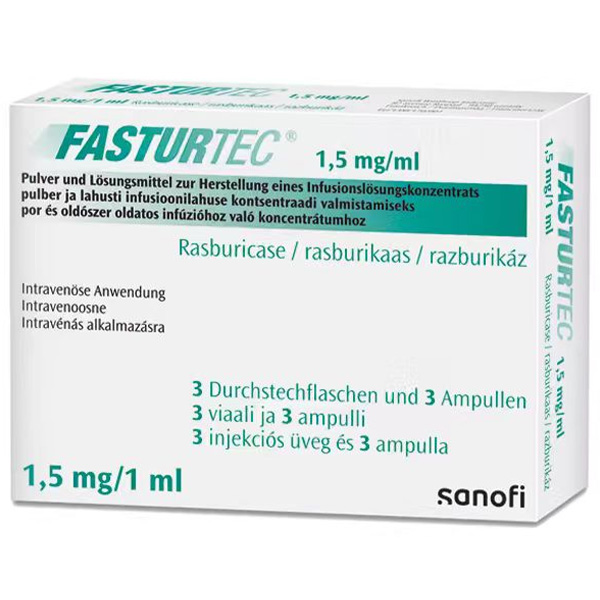
All Names: fasturtec、Elitek、Rasburicase、拉布立酶
Indications:Suitable for children (1 month to 17 years old) and adult patients with leukemia, lymphoma, and solid tumor malignancy who are undergoing anti-cancer treatment and are expected to experience tumor lysis syndrome leading to elevated blood uric acid levels.
Manufacturer:Sanofi,France
Customs Clearance Procedure:If the customs requires the package for customs clearance, please pay the customs clearance fee according to the content of EMS SMS and customs regulations.
Labridase is a recombinant uric acid oxidase that rapidly reduces plasma uric acid levels by catalyzing the oxidation of uric acid to the more soluble metabolite allopurinol.
1、 Drug name
1. Common name: Rasburicase
2. Product Name: Elitek
2、 Indications
1. Used for initial management of plasma uric acid levels in children and adult patients with leukemia, lymphoma, and solid tumor malignancies who are undergoing anti-cancer therapy expected to cause tumor lysis and elevated plasma uric acid levels.
2. Usage restriction: Limited to one course of treatment.
3、 Specifications and characteristics
1. Specification: Freeze dried powder for injection, available in two specifications.
2. Each bottle contains 1.5 milligrams of Rabelase and comes with 1 milliliter of diluent.
3. Appearance: White to off white freeze-dried powder, dissolved to a clear solution.
4、 Main components
Active ingredient: Recombinant Rabelase.
5、 Usage and dosage
1. Usage: For intravenous infusion only, intravenous push injection is prohibited.
2. Dosage: The recommended dosage is 0.2 milligrams per kilogram of body weight once daily.
3. Course of treatment: Continuous intravenous infusion for 30 minutes, up to a maximum of 5 days of continuous administration. It is not recommended to exceed 5 days or use multiple treatment courses.
6、 Dose adjustment
1. Regular adjustment is not required, and the fixed dose is calculated based on body weight.
2. Currently, it is not recommended to adjust based on kidney or liver function.
7、 Medication precautions
1. Medication method: The accompanying diluent must be used to dissolve the freeze-dried powder. Dilute the calculated dosage with 0.9% sodium chloride injection to a total volume of 50 milliliters, and administer intravenously for 30 minutes. It is recommended to use a separate infusion line or flush the line with at least 15 milliliters of physiological saline before and after infusion. Prohibit the use of filters.
2. Before and after meals: not affected by diet, unrelated to eating.
3. Missed administration: This medication is administered intravenously for a short period of time within the hospital, and there is usually no case of missed administration in patients. If you miss the scheduled infusion time for any reason, you should contact medical personnel as soon as possible to evaluate the replacement plan.
4. Vomiting: If vomiting occurs during or after infusion, the main symptom should be treated. Vomiting is a common adverse reaction of this medication, which usually does not affect subsequent administration, but it is necessary to ensure the patient's fluid and electrolyte balance.
5. Blood sample processing (crucial): Drugs can degrade uric acid in blood samples at room temperature, resulting in false low test values. Blood samples must be collected using pre cooled blood collection tubes containing heparin. Immediately after collection, the plasma sample should be immersed in an ice water bath and uric acid measurement should be completed within 4 hours.
8、 Medication for special populations
1. Pregnant women: May cause harm to the fetus, only use when potential benefits outweigh risks.
2. Breastfeeding women: It is not recommended to breastfeed during treatment and for at least 2 weeks after the last dose.
3. Children (1 month to 17 years old): Safety and efficacy have been established. The proportion of children under 2 years old who reach normal uric acid levels may be slightly lower than older children.
4. Elderly patients (≥ 65 years old): No overall differences in pharmacokinetics, safety, or efficacy were observed compared to younger patients.
5. High risk population for G6PD deficiency: For high-risk populations such as African Americans and Mediterranean Americans, screening for glucose-6-phosphate dehydrogenase (G6PD) deficiency should be conducted before starting treatment.
9、 Adverse reactions
1. Common adverse reactions (incidence ≥ 20%): vomiting, nausea, fever, peripheral edema, anxiety, headache, abdominal pain, constipation, diarrhea, hypophosphatemia, sore throat, elevated alanine aminotransferase.
2. Serious adverse reactions:
The incidence of hypersensitivity reactions (including anaphylactic shock) is less than 1%.
Hemolysis (prohibited for G6PD deficiency patients), with an incidence rate of<1%.
The incidence of methemoglobinemia is less than 1%.
Other reported adverse reactions include rash, oral mucositis, seizures, etc.
10、 Contraindications
1. Patients with a history of allergies to Rabelain, especially those with anaphylactic shock or severe hypersensitivity reactions.
2. Patients who have experienced hemolytic reactions or methemoglobinemia after previous use of Rabelase.
3. Patients with glucose-6-phosphate dehydrogenase (G6PD) deficiency.
11、 Drug interactions
1. There is currently no known clinically significant drug interaction mediated by cytochrome P450.
2. The main interaction is laboratory testing interference (such as the "blood sample processing" section mentioned earlier), which may lead to a false decrease in uric acid test results and interfere with clinical judgment.
12、 Storage method
1. Unopened freeze-dried powder and diluent should be stored refrigerated at 2 ° C-8 ° C.
2. Do not freeze.
3. Store away from light.
4. Dissolved or diluted drugs can be stored at 2 ° C-8 ° C, but must be used within 24 hours after preparation.
fasturtecinformation