- All Drug Categories
- Home
- Anti-cancer Drugs
- Healthcare Products
- Medical Information
- Statement
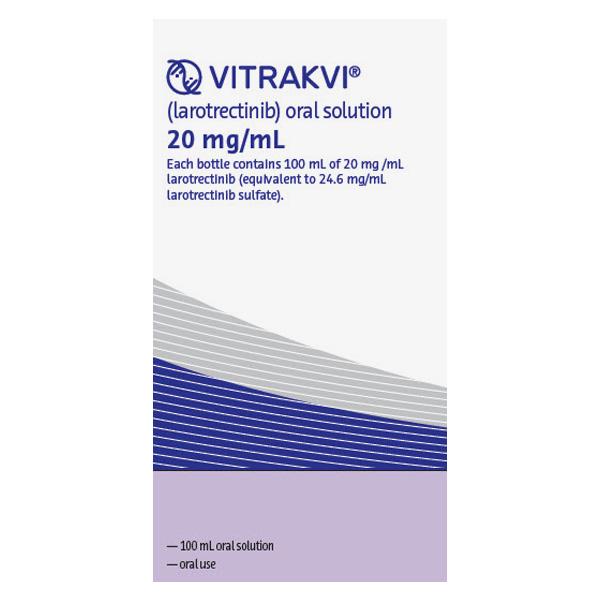
All Names: Vitrakvi、larotrectinib、拉罗替尼口服液
Indications:Adult cancer patients who carry fusion of the neurotrophin receptor tyrosine kinase (NTRK) gene and have no known acquired resistance mutations, metastasis, or surgical resection that may lead to severe disease and unsatisfactory alternative treatment or post-treatment progression.
Manufacturer:Bayer heathcare AG, Germany
Customs Clearance Procedure:If the customs requires the package for customs clearance, please pay the customs clearance fee according to the content of EMS SMS and customs regulations.
Larotrectinib is a highly selective tyrosine kinase inhibitor that inhibits tumor cell proliferation and survival by targeting the activity of TRKA, TRKB, and TRKC proteins produced by the fusion of neurotrophic tyrosine receptor kinase (NTRK) genes, blocking their downstream signaling pathways.
1、 Drug name
1. Product Name: VITRAKVI
2. Common name: Larotrectinib Oral Solution
2、 Indications
This product is suitable for treating solid tumor patients in adults and children, whose tumors:
1. Has neurotrophin receptor tyrosine kinase (NTRK) gene fusion and no known acquired resistance mutations.
2. For metastatic or surgical resection, it may lead to serious complications.
3. There is no satisfactory alternative treatment plan or progression after treatment.
4. The selection of patients for treatment should be based on FDA approved testing methods.
3、 Specifications and characteristics
1. Specification: 20mg/mL.
2. Appearance: Packaged in 100mL single bottle: Clear yellow to orange solution.
4、 Main components
Active ingredient: larotrectinib
5、 Usage and dosage
1. Patient selection: Select patients based on the presence of NTRK gene fusion in tumor specimens.
2. Recommended dosage:
Adult and pediatric patients with body surface area (BSA) ≥ 1 square meter: The recommended dose is 100mg, twice daily, orally.
Children with body surface area (BSA)<1 square meter: The recommended dose is 100mg/m ², taken orally twice daily.
Usage: Can be taken with food or on an empty stomach.
Duration of treatment: Continue treatment until disease progression or unacceptable toxicity occurs.
6、 Dose adjustment
1. Dose adjustment for adverse reactions:
For grade 3 or 4 adverse reactions: Suspend medication until the adverse reaction subsides to baseline or grade 1. If relieved within 4 weeks, resume medication at the reduced dose. If the condition does not improve within 4 weeks, the medication will be permanently discontinued.
Dose reduction plan: gradually reduce the dose according to different body surface areas (for example, for patients with BSA ≥ 1m ²: reduce to 75mg twice a day for the first time; Reduce the dosage to 50mg twice a day for the second time; Reduce the dosage to 100mg once daily for the third time. Patients who cannot tolerate the dose after three dose reductions should permanently discontinue the medication.
2. Dose adjustment for hepatotoxicity:
AST or ALT ≥ 5 times the upper limit of normal (ULN) and bilirubin ≤ 2 times ULN: Suspend medication until it returns to ≤ level 1 or baseline, and resume medication at a reduced dose. If there is a recurrence of grade 4 AST and/or ALT elevation after resuming medication, the medication will be permanently discontinued.
AST or ALT>3 times ULN and total bilirubin>2 times ULN (no other reason): permanent discontinuation of medication.
3. Dosage adjustment for co administration of CYP3A4 inhibitors:
Strong CYP3A4 inhibitors: should be avoided in combination. If unavoidable, the VITRAKVI dose should be reduced by 50%. After stopping the inhibitor for 3-5 half lives, restore the original dose.
4. Dosage adjustment of CYP3A4 inducer in combination:
Strong or moderate CYP3A4 inducers: Co administration of strong inducers should be avoided. If unavoidable (including potent or moderate inducers), the dose of VITRAKVI should be doubled. After discontinuing the inducer for 3-5 half lives, restore the original dose.
5. Initial dose adjustment for patients with liver function impairment:
Moderate (Child Pugh B) to severe (Child Pugh C) liver damage: It is recommended to reduce the starting dose by 50%.
7、 Medication precautions
1. Omission treatment: If the next scheduled administration time is less than 6 hours, the missed dose should be skipped and the regular dose should be taken at the next scheduled time.
2. Vomiting treatment: If vomiting occurs after taking medication, wait and take the next dose at the scheduled time.
3. Food impact: High fat meals can reduce peak blood drug concentrations, but have no clinically significant effect on total exposure, so they can be taken with food or on an empty stomach.
4. Grapefruit: Avoid consuming grapefruit or drinking grapefruit juice during treatment.
8、 Medication for special populations
1. Pregnancy: Based on animal studies and mechanisms of action, pregnant women taking medication may cause harm to the fetus. Pregnant women should be informed of potential risks to the fetus.
2. Breastfeeding: It is not yet clear whether it is secreted by human milk. It is recommended that women do not breastfeed during the treatment period and within one week after the last dose.
3. Women and men of childbearing age:
Before starting treatment, it is necessary to verify the pregnancy status.
It is recommended that women with fertility and their male partners with fertility use effective contraceptive measures during treatment and within one week after the last dose.
May impair the fertility of women with fertility.
4. Children: Safety and efficacy have been established in pediatric patients. Compared to adults, pediatric patients have a higher incidence of certain adverse reactions (such as vomiting, fever, cough) and laboratory abnormalities (such as elevated transaminase levels and decreased neutrophils).
5. Elderly individuals: No overall differences in safety or efficacy were observed compared to young adults.
6. Liver damage: see "Dose adjustment".
7. Renal damage: No dosage adjustment is required for any degree of renal damage.
9、 Adverse reactions
1. Very common adverse reactions (incidence ≥ 20%): elevation of aspartate aminotransferase, elevation of alanine aminotransferase, anemia, hypoalbuminemia, musculoskeletal pain, elevation of alkaline phosphatase, leukopenia, lymphopenia, neutropenia, hypocalcemia, fatigue, vomiting, cough, constipation, fever, diarrhea, nausea, abdominal pain, dizziness, rash.
2. Serious adverse reactions: pneumonia, fever, and difficulty breathing.
3. Other important adverse reactions: central nervous system effects (including dizziness, cognitive impairment, emotional disorders, sleep disorders), bone fractures.
10、 Contraindications
None.
11、 Drug interactions
1. Drugs that affect VITRAKVI:
Strong/moderate CYP3A4 inhibitors: Combined use can increase the blood concentration of Lalotinib. Avoid using potent inhibitors in combination; If it is unavoidable to use potent inhibitors in combination, it is necessary to reduce the dosage; When using intermediate acting inhibitors, it is necessary to strengthen monitoring and reduce the dosage as needed.
Strong/moderate CYP3A4 inducer: Combined use can reduce the blood concentration of Lalotinib. Avoid using potent inducers in combination; If it is not possible to avoid the use of potent or moderate inducers, the dose of VITRAKVI should be doubled.
2. Other drugs affected by VITRAKVI:
Sensitive CYP3A4 substrates: Co administration may increase the blood concentration of substrate drugs and increase the risk of adverse reactions. It should be avoided to use it together.
12、 Storage method
1. Oral liquid: Refrigerate at 2 ° C to 8 ° C (36 ° F to 46 ° F). Do not freeze.
2. Keep out of reach of children.
larotrectinibinformation
No information yet!!!