- All Drug Categories
- Home
- Anti-cancer Drugs
- Healthcare Products
- Medical Information
- Statement
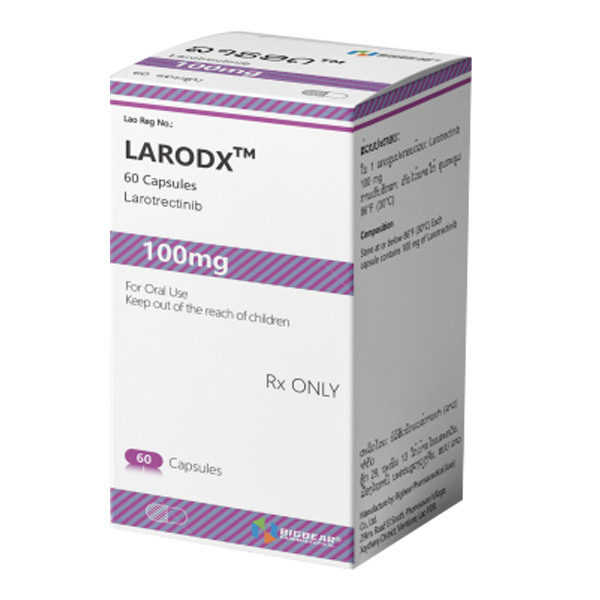
All Names: larotrectinib、Vitrakvi、拉罗替尼口服液、拉罗替尼胶囊
Indications:Adult cancer patients who carry fusion of the neurotrophin receptor tyrosine kinase (NTRK) gene and have no known acquired resistance mutations, metastases, or surgical resection that may lead to severe disease and unsatisfactory alternative treatment or post-treatment progression
Manufacturer:Daxiong
Customs Clearance Procedure:If the customs requires the package for customs clearance, please pay the customs clearance fee according to the content of EMS SMS and customs regulations.
Larotrectinib is a highly selective tyrosine kinase inhibitor that inhibits tumor cell proliferation and survival by targeting the activity of TRKA, TRKB, and TRKC proteins produced by the fusion of neurotrophic tyrosine receptor kinase (NTRK) genes, blocking their downstream signaling pathways.
1、 Drug name
1. Common name: Larotrectinib
2. Product Name: VITRAKVI ®
2、 Indications
For the treatment of solid tumors in adults and children, the following conditions must be met:
After testing, it was confirmed that there is fusion of the neurotrophin tyrosine receptor kinase (NTRK) gene, and there are no known acquired resistance mutations;
Tumor metastasis or surgical resection may lead to serious complications;
There is no satisfactory alternative treatment plan or disease progression after previous treatment.
3、 Specifications and characteristics
1. Specifications: Capsules: 25mg, 100mg (calculated based on Lalotinib);
2. Appearance: Capsule: White opaque hard capsule, printed with blue "LOXO" and dosage label (25mg or 100mg);
4、 Main components
1. Active ingredient: Lalotinib (calculated as Lalotinib sulfate, 25mg capsules contain 30.7mg sulfate, 100mg capsules contain 123mg sulfate, and oral solution contains 24.6mg/mL sulfate).
2. Accessories: Capsules: Gelatin, Titanium Dioxide, Edible Ink;
5、 Usage and dosage
1. Adults and children with a body surface area ≥ 1.0m ²: 100mg orally, twice daily;
2. Children with a body surface area<1.0m ²: 100mg/m ² orally, twice daily (maximum dose not exceeding 100mg/time);
3. Medication method: Take the capsule as a whole, do not chew or crush it; Oral solution should be measured using a specialized oral syringe;
4. Course of treatment: Continue treatment until disease progression or intolerable toxicity occurs.
6、 Dose adjustment
1. Gradually reduce according to the severity of adverse reactions:
First reduction: 75mg (or 75mg/m ²) twice a day;
Second reduction: 50mg (or 50mg/m ²) twice a day;
Third reduction: 100mg once daily (or 25mg/m ² twice daily);
Unable to tolerate permanent discontinuation of medication after the third dose reduction.
2. Specific adjustments are made to address serious adverse reactions such as neurotoxicity and hepatotoxicity.
7、 Medication precautions
1. Before and after meals: can be taken with food or on an empty stomach, with minimal impact on absorption;
2. Missed dose: If missed, it should be taken within 6 hours before the next dose, otherwise the dose will be skipped;
3. Vomiting: Vomiting after taking medication does not require supplementation, take the next dose according to the original plan time
4. Other:
During treatment, avoid driving or operating dangerous machinery as there may be symptoms of neurotoxicity such as dizziness;
Avoid consuming grapefruit or drinking grapefruit juice, and avoid using St. John's wort.
8、 Medication for special populations
1. Liver dysfunction:
Mild (Child Pugh A) does not require dose adjustment;
Moderate to severe cases (Child Pugh B or C) require a 50% reduction in the starting dose.
2. Renal insufficiency: No dose adjustment is required for any severity.
3. Elderly people: Data is limited and should be used with caution.
4. Pregnant women and lactation period:
Pregnant women may pose a risk to the fetus, and patients of childbearing age should take effective contraceptive measures until one week after the last dose;
Breastfeeding is prohibited, and it is not recommended to breastfeed within one week after discontinuing the medication.
9、 Adverse reactions
1. Common adverse reactions (≥ 20%): fatigue (37%), nausea (29%), dizziness (28%), vomiting (26%), elevated AST (45%), cough (26%), elevated ALT (45%), constipation (23%), diarrhea (22%).
2. Serious adverse reactions:
Neurotoxicity (53%, including delirium, dysarthria, ataxia, etc.);
Hepatotoxicity (ALT/AST elevation, 45%);
Other: anemia (42%), neutropenia (23%).
3. Laboratory abnormalities: hypoalbuminemia (35%), elevated alkaline phosphatase (30%).
10、 Contraindications
None.
11、 Drug interactions
1. Strong CYP3A4 inhibitors (such as itraconazole): avoid co administration, and if co administration is necessary, reduce the dose of larotinib by 50%;
2. Strong CYP3A4 inducers (such as rifampicin): Avoid co administration. If co administration is necessary, increase the dose of larotinib to 2 times;
3. Sensitive CYP3A4 substrates (such as midazolam): Avoid co administration as larotinib may increase its blood drug concentration.
12、 Storage method
Capsules: Store at room temperature (20 ° C-25 ° C), allowing short-term storage at 15 ° C-30 ° C.
larotrectinibinformation