- All Drug Categories
- Home
- Anti-cancer Drugs
- Healthcare Products
- Medical Information
- Statement
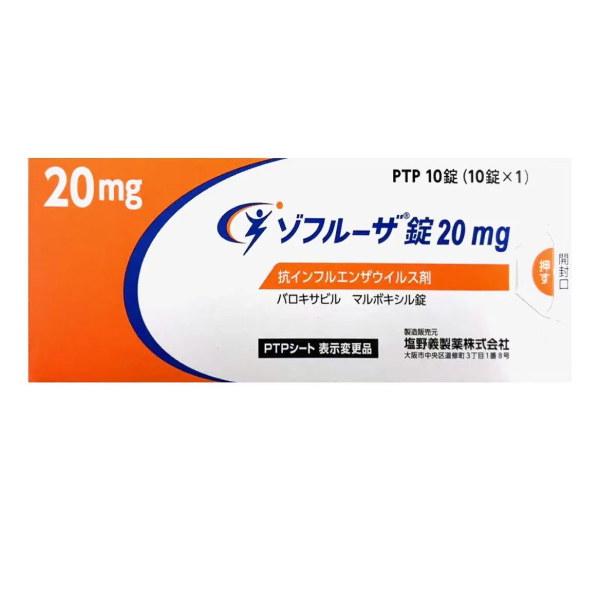
All Names: Xofluza、Baloxavir marboxil、玛巴洛沙韦、速福达
Indications:Used for the treatment of type A and type B influenza virus infections and post exposure prophylaxis (limited to 20mg tablets, 2% granules). The treatment is suitable for adults and children weighing 10kg or more, and granules can be used for infants and young children weighing 4kg or more; Prevention is applicable to individuals who live with influenza patients and are at risk of severe illness (such as the elderly, chronic disease patients, children over 12 years old or weighing over 20kg).
Manufacturer:SHIONOGI, Japan
Customs Clearance Procedure:If the customs requires the package for customs clearance, please pay the customs clearance fee according to the content of EMS SMS and customs regulations.
Mabaloxavir is an oral antiviral drug that belongs to cap dependent endonuclease inhibitors. It exerts therapeutic and preventive effects by selectively inhibiting the replication mechanism of influenza virus.
1、 Drug name
1. Common name: Baloxavir Methoxil
2. Product Name: Zoflux
2、 Indications
1. Used for the treatment of influenza A and B virus infections.
2. Used for the prevention of influenza A and B virus infections (limited to 20mg tablets and granules only).
3、 Specifications and characteristics
1. 10mg tablets: white to pale yellow white round plain tablets, with a diameter of about 5.0mm, a thickness of about 2.65mm, a mass of about 61mg, and surface scratches.
2. 20mg tablets: white to pale yellow oval shaped film coated tablets, with a length diameter of about 8.5mm, a short diameter of about 4.4mm, a thickness of about 3.40mm, and a mass of about 127mg.
3. 2% granules (sub packaged): white to pale yellow granules, 0.5g per package.
4、 Main components
Active ingredient: Baloxavir Methoxil.
5、 Usage and dosage
1. Treatment: Single oral dose. It is recommended to take it as early as possible within 48 hours after symptoms appear.
2. Weight above 10kg but below 20kg: 10mg (10mg tablets or granules).
3. Weight above 20kg but below 40kg: 20mg (20mg tablets or 10mg tablets, 2 tablets).
4. Weight above 40kg: 40mg (20mg tablets, 2 tablets).
5. Weight less than 10kg: 1mg/kg (granules).
6. Prevention: Take orally once, within 2 days after contact with influenza patients. Children and adults weighing over 20kg should be given 10mg, 20mg, 40mg, or 80mg according to their body weight.
6、 Dose adjustment
1. 10mg tablets and 20mg tablets are not bioequivalence, and 10mg tablets should not be used as a substitute when taking doses of 20mg or higher.
2. No dose adjustment studies have been conducted for patients with severe liver dysfunction.
3. Patients with mild to moderate liver function impairment do not need to adjust the dosage.
7、 Medication precautions
1. Before and after meals: can be taken on an empty stomach or after meals, but when taken with regular meals, Cmax decreases by 48% and AUC decreases by 36%. It is recommended to take on an empty stomach for optimal absorption.
2. Missed administration: This product is a single dose regimen, and missed doses should be taken as soon as possible; If the symptom window has exceeded 48 hours, consult a doctor.
3. Vomiting: Whether vomiting after taking medication needs to be supplemented depends on the time of vomiting and whether capsules/particles are visible. It is recommended to consult a doctor.
8、 Medication for special populations
1. Pregnant women: Use only when the benefits outweigh the risks; No teratogenicity was observed in animal experiments, but miscarriage and excessive cervical ribs were observed in the high-dose group.
2. Breastfeeding period: After weighing the pros and cons, decide whether to breastfeed (there is migration in rat milk).
3. Children:
Low birth weight infants and newborns: No clinical trial data available.
Newborns and infants: There may be a tendency for bleeding due to vitamin K deficiency. Before medication, it should be confirmed that vitamin K preparations have been supplemented and family members should be informed to observe symptoms such as bleeding and consciousness disorders.
Children weighing less than 20kg have not been approved for prevention.
4. Elderly people: physiological function decline, closely observe during medication.
9、 Adverse reactions
1. Common (incidence ≥ 1%): diarrhea, elevated ALT, elevated AST.
2. Rare (less than 1%): Nausea, vomiting, headache, rash, urticaria.
3. Frequency unknown (serious adverse reactions):
Shock, anaphylactic shock.
Abnormal behavior, such as sudden running, wandering, etc., is more common in boys of school age, and is more likely to occur within 2 days after fever.
Ischemic colitis.
Bleeding (such as rectal bleeding, nosebleeds, hematuria, etc., which may occur several days after administration).
10、 Contraindications
Patients with a history of allergies to any component of this medication.
11、 Drug interactions
1. Avoid use or caution:
Itraconazole (P-glycoprotein inhibitor): Increases the Cmax and AUC of the active form of balosavir by 33% and 23%, respectively.
Probenecid (UGT inhibitor): reduces the Cmax and AUC of the active form of balosavir by 21% and 25%, respectively.
2. No clinically significant interactions:
There are reports of PT prolongation when used in combination with warfarin, but the mechanism is unclear and needs to be monitored.
There is no significant effect on midazolam (CYP3A substrate), digoxin (P-glycoprotein substrate), and rosuvastatin (BCRP substrate).
12、 Storage method
1. Tablets: stored at room temperature, with an expiration date of 8 years.
2. Granules: stored at room temperature, with a shelf life of 3 years.
13、 Manufacturer
Manufacturer: Shionogi&Co., Ltd.
Xofluzainformation