- All Drug Categories
- Home
- Anti-cancer Drugs
- Healthcare Products
- Medical Information
- Statement
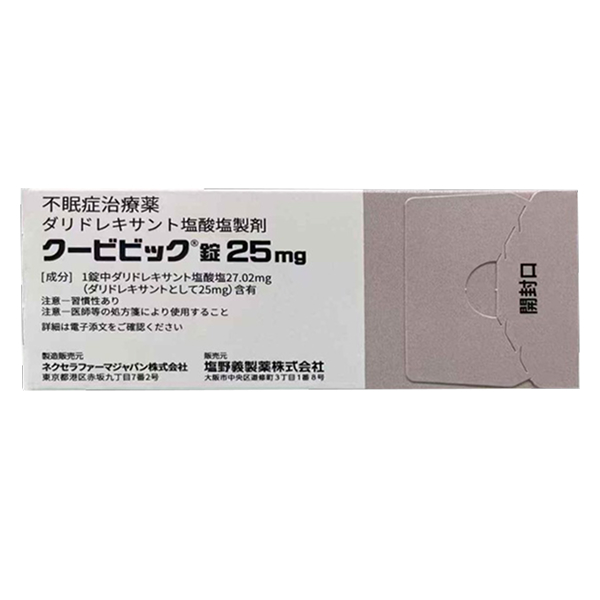
All Names: Quviviq、Daridorexant、达利雷生、科唯可
Indications:Adult patients with sleep disturbances and/or difficulty maintaining sleep.
Manufacturer:SHIONOGI, Japan
Customs Clearance Procedure:If the customs requires the package for customs clearance, please pay the customs clearance fee according to the content of EMS SMS and customs regulations.
Daridorexint is a novel appetite stimulating hormone receptor antagonist that selectively blocks the binding of hypothalamic secreted arousal promoting neuropeptides (orexin A and B) to their receptors OX1R and OX2R, inhibiting the transmission of arousal signals and reducing central nervous system excitability, promoting sleep initiation and maintenance.
1、 Drug name
Quviviq, commonly known as daridorexint in English, is formulated as an oral tablet.
2、 Indications
Used to treat adult insomnia, characterized by difficulty falling asleep and/or maintaining sleep.
3、 Specifications and characteristics
25mg、50mg。
tablet。
4、 Main components
The active ingredient is daridorexin hydrochloride.
5、 Usage and dosage
1. The recommended dosage is 25mg or 50mg, taken once a night within 30 minutes before bedtime, and should ensure at least 7 hours of sleep after taking the medication.
2. Taking it with meals or shortly after meals may delay the onset time.
6、 Dose adjustment
1. Combined with moderate CYP3A4 inhibitors: The maximum recommended dose is 25mg.
2. Co administration with potent CYP3A4 inhibitors: Avoid co administration.
3. Co administration with moderate or potent CYP3A4 inducers: Avoid co administration.
4. Moderate liver dysfunction (Child Pugh score 7-9): The maximum recommended dose is 25mg.
5. Severe liver dysfunction (Child Pugh ≥ 10 points): Not recommended for use.
7、 Medication precautions
1. Before and after meals: It is recommended not to take it with meals or immediately after meals to avoid delaying the effect.
2. Missed dose: It is generally not recommended to supplement or double the dose the next day.
3. Vomiting: If vomiting occurs quickly after taking medication, it may affect absorption. It is recommended to consult a doctor.
4. If insomnia does not improve after 7-10 days of treatment, re evaluation of comorbidities is necessary.
5. After taking medication, one should avoid driving or engaging in activities that require high alertness, especially when sleeping less than 7 hours or taking higher doses.
8、 Medication for special populations
1. Pregnancy: No human data available, no significant teratogenicity observed in animal studies.
2. Breastfeeding: It is unknown whether it has entered human milk, but it can be seen in animal milk. It is recommended to monitor for excessive sedation in infants.
3. Children: Safety and efficacy are uncertain.
4. Older adults (≥ 65 years old): No dosage adjustment is required, but there is an increased risk of drowsiness and fatigue, and a higher risk of falls.
5. Liver function impairment: moderate impairment reduced to 25mg; not recommended for severe impairment.
6. Respiratory dysfunction: Limited data on patients with mild to moderate obstructive sleep apnea (OSA) and moderate chronic obstructive pulmonary disease (COPD), and no studies have been conducted on severe OSA or COPD. Respiratory effects of unknown clinical significance cannot be ruled out.
9、 Adverse reactions
1. Common (≥ 5% and higher than placebo): headache, drowsiness, or fatigue.
2. Other (<2% but higher than placebo): Dizziness, nausea, sleep paralysis (0.3% -0.5%), hallucinations when falling asleep or waking up (0.6%).
3. Serious Warning: Decreased daytime alertness, worsening depression or suicidal ideation, complex sleep behaviors (such as daydreaming, sleep driving, etc.), and sudden onset symptoms.
10、 Contraindications
Patients with episodic sleep disorder are prohibited from using it.
11、 Drug interactions
1. Strong CYP3A4 inhibitors (such as itraconazole): avoid co administration (can increase the AUC of daliresin by>400%).
2. Moderate CYP3A4 inhibitor: Reduce daliresin to 25mg.
3. Strong or moderate CYP3A4 inducers (such as rifampicin): avoid co administration (can reduce AUC by>50%).
4. Alcohol and other central nervous system inhibitors: When used in combination, they can worsen mental and motor function damage, so avoid drinking alcohol.
12、 Storage method
Store at room temperature of 20 ℃ -25 ℃ (68 ℉ -77 ℉), and allow short-term storage between 15 ℃ -30 ℃ (59 ℉ -86 ℉).
Quviviqinformation