- All Drug Categories
- Home
- Anti-cancer Drugs
- Healthcare Products
- Medical Information
- Statement
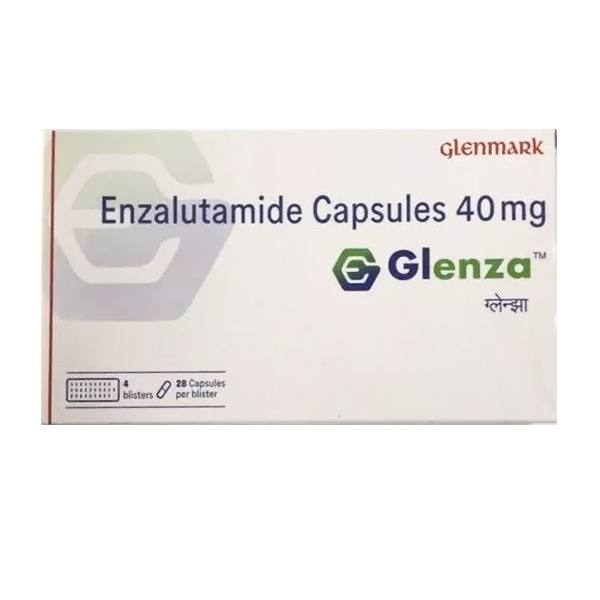
All Names: Enzalutamide、Xtandi、MDV 3100、恩杂鲁胺、恩扎卢胺、安可坦
Indications:Suitable for patients with castration resistant prostate cancer, metastatic castration sensitive prostate cancer, non metastatic castration sensitive prostate cancer with biochemical recurrence and high risk of metastasis.
Manufacturer:Glenmark,India
Customs Clearance Procedure:If the customs requires the package for customs clearance, please pay the customs clearance fee according to the content of EMS SMS and customs regulations.
Enzalutamide is an androgen receptor inhibitor, belonging to the categories of anti androgen drugs and hormone/anti-tumor drugs.
1、 Drug name
Enzalutamide (Xtandi, Enzalutamide).
2、 Indications
Used to treat patients with metastatic castration resistant prostate cancer who have previously received treatment with docetaxel.
3、 Specifications
The specification is 40mg capsules.
4、 Main components
The active ingredient is Enzalutamide.
5、 Usage and dosage
1. The recommended dosage is 160mg (4 40mg capsules), taken orally once a day.
2. Can be taken with food or taken separately.
3. Swallow the entire capsule, do not chew, dissolve or open the capsule.
6、 Dose adjustment
1. Toxic reactions: If there are adverse reactions of ≥ grade 3 toxicity or intolerance, the administration should be suspended until the symptoms improve to ≤ grade 2. Afterwards, the original dose can be restored or reduced to 120mg or 80mg once daily.
2. Combination with strong CYP2C8 inhibitors (such as gefebuzi): If combination cannot be avoided, reduce enzalutamide to 80mg once daily; Restore the original dose after discontinuing the strong inhibitor.
7、 Medication precautions
1. Before and after meals: can be taken with meals or on an empty stomach, high-fat meals do not affect total exposure.
2. Missing medication: Once remembered, it should be taken immediately.
3. Vomiting: not specifically mentioned.
4. Take medication at a fixed time every day.
5. During the treatment period, it is necessary to continue receiving treatment with gonadotropin-releasing hormone analogs.
6. Do not interrupt, adjust dosage or discontinue medication without the guidance of a doctor.
8、 Medication for special populations
1. Pregnant women: Do not use. May cause harm to the fetus and pose a risk of miscarriage. Women with fertility should avoid pregnancy during treatment.
2. Breastfeeding mother: Not suitable for women's use, unknown whether it will be discharged into human milk. A balance needs to be struck between breastfeeding and medication.
3. Children: Safety and efficacy are uncertain.
4. Elderly (≥ 65 years old): In clinical trials, 71% of patients were ≥ 65 years old, and 25% were ≥ 75 years old. There is no significant difference in overall safety and effectiveness, but it cannot be ruled out that some elderly people are more sensitive.
5. Renal injury: Mild to moderate renal injury (creatinine clearance rate 30-89mL/min) does not require adjustment of initial dose. Severe kidney injury or end-stage renal disease not evaluated.
6. Liver injury: Mild to moderate liver injury (Child Pugh A or B) does not require adjustment of initial dose. Severe liver injury (Child Pugh C) was not evaluated.
9、 Adverse reactions
1. The most common adverse reactions (incidence ≥ 2%, higher than placebo): weakness/fatigue, back pain, diarrhea, joint pain, hot flashes, peripheral edema, musculoskeletal pain, headache, upper respiratory tract infection, muscle weakness, dizziness, insomnia, lower respiratory tract infection, spinal cord compression syndrome and cauda equina syndrome, hematuria, sensory abnormalities, anxiety, hypertension.
2. Adverse reactions that require special attention: epileptic seizures (0.9%), falls and fall related injuries (4.6%), hallucinations (1.6%), infections/sepsis (1.0% deaths).
3. Laboratory abnormalities: neutropenia (15%), elevated ALT (10%), elevated bilirubin (3%).
10、 Contraindications
Pregnant women are prohibited from using it.
11、 Drug interactions
1. Strong CYP2C8 inhibitors (such as gemcitabine): When used in combination, the exposure to enzalutamide increases by 2.2 times and needs to be reduced to 80mg.
2. Strong or moderate CYP2C8 inducers (such as rifampicin): may reduce exposure to enzalutamide and should be avoided in combination.
3. Strong CYP3A4 inhibitors (such as itraconazole): Combined use increases exposure by 1.3 times.
4. Strong or moderate CYP3A4 inducers (such as carbamazepine, phenobarbital, St. John's wort, etc.): may reduce exposure to enzalutamide and should be avoided in combination.
5. The effects of enzalutamide on other drugs: enzalutamide is a strong CYP3A4 inducer, moderate CYP2C9 and CYP2C19 inducer, and may reduce the concentration of drugs metabolized by these enzymes.
12、 Storage method
1. Dry and store at 20 ° C to 25 ° C (68 ° F to 77 ° F) in a sealed container.
2. Allow short-term storage between 15 ° C and 30 ° C (59 ° F and 86 ° F).
Enzalutamidinformation