- All Drug Categories
- Home
- Anti-cancer Drugs
- Healthcare Products
- Medical Information
- Statement
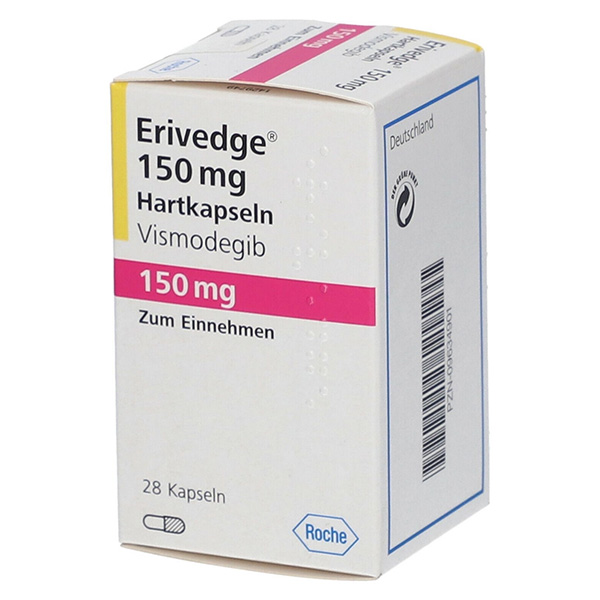
All Names: Erivedge、vismodegib、维莫德吉
Indications:Adult patients with metastatic basal cell carcinoma or locally advanced basal cell carcinoma that recurs after surgical treatment and is not suitable for surgery and radiation therapy.
Manufacturer:Roche, Switzerland
Customs Clearance Procedure:If the customs requires the package for customs clearance, please pay the customs clearance fee according to the content of EMS SMS and customs regulations.
Vimodege is a selective Hedgehog (Hh) signaling pathway inhibitor that blocks Hh signaling by targeting and inhibiting the transmembrane protein Smoothened (SMO), thereby inhibiting abnormal proliferation of basal cell carcinoma (BCC) cells.
1、 Drug name
Erivedge (English trade name: Erivedge, common name: vismodegib).
2、 Indications
Suitable for the treatment of adult metastatic basal cell carcinoma or locally advanced basal cell carcinoma (this type must meet the following conditions: postoperative recurrence, unsuitability for surgery, and unsuitability for radiotherapy).
3、 Specifications and characteristics
1. Specification: 150mg capsules.
2. Appearance: The capsule has a pink opaque body and a gray opaque cap, with the black "150mg" label printed on the body and the black "VISMO" label printed on the cap.
4、 Main components
Active ingredient: vismodegib.
5、 Usage and dosage
1. Recommended dosage: 150mg once daily, orally.
2. Usage: Can be taken with meals or on an empty stomach. The capsule should be swallowed whole and should not be opened or crushed.
3. Omission treatment: If one dose is missed, the dose should be skipped and the next dose should be taken according to the original plan.
6、 Dose adjustment
1. For intolerable adverse reactions, medication can be suspended for up to 8 weeks until symptoms improve or alleviate.
2. If serious skin adverse reactions occur (such as Stevens Johnson syndrome, toxic epidermal necrolysis, drug reactions with eosinophilia and systemic symptoms), permanent discontinuation of medication is required.
3. If serious or intolerable musculoskeletal adverse reactions occur, medication should be discontinued; If the symptoms recur or become severe/intolerable, the medication should be permanently discontinued.
7、 Medication precautions
1. Before and after meals: Both are acceptable.
2. Missed dose: Skip the missed dose and take the next dose according to the original plan.
3. Vomiting: If vomiting occurs, it is not recommended to take the next dose as planned.
4. Other precautions:
The risk of embryo fetal toxicity is extremely high. Women of childbearing age should confirm that they are not pregnant within 7 days before taking medication, and take effective contraceptive measures during the medication period and 24 months after the last dose.
Male patients' semen contains drugs. During the medication period and within 3 months after the last administration, even if a vasectomy has been performed, condoms should be used to avoid exposing pregnant partners or female partners with fertility to drugs.
Blood donation or blood products are prohibited during the medication period and within 24 months after the last administration.
Male patients are prohibited from donating sperm during medication and within 3 months after the last dose.
There may be risks of severe skin reactions, muscle related issues (such as spasms, pain), and premature closure of epiphyseal plates in children, which require close monitoring.
8、 Medication for special populations
1. Pregnant women: Prohibited, there is a risk of embryo fetal death or serious birth defects.
2. Breastfeeding women: It is not recommended to breastfeed. Breastfeeding should be stopped during the medication period and within 24 months after the last dose.
3. Women and men of childbearing age: strict contraceptive measures should be taken.
4. Children: Safety and efficacy have not been established, there is a risk of premature closure of epiphyseal plates, and it is not suitable.
5. Elderly: Insufficient clinical research data, caution is needed.
6. Patients with liver/kidney dysfunction: Mild to moderate liver injury or kidney dysfunction do not require dose adjustment; The impact of severe renal insufficiency is unknown.
9、 Adverse reactions
1. The most common adverse reactions (incidence ≥ 10%) include muscle spasms, hair loss, taste disorders, weight loss, fatigue, nausea, diarrhea, decreased appetite, constipation, joint pain, vomiting, and loss of taste.
2. Other important adverse reactions include: severe skin reactions, musculoskeletal adverse reactions (possibly accompanied by elevated creatine kinase), menstrual cessation (in women of childbearing age), laboratory abnormalities (such as hyponatremia, azotemia, hypokalemia), etc.
10、 Contraindications
There are no clear contraindications.
11、 Drug interactions
1. Clinical studies have shown that co administration with fluconazole (moderate inhibitor of CYP2C9 and CYP3A4), itraconazole (strong inhibitor of CYP3A4 and P-gp inhibitor), or rabeprazole (acid reducing agent) has no significant clinical effect on the pharmacokinetics of Vimodge.
2. Vimodge also had no significant effect on the pharmacokinetics of Rogoglitazone (CYP2C8 substrate) or oral contraceptives (ethinylestradiol/norgestrel). In vitro studies have shown that Vimodge is a BCRP transporter inhibitor and not a CYP1A2, CYP2B6, or CYP3A inducer.
12、 Storage method
1. Store at room temperature of 20 ° C to 25 ° C (68 ° F to 77 ° F), and allow short-term storage within the range of 15 ° C to 30 ° C (59 ° F to 86 ° F).
2. Keep the bottle cap tightly closed to prevent moisture.
Erivedgeinformation