- All Drug Categories
- Home
- Anti-cancer Drugs
- Healthcare Products
- Medical Information
- Statement
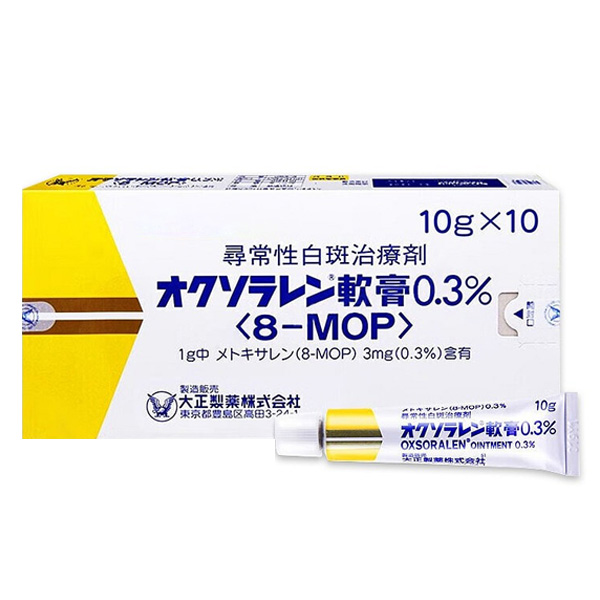
All Names: Methoxsalen、Oxsoralen、甲氧沙林软膏
Indications:Adult and pediatric patients diagnosed with common leukoplakia and without relevant contraindications.
Manufacturer:日本大正制药
Customs Clearance Procedure:If the customs requires the package for customs clearance, please pay the customs clearance fee according to the content of EMS SMS and customs regulations.
Methoxysarin ointment 0.3% was originally developed by Taisho Pharmaceutical Co., Ltd. in Japan, and is a classic topical preparation based on the photochemical therapy of psoralen.
1、 Drug name
1. Common name: Methoxsalen
2. Product Name: OXSORALENOINTMENT 0.3% Ointment
2、 Indications
Used for treating common vitiligo.
3、 Specifications and characteristics
1. Specification: Each 1g of ointment contains 3mg (0.3%) of methoxysarin.
2. Appearance: White W/O cream with uniform texture.
4、 Main components
1. Active ingredient: Methoxsalen
2. Additives: light liquid paraffin wax, white Vaseline, white beeswax, propylene glycol, polyoxyethylene oil-based ether sodium phosphate, polyoxyethylene hexadecyl ether, lauryl alcohol polyoxyethylene ether, polyoxyethylene stearyl ether.
5、 Usage and dosage
1. Apply an appropriate amount only to the white spot area, and then soak in sunlight or artificial ultraviolet radiation (PUVA therapy) for 1 to 2 hours after application.
2. It is usually recommended to treat the same white spot area 1 to 3 times a week. Topical therapy is recommended for localized vitiligo.
6、 Dose adjustment
1. The dosage or duration of ultraviolet radiation can be adjusted based on skin reactions and tolerance.
2. If there is excessive skin inflammation reaction (such as redness, blisters), treatment should be suspended, and the radiation dose should be reduced when resuming after recovery.
7、 Medication precautions
1. Cleaning after UV irradiation: After irradiation, the affected area should be thoroughly cleaned with ethanol cotton or soap, or rinsed with a bath to avoid excessive skin inflammation caused by prolonged residue.
2. Avoid direct sunlight if necessary to prevent phototoxic reactions.
3. For use only on affected areas: avoid applying to normal skin. If fingers or other parts are accidentally contaminated, they should be cleaned immediately.
4. Long term treatment risk: Long term or repeated treatment may increase the risk of skin cancer, and unplanned long-term use should be avoided.
8、 Medication for special populations
1. Pregnant women: Use only when the benefits of treatment outweigh the risks. Animal experiments (rats) showed that oral administration can penetrate the placenta.
2. Breastfeeding period: It is necessary to consider the necessity of treatment and the benefits of breastfeeding before deciding whether to continue breastfeeding. Animal experiments (rats) showed oral administration and secretion into breast milk.
3. Children: Clinical trials targeting children have not yet been conducted, and there is a lack of safety data.
4. Elderly people: Physiological functions usually decline, and treatment plans should be carefully determined.
9、 Adverse reactions
1. Skin reaction:
Incidence rate of 5% to 10%: Skin redness and blisters.
Incidence less than 5%: dermatitis, itching, flushing, desquamation, swelling, scabbing.
Note: The above reactions are mostly caused by excessive exposure to ultraviolet radiation. When they occur, treatment should be suspended and the radiation dose should be reduced after recovery.
2. Serious risk: PUVA therapy has been reported to induce skin cancer.
10、 Contraindications
1. Individuals with skin cancer or a history of skin cancer.
2. Patients with photosensitive diseases such as porphyria, lupus erythematosus, pigmentary dry skin disease, polymorphic solar rash, etc.
11、 Drug interactions
1. CYP2A6 metabolic drugs (such as itraconazole, fluazuron hydrochloride, pilocarpine, etc.): This product can inhibit CYP2A6, which may increase the blood concentration of these drugs and enhance their effects.
2. Known drugs that can cause photosensitivity (such as pyridone carboxylic acids, tetracyclines, sulfonamides, tar preparations, thiazine derivatives, porphyrins, phenothiazine derivatives, etc.): their combination may increase the risk of photosensitivity reactions.
3. Foods containing furan coumarin (such as celery, lime, carrots, parsley, figs, windproof, mustard, etc.): may enhance photosensitivity.
12、 Storage method
Usually, ointments should be stored in a sealed, dark, and cool place (not exceeding 25 ° C) to avoid contact with children.
13、 Manufacturer
1. Manufacturer and seller: TAISHO Pharmaceutical Co., Ltd
2. Address: 3-24-1 Takada, Toyoshima ku, Tokyo 170-8633
Oxsoraleninformation