- All Drug Categories
- Home
- Anti-cancer Drugs
- Healthcare Products
- Medical Information
- Statement
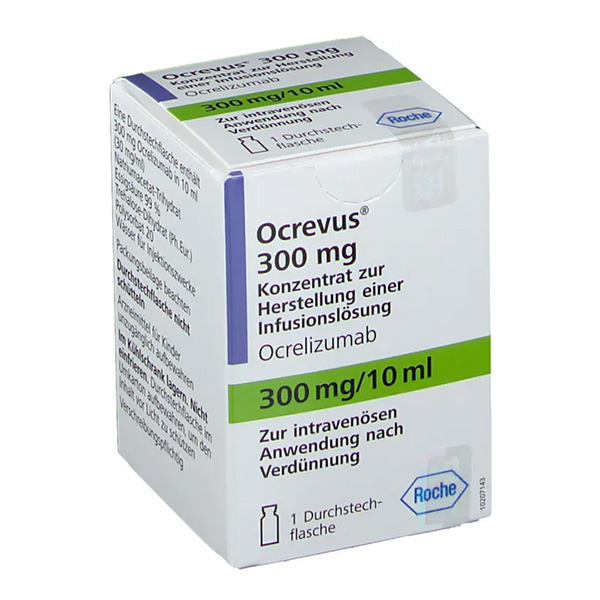
All Names: Ocrevus、Ocrelizumab、奥瑞利珠单抗、罗可适
Indications:Suitable for adult patients with recurrent multiple sclerosis and primary progressive multiple sclerosis.
Manufacturer:Roche, Switzerland
Customs Clearance Procedure:If the customs requires the package for customs clearance, please pay the customs clearance fee according to the content of EMS SMS and customs regulations.
Orilizumab is a humanized anti-CD20 monoclonal antibody that targets the CD20 antigen on the surface of B cells, mediates antibody dependent cytotoxicity (ADCC) and complement dependent cytotoxicity (CDC), and exhausts B cells.
1、 Drug name
1. Common name: Ocrelizumab
2. Product Name: OCREVUS
2、 Indications
Used for treating adults:
1. Recurrent multiple sclerosis: including clinically isolated syndrome, relapsing remitting disease, and active secondary progressive disease.
2. Primary progressive multiple sclerosis.
3、 Specifications and characteristics
1. Specification: Single dose penicillin bottle, 300mg/10mL (30mg/mL).
2. Appearance: Clear to slightly milky, colorless to light brown solution.
4、 Main components
1. Active ingredient: Orilizumab (recombinant humanized anti-CD20 monoclonal antibody)
2. Accessories: glacial acetic acid, polysorbate 20, sodium acetate trihydrate, trehalose dihydrate.
5、 Usage and dosage
1. Pre administration evaluation:
Hepatitis B virus screening.
Detect quantitative serum immunoglobulin.
Complete all necessary vaccinations (live vaccines at least 4 weeks in advance, non live vaccines at least 2 weeks in advance if possible).
Detect liver function (transaminase, alkaline phosphatase, bilirubin).
2. Preparation before each infusion:
Confirm no active infection.
Pre use glucocorticoids (such as methylprednisolone 100mg intravenous infusion) and antihistamines (such as diphenhydramine).
3. Recommended dosage and infusion plan:
First administration: divided into two intravenous infusions, 300mg each time, with a two-week interval.
Subsequent administration: 600mg each time, once every 6 months.
The infusion rate gradually increases according to the instructions, and the total infusion time is about 2 to 3.5 hours.
Observation after infusion: Observe the patient for at least 1 hour after each infusion is completed.
6、 Dose adjustment
1. Delayed or missed dose: If the scheduled infusion is missed, it should be administered as soon as possible and the next administration time should be reset to 6 months after the current infusion. The interval between two infusions shall not be less than 5 months.
2. Adjustment due to infusion response:
Life threatening infusion reactions: Immediately and permanently stop infusion.
Severe infusion response: Immediately interrupt the infusion and restart at half the infusion rate at the time of the response, once the symptoms have improved.
Mild to moderate infusion response: Reduce the infusion rate to half of the rate at which the response occurred and maintain this rate for at least 30 minutes.
7、 Medication precautions
1. Relationship with diet: This product is administered intravenously and is not related to diet.
2. Infusion reaction: Inform the patient that there may be a reaction during the infusion period and within 24 hours after infusion, and report it promptly.
3. Infection monitoring: During treatment, be alert to infection symptoms (such as fever, persistent cough, shingles, etc.) and seek medical attention promptly.
4. Vaccination: It is not recommended to receive live or attenuated vaccines during treatment and before B cell recovery.
8、 Medication for special populations
1. Pregnant women: Immunoglobulin can pass through the placenta. Exposure during pregnancy may lead to depletion of B cells in newborns. It is recommended that women with fertility take effective contraceptive measures during treatment and within 6 months after the last infusion.
2. Breastfeeding period: It is not yet clear whether it is secreted into human milk, and the pros and cons need to be weighed.
3. Children: Safety and efficacy have not yet been established.
4. Elderly patients: Data is limited and it cannot be determined whether there are differences compared to younger patients.
5. Liver and kidney dysfunction: No clinically significant pharmacokinetic changes were observed in patients with mild impairment.
9、 Adverse reactions
1. Common adverse reactions (incidence ≥ 10%):
Upper respiratory tract infection, infusion reaction, skin infection, lower respiratory tract infection, depression (recurrent MS), back pain, limb pain (recurrent MS).
2. Serious adverse reactions:
Infusion reaction, severe infection (including life-threatening and fatal bacterial, viral and fungal infections), reactivation of hepatitis B virus, progressive multifocal leukoencephalopathy, decreased immunoglobulin levels, malignant tumors (such as breast cancer), immune-mediated colitis, and liver injury.
10、 Contraindications
1. Active hepatitis B virus infection.
2. There is a history of life-threatening infusion reactions to Orilizumab.
11、 Drug interactions
1. Immunosuppressive or immunomodulatory therapy: Combination with other immunosuppressants may increase the immunosuppressive effect.
2. Vaccination: can weaken the immune response of non live vaccines. Prohibition of simultaneous use with live or attenuated vaccines.
12、 Storage method
1. Place the penicillin bottle in the original paper box and store it refrigerated at 2 ° C to 8 ° C (36 ° F to 46 ° F) to avoid light.
2. Do not freeze or shake.
3. The diluted infusion solution can be refrigerated at 2 ° C to 8 ° C for 24 hours, followed by infusion at room temperature for 8 hours.
Ocrelizumabinformation