- All Drug Categories
- Home
- Anti-cancer Drugs
- Healthcare Products
- Medical Information
- Statement
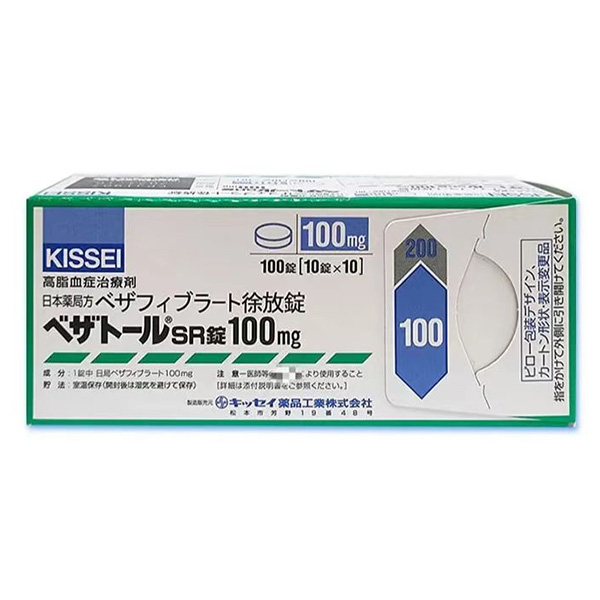
All Names: Bezafibrate、Bezatol SR Tablets、 苯扎贝特缓释片
Indications:Suitable for adult patients whose blood lipid levels have not yet reached the standard after strict dietary control and exercise therapy. Especially suitable for patients with lipid metabolism disorders mainly characterized by elevated triglycerides, or mixed hyperlipidemia patients with poor triglyceride control after the use of statins.
Manufacturer:kissei
Customs Clearance Procedure:If the customs requires the package for customs clearance, please pay the customs clearance fee according to the content of EMS SMS and customs regulations.
Bezafibrate sustained-release tablets are a type of fatty acid derivative lipid regulating drug. By activating peroxisome proliferator activated receptor alpha, regulating lipoprotein metabolism, significantly reducing serum triglycerides and total cholesterol, and increasing high-density lipoprotein cholesterol.
1、 Drug name
1. Product Name: ベベール SR Ingot 100mg
2. Domestic reference translation: Benzarthor SR Tablets 100mg
3. Common name: Bezafibrate
2、 Indications
Hyperlipidemia (including familial hyperlipidemia).
3、 Specifications and characteristics
1. This product is a sustained-release tablet coated with a thin film, consisting of 100mg Salbutamol SR tablets (100mg Benzartol SR tablets):
2. Appearance: White film coated sheet.
4、 Main components
1. Active ingredient: Benzabet
2. 100mg specification: Each tablet contains 100mg of benzimidazole
5、 Usage and dosage
1. Conventional dosage: Typically, adults take 400mg of benzalkonium chloride orally twice a day, once after breakfast and once after meals.
2. Special populations: For patients with renal dysfunction and the elderly, appropriate reductions should be made.
6、 Dose adjustment
1. Patients with renal dysfunction: This product is mainly excreted through the kidneys and the dosage must be adjusted according to the renal function status. It is recommended to adjust according to the serum creatinine value or creatinine clearance rate.
2. Serum creatinine level ≤ 1.5mg/dL or creatinine clearance rate ≥ 60mL/min: Conventional dose of 400mg per day (divided into 2 doses) can be given.
3. Serum creatinine level>1.5mg/dL or creatinine clearance rate 50-60mL/min: should be reduced to 200mg per day (once 200mg).
7、 Medication precautions
Usage:
1. This product is a sustained-release tablet that must be swallowed whole and cannot be divided, chewed, or crushed.
2. It should be taken after breakfast and dinner.
3. The medication packaged in PTP should be taken by patients after being removed from the PTP board to prevent ingestion of sharp packaging that may damage the esophagus.
4. Omission treatment: If you forget to take your medication, you should take it as soon as possible when you remember. But if the next dose is approaching, the missed dose should be skipped and the next dose should be taken at the normal time. Do not take double the dose at once.
5. Vomiting treatment: If vomiting occurs shortly after taking medication, the medication may not be fully absorbed and should not be taken again.
8、 Medication for special populations
1. Pregnant women: Pregnant women or women who may become pregnant are prohibited from using it.
2. Breastfeeding women should consider both the benefits of treatment and breastfeeding before deciding whether to continue or stop breastfeeding. Animal experiments have shown that drugs can enter breast milk.
3. Children: Clinical trials targeting children have not yet been conducted, and safety is unknown.
4. Elderly people:
Liver and kidney function often decline with age and low body weight, which can lead to side effects. Therefore, caution should be exercised when administering low doses.
Regular monitoring of renal function is required during medication.
When used in combination with sulfonylurea hypoglycemic drugs, attention should be paid to the risk of hypoglycemia.
5. Comorbidity patients:
Patients with gallstones or a history of gallstones: may promote the formation of gallstones.
Patients with liver dysfunction: may lead to an increase in blood drug concentration.
9、 Adverse reactions
1. Major side effects:
Rhabdomyolysis (frequency unknown): manifested as muscle pain, fatigue, elevated CK, elevated myoglobin in blood/urine, and may be secondary to severe kidney disease such as acute kidney injury. Once symptoms appear, the medication should be stopped immediately.
Allergic shock (frequency unknown): Possible swelling of the face, lips, etc.
Liver dysfunction and jaundice (frequency unknown): accompanied by elevated levels of AST, ALT, and γ - GTP.
2. Other side effects:
Mental nervous system: headache, dizziness, drowsiness, insomnia, numbness.
Muscle: CK elevation, muscle pain, muscle spasms.
Digestive system: abdominal pain, nausea, loss of appetite, bloating, diarrhea, stomatitis, vomiting, constipation, gastric ulcer, heartburn, dry mouth.
Skin: rash, itching, urticaria, photosensitivity.
Liver: Elevated AST, ALT, and LDH.
Kidney: Elevated BUN and creatinine levels.
Blood: anemia, decreased white blood cells, increased or decreased platelets.
Other: Elevated uric acid, hypoglycemia, general fatigue, hair loss, gallstones, erectile dysfunction, abnormal taste, fever, edema, frequent urination.
10、 Contraindications
The following patients are prohibited:
1. Patients undergoing artificial dialysis (including peritoneal dialysis).
2. Patients with severe kidney diseases such as renal failure.
3. Patients with serum creatinine levels above 2.0mg/dL.
4. Individuals with a history of allergies to the ingredients of this medication.
5. Pregnant or potentially pregnant women.
11、 Drug interactions
1. HMG CoA reductase inhibitors (statins: pravastatin, simvastatin, fluvastatin, etc.):
Risk: Prone to rhabdomyolysis accompanied by rapid deterioration of renal function. Especially for patients with abnormal renal function test values, the risk is higher.
Treatment: If combination therapy is necessary, it should start with a low dose and regularly check kidney function, closely observe muscle symptoms and CK values. If any abnormalities occur, stop taking the medication immediately.
2. Anticoagulants (warfarin potassium):
Risk: Enhance anticoagulant effect and increase bleeding risk.
Processing: When used in combination, monitor prothrombin time and adjust anticoagulant dosage.
Sulfonylurea hypoglycemic drugs (such as glibenclamide, gliclazide, glimepiride, etc.) and insulin:
Risk: Enhanced hypoglycemic effect may lead to hypoglycemia (cold sweat, strong hunger, palpitations, etc.).
Treatment: Pay attention to observing changes in blood sugar and adjust the dosage of hypoglycemic drugs if necessary. Older people are at higher risk.
3. Cyclosporine:
Risk: May mutually enhance nephrotoxicity, leading to kidney damage.
Handling: Close monitoring of renal function indicators (creatinine, BUN, etc.).
Anion exchange resin (Colleene amine):
Risk: Adsorption of this product may delay or reduce its absorption.
Handling: If combined use is required, it should be taken at least 2 hours apart.
12、 Storage method
1. Storage conditions: Store at room temperature.
2. Validity period: 3 years.
3. Attention: After opening the aluminum-plastic packaging (PTP), moisture-proof measures should be taken.
Bezafibrateinformation