- All Drug Categories
- Home
- Anti-cancer Drugs
- Healthcare Products
- Medical Information
- Statement
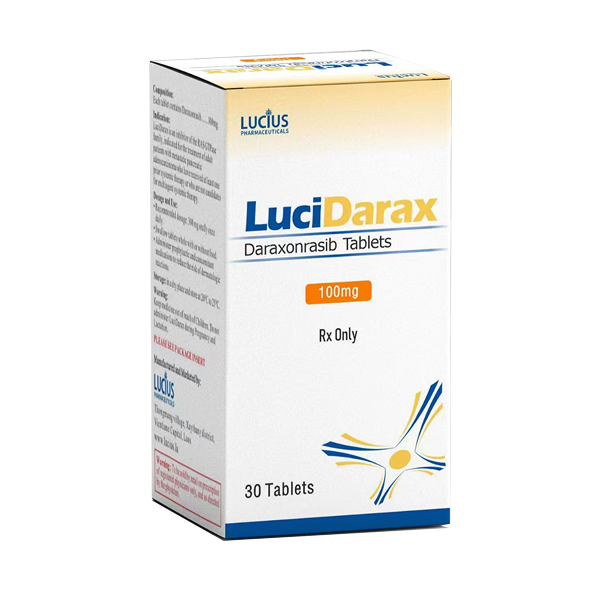
All Names: Daraxonrasib、Rasonque
Indications:Dalasoraxib is suitable for the treatment of adult patients with metastatic pancreatic adenocarcinoma.
Manufacturer:LUCIUS PHARMACEUTICAL (LAOS) CO., LTD
Customs Clearance Procedure:If the customs requires the package for customs clearance, please pay the customs clearance fee according to the content of EMS SMS and customs regulations.
Dalasoraxib is suitable for the treatment of adult patients with metastatic pancreatic adenocarcinoma.
1、 Drug name
1. Common name: Daraxonrasib
2. Product Name: RASONQUE
3. Dosage form: Oral film coated tablets
2、 Indications
Suitable for adult patients with metastatic pancreatic adenocarcinoma who have previously received at least one systemic therapy or are not suitable for multi drug combination therapy.
3、 Specifications
Specifications: 100mg and 150mg tablets.
4、 Main components
1. Active ingredient: daraxonrasib.
2. Core materials: Butylated hydroxytoluene, colloidal silica, cross-linked carboxymethyl cellulose sodium, hydroxypropyl cellulose, hydroxypropyl methylcellulose acetate succinate, magnesium stearate, mannitol, microcrystalline cellulose.
5、 Usage and dosage
1. Recommended dosage: 300mg, once daily, orally.
2. Continue medication until disease progression or intolerable toxicity occurs.
3. Take it at a fixed time every day, it can be taken with food or on an empty stomach.
4. Swallow the whole piece, do not chew, crush or pry open.
6、 Dose adjustment
1. First dose reduction: 200mg, once daily.
2. Second dose reduction: 150mg, once daily.
3. Those who cannot tolerate 150mg once daily will permanently discontinue the medication.
4. When adverse reactions occur, medication should be suspended, reduced, or permanently discontinued depending on the severity.
7、 Medication precautions
1. Before and after meals: can be taken with food or on an empty stomach, and food has no clinically significant effect on pharmacokinetics.
2. Missed dose: If missed for more than 4 hours, skip the dose and take the next dose according to the original plan; Do not take two doses at once.
3. Vomiting: Vomiting after taking medication, no need to retake, take the next dose according to the original plan.
4. Preventive medication: Use topical corticosteroids (facial and chest) and moisturizers at the beginning of treatment, recommend oral prophylactic antibiotics, limit sun exposure, and use broad-spectrum sunscreen (SPF30 or above).
8、 Medication for special populations
1. Pregnancy: Animal studies have shown that it can cause fetal damage; Pregnant women should be informed of the risks to the fetus when taking medication.
2. Breastfeeding period: It is not yet clear whether it is secreted into human milk; Stop breastfeeding during the treatment period and within one week after the last dose.
3. Women of childbearing age: undergo pregnancy testing before treatment; Use effective contraception during treatment and within one week after the last dose.
4. Male patients: those whose partners have fertility should use effective contraception during treatment and within one week after the last dose.
5. Children: Safety and efficacy have not yet been established.
6. Elderly patients: There is no overall difference in safety and efficacy compared to younger patients.
7. Renal function impairment: mild to moderate without dose adjustment; The severe impact is not yet clear.
8. Liver function injury: mild to moderate without dose adjustment; The severe impact is not yet clear.
9、 Adverse reactions
1. Skin and soft tissue: rash, itching, paronychia, dry skin, cracking.
2. Oral: Oral inflammation, oral ulcers, oral mucosal inflammation.
3. Digestive system: diarrhea, nausea, vomiting, abdominal pain, constipation, gastrointestinal perforation.
4. Systemic: fatigue, weakness, edema, fever, decreased appetite, bleeding.
5. Respiratory system: interstitial lung disease/pneumonia.
6. Laboratory abnormalities: decreased albumin, decreased calcium, increased liver enzymes, decreased sodium, decreased magnesium, increased creatinine, decreased hemoglobin, decreased lymphocytes, decreased platelets, decreased white blood cells, increased alkaline phosphatase, decreased potassium.
10、 Contraindications
None.
11、 Drug interactions
1. Strong CYP3A inhibitors with P-gp inhibition: avoid combination therapy.
2. Strong CYP3A inhibitor without P-gp inhibition: reduce to 150mg once daily.
3. Intermediate acting CYP3A inhibitor with P-gp inhibition: reduce to 100mg once daily.
4. Intermediate acting CYP3A inhibitor without P-gp inhibition: reduce to 200mg once daily.
5. P-gp inhibitor: Reduce to 150mg once daily.
6. Strong or moderate CYP3A inducers: If unavoidable, increase to 400mg once daily.
7. P-gp substrate: Take at least 4 hours apart from this product.
8. Cyclosporine A: Avoid combination use.
9. Other: There is no clinically significant interaction with esomeprazole, midazolam, rosuvastatin, or pravastatin.
12、 Storage method
1. Storage temperature: 20 ° C to 25 ° C (68 ° F to 77 ° F).
2. Allow short distance fluctuations: 15 ° C to 30 ° C (59 ° F to 86 ° F).
3. Store in the original bottle with desiccant inside, keep the bottle cap tightly closed.
4. Avoid light, moisture, and extreme temperatures. Do not refrigerate or freeze.
5. Store in a place that children cannot reach or see.
Daraxonrasiinformation