- All Drug Categories
- Home
- Anti-cancer Drugs
- Healthcare Products
- Medical Information
- Statement
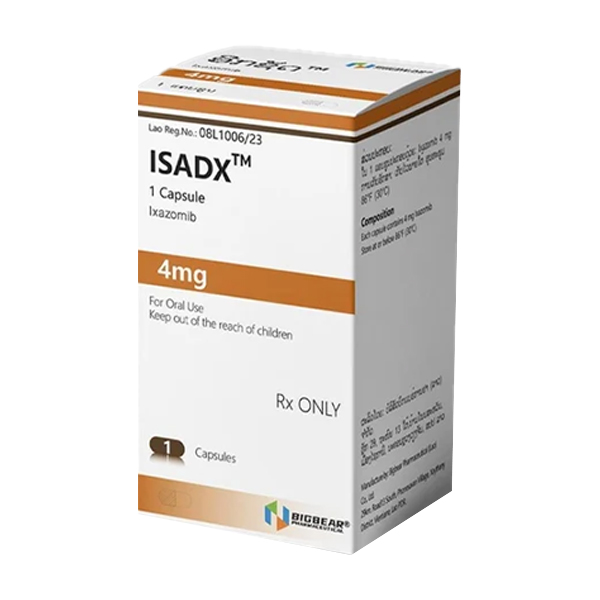
All Names: Ixazomib、Ninlaro、Iksazomib、伊沙佐米、恩莱瑞
Indications:Suitable for multiple myeloma patients who have received at least one previous treatment and need to be used in combination with lenalidomide and dexamethasone.
Manufacturer:Daxiong
Customs Clearance Procedure:If the customs requires the package for customs clearance, please pay the customs clearance fee according to the content of EMS SMS and customs regulations.
In China, Isazomib was approved by the National Medical Products Administration (NMPA) on April 12, 2018, to be marketed under the brand name Enlai Rui.
1、 Drug name
1. Common name: Isazomi
2. Product Name: NINLARO ®
3. English name: Ixazomib
2、 Indications
1. This product is used in combination with lenalidomide and dexamethasone to treat adult patients with multiple myeloma who have received at least one previous treatment.
2. Usage restrictions: Not recommended for maintenance therapy or for newly diagnosed multiple myeloma patients (unless in controlled clinical trials).
3、 Specifications and characteristics
4 milligrams capsules.
4、 Main components
1. Active ingredient: Isazomib (present in the form of Isazomib citrate).
2. Accessories: Microcrystalline cellulose, magnesium stearate, talc powder. The capsule shell contains gelatin and titanium dioxide, as well as different coloring agents.
5、 Usage and dosage
1. Recommended starting dose: 4 milligrams per dose, oral, once a week, taken on the 1st, 8th, and 15th days of the 28 day treatment cycle.
2. Combination therapy: Lenalidomide and dexamethasone should be taken simultaneously according to the corresponding prescription information.
3. Duration of treatment: Treatment should be continued until disease progression or unacceptable toxicity occurs.
6、 Dose adjustment
1. Dose reduction steps: Initial dose of 4 milligrams → First dose reduced to 3 milligrams → Second dose reduced to 2.3 milligrams → Discontinue medication.
2. The situations that require dose adjustment or suspension of administration based on adverse reactions include:
3. Hematological toxicity: such as thrombocytopenia (platelet count below 30000/mm ³) and neutropenia (neutrophil count below 500/mm ³).
4. Non hematological toxicity: such as rash (grade 2 or 3), peripheral neuropathy (grade 1 or 2, or 3 with pain), other grade 3 or 4 non hematological toxicity.
5. When grade 4 peripheral neuropathy or grade 4 rash occurs, the treatment plan should be terminated.
6. Adjustment of starting dose for special populations: For patients with moderate or severe liver dysfunction, severe renal dysfunction, or end-stage renal disease requiring dialysis, the starting dose should be reduced to 3 milligrams.
7、 Medication precautions
1. Medication time: It should be taken on an empty stomach at least 1 hour before meals or 2 hours after meals.
2. Dexamethasone should be taken with food, therefore it should not be taken simultaneously with Isazomib.
3. Usage: Swallow the whole capsule with water, do not crush, chew or open the capsule.
4. Avoid contact: Avoid direct contact with the contents of the capsule. If the capsule is damaged, avoid contact between the contents and the skin or eyes. If contact occurs, thoroughly wash the skin with soap and water, or rinse the eyes thoroughly with water.
5. Missed dose: If one dose is missed and the time to the next scheduled dose is greater than or equal to 72 hours, it can be supplemented. Missed doses should not be taken within 72 hours of the next scheduled dose. Do not take double doses to make up for missed doses.
6. Vomiting after taking medication: If vomiting occurs after taking medication, the dose should not be repeated and should be taken as usual at the next scheduled time.
7. Overdose risk: Strictly follow the recommended dosage, and overdose (including fatal overdose) has been reported.
8、 Medication for special populations
1. Liver dysfunction: For patients with moderate or severe liver dysfunction, the initial dose should be reduced to 3 milligrams.
2. Renal insufficiency: For patients with severe renal insufficiency or end-stage renal disease requiring dialysis, the starting dose should be reduced to 3 milligrams. This product is not dialyzable, so the administration time does not need to consider dialysis time.
3. Pregnant women: Based on the mechanism of action and animal studies, this product may cause harm to the fetus. It is recommended that women with fertility potential take effective non hormonal contraceptive measures during treatment and within 90 days after the last dose.
4. Breastfeeding women: It is recommended that women do not breastfeed during the treatment period and within 90 days after the last dose.
5. Children: Safety and efficacy have not yet been established.
6. Elderly individuals: No overall differences were observed compared to younger patients, but it cannot be ruled out that some elderly individuals have higher sensitivity.
9、 Adverse reactions
1. Very common (≥ 20%) adverse reactions include thrombocytopenia, neutropenia, diarrhea, constipation, peripheral neuropathy, nausea, peripheral edema, rash, vomiting, and bronchitis.
2. Serious other adverse reactions may include thrombotic microvascular disease (TTP/HUS), hepatotoxicity, Stevens Johnson syndrome, toxic epidermal necrolysis, etc.
10、 Contraindications
None.
11、 Drug interactions
It should be avoided to use potent CYP3A inducers (such as rifampicin, phenytoin, carbamazepine, St. John's wort) simultaneously, as they can significantly reduce the blood concentration of isazomib.
12、 Storage method
1. Store at room temperature, do not exceed 30 ° C. Do not freeze.
2. Capsules should be stored in their original packaging and taken out immediately before consumption.
3. This product belongs to hazardous drugs and should follow special handling and disposal procedures.
Ixazomibinformation