- All Drug Categories
- Home
- Anti-cancer Drugs
- Healthcare Products
- Medical Information
- Statement
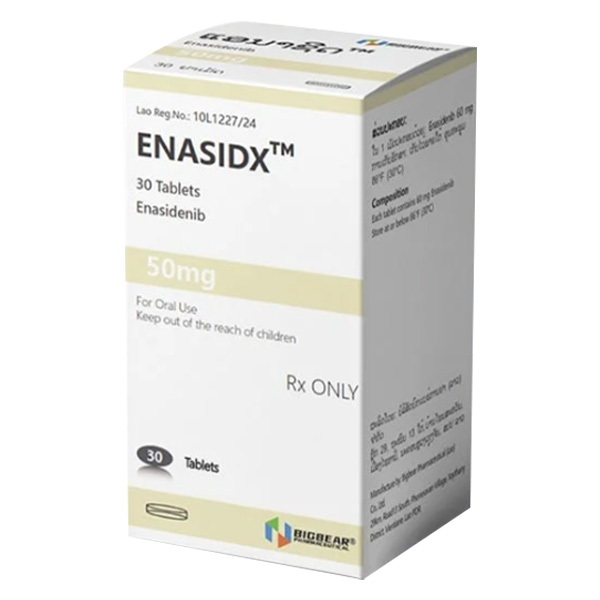
All Names: Idhifa、Enasidenib、恩西地平
Indications:Adult patients with recurrent or refractory acute myeloid leukemia (AML) who have mutations in isocitrate dehydrogenase-2 (IDH2).
Manufacturer:Daxiong
Customs Clearance Procedure:If the customs requires the package for customs clearance, please pay the customs clearance fee according to the content of EMS SMS and customs regulations.
The innovative therapy of amlodipine provides a new treatment option for AML patients, especially those who have failed or relapsed with traditional treatments.
1、 Drug name
1. Common name: Ensidipine
2. Product Name: IDHIFA ®
3. English name: Enasidenib
2、 Indications
This product is suitable for treating adult patients with relapsed or refractory acute myeloid leukemia (AML) confirmed to have isocitrate dehydrogenase-2 (IDH2) mutations by FDA approved testing methods in the United States.
3、 Specifications and characteristics
1. This product is a film coated sheet.
2. There are two specifications: 50mg tablets,; 100mg tablets.
4、 Main components
1. Active ingredient: Ensidipine (present in the form of methanesulfonate salt).
2. Auxiliary materials include: colloidal silica, hydroxypropyl cellulose, hydroxypropyl methylcellulose acetate succinate, iron oxide yellow, magnesium stearate, microcrystalline cellulose, polyethylene glycol, polyvinyl alcohol, sodium dodecyl sulfate, starch sodium hydroxide, talc powder, titanium dioxide, etc.
5、 Usage and dosage
1. The recommended starting dose is once daily, 100 milligrams per dose, taken orally.
2. Can be taken with food or on an empty stomach.
3. It should be swallowed whole and should not be chewed, crushed, or opened.
4. Take medication approximately at the same time every day. If one dose is missed or vomiting occurs after taking the medication, it should be taken as soon as possible on the same day and the normal medication time should be restored the next day. Do not take double the dose on the same day to make up for missed doses.
6、 Dose adjustment
1. Depending on the severity of the adverse reactions, it may be necessary to interrupt administration, reduce dosage, or permanently discontinue medication.
2. Differentiation syndrome: If suspected, systemic corticosteroid treatment and hemodynamic monitoring should be initiated. If severe pulmonary symptoms or renal dysfunction persist for more than 48 hours after starting corticosteroid treatment, the treatment with this product should be interrupted until symptoms and signs improve to level 2 or below before resuming administration.
3. Non infectious leukocytosis: If the white blood cell count does not improve with hydroxyurea treatment, this product should be discontinued until the white blood cell count drops below a specific value before resuming administration.
4. Elevated bilirubin: If bilirubin continues to be three times higher than the upper limit of normal for no less than two weeks without elevated transaminase levels or other liver diseases, the dose should be reduced to 50 milligrams per day; After bilirubin is restored, it can be increased back to 100 milligrams per day.
5. Other toxicity levels of 3 or above: Administration should be interrupted until the toxicity subsides to level 2 or below, and then resumed at a daily dose of 50 milligrams; If the toxicity is reduced to level 1 or below, it may be considered to increase to 100 milligrams per day. If toxicity level 3 or above recurs, this product should be permanently discontinued.
7、 Medication precautions
1. Differentiation syndrome: During the treatment period (from the earliest 10 days to 5 months), differentiation syndrome may occur, which may be life-threatening. Patients need to be aware of symptoms (such as fever, cough, difficulty breathing, bone pain, rapid weight gain, limb swelling, etc.), and seek medical attention immediately once they occur.
2. Tumor lysis syndrome: There is a risk of tumor lysis syndrome during treatment, and adequate water intake should be maintained and blood biochemical indicators should be monitored regularly.
3. Gastrointestinal adverse reactions: common nausea, vomiting, diarrhea, decreased appetite, etc., should be reported to the doctor and management methods should be learned.
4. Elevated bilirubin: This product may cause an increase in bilirubin, which is usually related to the mechanism of action and may not necessarily represent liver damage. However, it is necessary to report skin or eye whitening to a doctor.
5. Embryo fetal toxicity: There is a potential risk to the fetus, and both men and women of childbearing age should take effective contraceptive measures.
6. Storage: Store in the original packaging bottle (containing desiccant), tightly seal the bottle cap to prevent moisture.
8、 Medication for special populations
1. Pregnant women: May cause harm to the fetus, prohibited. Pregnancy testing is required before medication.
2. Breastfeeding women: It is not recommended to breastfeed during treatment and for at least one month after the last dose.
3. Men and women of childbearing age: Female patients need to take effective contraceptive measures during treatment and at least one month after the last dose; When male patients have female partners of childbearing age, effective contraceptive measures should also be taken during treatment and for at least one month after the last dose. This product may affect the effectiveness of hormonal contraceptives. May affect fertility.
4. Children: Safety and efficacy have not yet been established.
5. Elderly: No need to adjust dosage solely based on age.
9、 Adverse reactions
1. Very common (≥ 20%) adverse reactions include nausea, vomiting, diarrhea, elevated bilirubin, and decreased appetite.
2. Common serious adverse reactions (≥ 2%) include differentiation syndrome, leukocytosis, diarrhea, nausea, vomiting, decreased appetite, and tumor lysis syndrome.
3. Other important adverse reactions include non infectious leukocytosis, tumor lysis syndrome, taste disorders, etc.
4. Common abnormalities in laboratory tests include elevated bilirubin, decreased blood calcium, decreased blood potassium, and decreased blood phosphorus.
10、 Contraindications
None.
11、 Drug interactions
1. When used in combination with hormonal contraceptives, this product may increase or decrease its blood drug concentration, affecting contraceptive effectiveness. Its clinical significance is not yet clear, and additional or alternative contraceptive methods need to be used.
2. In vitro studies have shown that amlodipine and its metabolites may inhibit or induce multiple metabolic enzymes and transporters, and have the potential to interact with other drugs. Caution should be exercised when using other drugs in combination.
12、 Storage method
1. Store at room temperature of 20 ° C-25 ° C (68 ° F-77 ° F) and allow for short distance transportation between 15 ° C-30 ° C (59 ° F-86 ° F).
2. Always keep in the original packaging bottle and keep the bottle cap tightly closed. The desiccant inside the bottle should be retained to prevent moisture.
Enasidenibinformation