- All Drug Categories
- Home
- Anti-cancer Drugs
- Healthcare Products
- Medical Information
- Statement
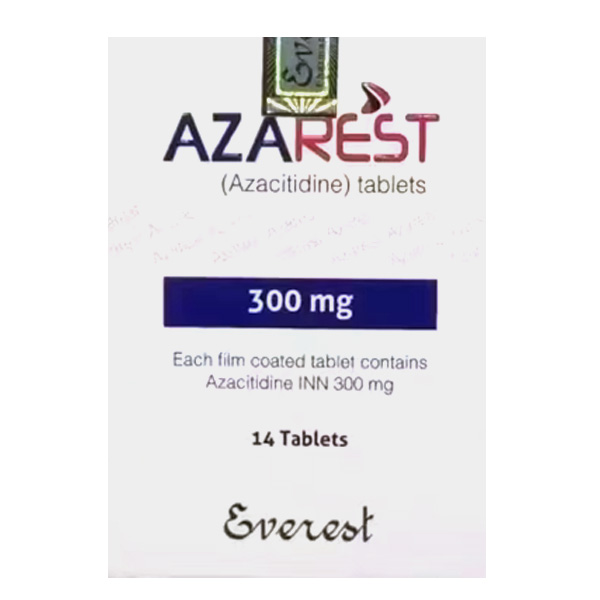
All Names: Azacitidine、Onureg、阿扎胞苷片
Indications:Suitable for adult patients with acute myeloid leukemia, specifically those who achieve CR or CRi after the first intensive induction chemotherapy and are unable to receive further intensive curative treatment (such as allogeneic hematopoietic stem cell transplantation) due to factors such as age, comorbidities, or physical condition.
Manufacturer:Everest Medicines, Bangladesh
Customs Clearance Procedure:If the customs requires the package for customs clearance, please pay the customs clearance fee according to the content of EMS SMS and customs regulations.
Azacitidine tablets are an innovative anti metabolic and demethylating drug. Azacitidine is a pyrimidine nucleoside analogue of cytidine, which exerts its demethylation effect by inhibiting DNA/RNA methyltransferase and is widely used in the treatment of hematological malignancies.
1、 Drug name
Common name: Azacitidine
Product Name: ONUREG ®
2、 Indications
ONUREG (Azacitidine) is a nucleoside metabolism inhibitor suitable for continued treatment of adult patients with acute myeloid leukemia (AML) who have achieved first complete response (CR) or complete response with incomplete recovery of blood cell count (CRi) through intensified induction chemotherapy and are unable to complete intensified cure therapy.
3、 Specifications and characteristics
This product is a film coated tablet, 300mg tablet.
4、 Main components
Active ingredient: Azacitidine.
5、 Usage and dosage
Administration route: Oral.
Recommended dosage: Take 300mg orally once daily from day 1 to day 14 of each 28 day cycle.
Timing of administration: Take at approximately the same time every day, either with food or alone.
Antiemetic preparation: During the first 2 cycles of treatment, antiemetic medication should be taken 30 minutes before each administration to prevent nausea and vomiting. If nausea and vomiting do not occur after 2 cycles, antiemetic prophylaxis can be omitted.
Treatment cycle: Treatment should be continued until disease progression or unacceptable toxicity occurs.
6、 Dose adjustment
The dose adjustment is mainly aimed at adverse reactions, and the following are the key adjustment principles:
Bone marrow suppression
If the absolute neutrophil count (ANC) is less than 0.5Gi/L on the first day of the cycle, treatment should be interrupted and treatment should be resumed at the original dose after ANC returns to ≥ 0.5Gi/L.
If ANC<1Gi/L accompanied by fever occurs, treatment should be interrupted for the first time, and the original dose should be restored after ANC recovers to ≥ 1Gi/L; If it occurs for two consecutive cycles, treatment should be interrupted and ANC should be restored at a dose of 200 milligrams; If febrile neutropenia still occurs after dose reduction, the treatment period will be shortened by 7 days.
If platelet count<50Gi/L accompanied by bleeding occurs: discontinue administration for the first time, and resume at the original dose after platelet count returns to ≥ 50Gi/L; If it occurs for two consecutive cycles, the administration will be interrupted and the platelets will recover at a dose of 200 milligrams; If hemorrhagic thrombocytopenia still occurs after dose reduction, the treatment period will be shortened by 7 days.
Gastrointestinal toxicity (grade 3 or 4 nausea, vomiting, or diarrhea)
First occurrence: Discontinue administration and resume at the original dose after the toxicity subsides to level 1 or below.
Recurrence: Discontinue administration until remission reaches level 1 or below, and restore at a dose of 200 milligrams.
If toxicity still occurs after reducing the dosage, the treatment period will be shortened by 7 days.
If toxicity persists or reoccurs after dose and cycle adjustments, discontinue ONUREG.
Other adverse reactions (grade 3 or 4)
The treatment principles are similar to gastrointestinal toxicity, including discontinuing administration, supportive therapy, reducing dosage to 200 milligrams, or shortening the course of treatment.
7、 Medication precautions
Before and after meals: can be taken with meals or on an empty stomach, no specific requirements.
Medication method: The tablet must be swallowed whole and cannot be cut, crushed, or chewed.
Omission treatment: If the medication is missed or not taken at the regular time on the same day, it should be taken as soon as possible on the same day, and the regular medication time should be restored the next day. Do not take twice the dose on the same day.
Vomiting treatment: If vomiting occurs after taking medication, it should not be taken on the same day. The next dose should be taken at the regular time the next day.
Important Warning:
Irreplaceable: It is strictly prohibited to use ONUREG as a substitute for intravenous or subcutaneous injection of azacitidine, and vice versa. Due to differences in pharmacokinetics, indications, and dosing regimens, it may lead to serious adverse reactions or ineffective treatment.
Handling precautions: ONUREG is a hazardous drug and should follow special handling and disposal procedures. If the powder comes into contact with the skin, immediately wash thoroughly with soap and water; If in contact with mucous membranes (such as eyes or mouth), rinse immediately with clean water.
8、 Medication for special populations
Pregnant women: This product poses a risk of embryo fetal toxicity and may cause harm to the fetus. Pregnant women should be informed of potential risks. Women with fertility should take effective contraceptive measures during treatment and for at least 6 months after the last dose; Male partners with fertility should take effective contraceptive measures during treatment and for at least 3 months after the last dose.
Breastfeeding women: It is recommended not to breastfeed during the treatment period and within one week after the last dose.
Elderly use (≥ 65 years old): No overall difference in safety and efficacy was observed in clinical studies.
Renal insufficiency:
Mild to severe renal insufficiency (creatinine clearance rate CLcr15-89mL/min): No need to adjust the starting dose.
Severe renal insufficiency (CLcr15-29mL/min): Close monitoring of adverse reactions is required, and the dosage should be adjusted according to the adverse reactions.
Liver dysfunction:
Mild liver dysfunction (total bilirubin ≤ upper limit of normal and AST>upper limit of normal, or total bilirubin 1-1.5 times upper limit of normal with any AST value): No dose adjustment is required.
Moderate liver dysfunction (total bilirubin>1.5-3 times the upper limit of normal): The recommended dosage has not yet been established.
Severe liver dysfunction (total bilirubin>3 times the upper limit of normal): No research has been conducted yet.
Pediatric medication: Safety and efficacy have not yet been established.
Fertility: Based on animal data, this product may impair the fertility of both males and females.
9、 Adverse reactions
Common adverse reactions (incidence ≥ 10%): nausea, vomiting, diarrhea, fatigue/weakness, constipation, pneumonia, abdominal pain, joint pain, decreased appetite, febrile neutropenia, dizziness, limb pain.
Serious adverse reactions:
Bone marrow suppression: newly developed or aggravated grade 3/4 neutropenia (49%), thrombocytopenia (22%); Febrile neutropenia (12%).
Gastrointestinal toxicity: Grade 3/4 nausea, vomiting, diarrhea.
Other: severe allergic reactions, interstitial lung disease, tumor lysis syndrome, etc. (post marketing monitoring report).
The main adverse reactions leading to drug discontinuation (>1%) are nausea (2.1%), diarrhea (1.7%), and vomiting (1.3%).
10、 Contraindications
Patients with a history of severe allergies to Azacitidine or ONUREG are contraindicated.
11、 Drug interactions
Gastric acid reducing agent: When taken together with proton pump inhibitors such as omeprazole, the systemic exposure (AUC) of azacitidine increases by approximately 19%, but the maximum blood concentration (Cmax) is not affected.
Enzymes and transporters: Azacitidine does not significantly inhibit or induce major cytochrome P450 enzymes at clinically relevant concentrations, nor is it a substrate or inhibitor of common transporters such as P-glycoprotein.
12、 Storage method
Storage temperature: Store at room temperature between 20 ° C and 25 ° C (68 ° F and 77 ° F); Allow short distance transportation between 15 ° C and 30 ° C (59 ° F and 86 ° F).
Packaging requirements: It must be stored in the original bottle (with two desiccant cans inside) and keep the bottle cap tightly closed. Do not swallow the desiccant canister.
Disposal: Handle according to the special disposal regulations for dangerous drugs.
Azacitidineinformation