- All Drug Categories
- Home
- Anti-cancer Drugs
- Healthcare Products
- Medical Information
- Statement
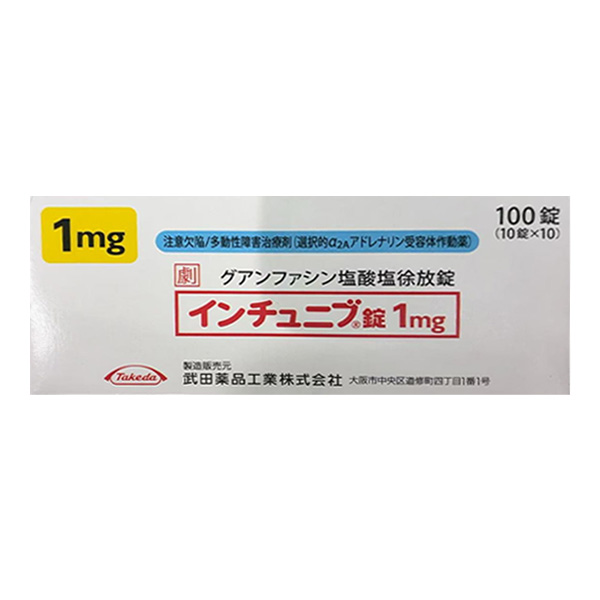
All Names: Guanfacine Hydrochloride Extended-Release Tablets、Intuniv、胍法辛缓释片
Indications:Suitable for children, adolescents, and adult patients with Attention Deficit/Hyperactivity Disorder (ADHD) aged 6 and above, it must be diagnosed according to DSM and other standards before use. The effectiveness and safety of this medication for patients under 6 years old have not been established.
Manufacturer:Takeda,Japan
Customs Clearance Procedure:If the customs requires the package for customs clearance, please pay the customs clearance fee according to the content of EMS SMS and customs regulations.
Guanfaxin sustained-release tablets are a selective alpha 2A adrenergic receptor agonist used to treat attention deficit hyperactivity disorder by regulating signal transduction in the prefrontal cortex and basal ganglia.
1、 Drug name
Common name: Guanfaxin sustained-release tablets.
Product Name: Intuniv (インチュュプ Ingot).
2、 Indications
Attention Deficit/Hyperactivity Disorder (AD/HD).
3、 Specifications and characteristics
インチュプ Tablets 1mg (calculated as guanidine hydrochloride): Each tablet contains 1.14mg of guanidine hydrochloride.
Appearance: 1mg tablet is a white circular tablet.
Sustained release tablets should not be broken, crushed, or chewed for consumption.
4、 Main components
Active ingredient: GuanfacineHydrochloride.
5、 Usage and dosage
General principle: Take orally once a day.
Patients under 18 years old:
Initial dose: 1mg per day for individuals weighing less than 50kg; 2mg per day for individuals weighing ≥ 50kg.
Dose adjustment: Increase 1mg at intervals of at least 1 week until individualized maintenance dose is reached. The maximum dose shall not exceed the maximum dosage. The specific dosage should strictly follow the following table (converted into text description) according to the weight range:
Weight above 17kg to less than 25kg: initial dose 1mg, maintenance dose 1mg, maximum dose 2mg.
Weight above 25kg to less than 34kg: starting at 1mg, maintaining at 2mg, and reaching a maximum of 3mg.
Weight above 34kg to less than 38kg: starting at 1mg, maintaining at 2mg, and reaching a maximum of 4mg.
Weight above 38kg to less than 42kg: starting at 1mg, maintaining at 3mg, and reaching a maximum of 4mg.
Weight above 42kg to less than 50kg: starting at 1mg, maintaining at 3mg, and up to 5mg.
Weight above 50kg to less than 63kg: starting at 2mg, maintaining at 4mg, and reaching a maximum of 6mg.
Weight above 63kg to less than 75kg: starting at 2mg, maintaining at 5mg, and reaching a maximum of 6mg.
Weight above 75kg: starting at 2mg, maintaining at 6mg, and reaching a maximum of 6mg.
Patients aged 18 and above:
Initial dose: 2mg per day.
Dose adjustment: Increase by 1mg at intervals of at least 1 week until reaching the daily maintenance dose of 4-6mg. The maximum daily dose should not exceed 6mg.
6、 Dose adjustment
Starting dose for special patients: For patients who are currently taking strong CYP3A4/5 inhibitors (such as itraconazole, clarithromycin, etc.) or patients with severe liver/kidney dysfunction, they should start taking 1mg per day.
Discontinuation method: If medication needs to be stopped, it should be reduced by 1mg at least every 3 days, gradually decreasing while closely monitoring blood pressure and heart rate. Sudden discontinuation of medication may lead to elevated blood pressure and rapid heartbeat.
7、 Medication precautions
Before and after meals: Food can affect the absorption of medication. Compared to taking on an empty stomach, taking after a high-fat meal can lead to a peak increase in blood drug concentration of about 1.2-1.4 times and an overall increase in exposure of about 1.2-1.3 times. The specific time of taking should follow the doctor's advice.
Omission: In general, if the sustained-release formulation is close to the next dose, it should not be supplemented or the dosage should be doubled. Please consult a doctor or pharmacist for specific information.
Usage: This product is a sustained-release tablet and should be swallowed whole. Do not break, crush, or chew. Take it out of the aluminum-plastic panel (PTP) before taking it again.
Monitoring requirements: blood pressure and heart rate should be measured before taking the medicine and within 1-2 weeks after adjusting the dosage. After reaching the stabilizer level, it is also recommended to monitor at least once every 4 weeks. Be alert to the risks of low blood pressure, bradycardia, and fainting.
Other important notes:
May cause drowsiness and sedation, avoid driving or operating dangerous machinery during medication.
Attention should be paid to emotional changes, such as suicidal thoughts, increased aggression or hostility, and timely medical attention should be sought.
May lead to weight gain, weight should be monitored regularly.
During medication, it is important to replenish fluids to prevent dehydration.
8、 Medication for special populations
Pregnant women and women at risk of pregnancy: Do not use. Animal experiments have shown that high doses pose a teratogenic risk.
Breastfeeding women: Medications may be secreted into breast milk, and the necessity of treatment and the benefits of breastfeeding should be balanced before deciding whether to continue breastfeeding or discontinue medication.
Children: The safety and effectiveness of children under 6 years old have not yet been established.
Patients with liver/kidney dysfunction:
Patients with severe liver or kidney dysfunction should start with a low dose (1mg per day).
The medication information for patients with mild to moderate liver and kidney dysfunction is unclear, and caution should be exercised when using it.
Cardiovascular disease patients: Patients with low blood pressure, bradycardia, history of heart disease, QT interval prolongation, or related risks should use caution and strengthen monitoring (such as electrocardiogram).
9、 Adverse reactions
Common adverse reactions (incidence ≥ 1%): drowsiness (drowsiness), headache, insomnia, dizziness, dry mouth, constipation, abdominal pain, decreased appetite, nausea, diarrhea, fatigue, enuresis, weight gain, etc.
Major side effects (requiring immediate medical attention):
Hypotension and bradycardia can lead to fainting in severe cases.
Atrioventricular block.
Suicide ideation or behavior.
Allergic reactions (rash, itching, etc.).
QT interval prolongation (abnormal electrocardiogram).
10、 Contraindications
Patients with a history of allergies to any of the ingredients in this product.
Pregnant or potentially pregnant women.
Patients with grade II or III atrioventricular block.
11、 Drug interactions
Prohibited or highly vigilant combination:
CYP3A4/5 strong inhibitors (such as itraconazole, clarithromycin, ritonavir): will significantly increase the blood concentration of this drug, increase the risk of side effects, and consider reducing the dosage of this product.
CYP3A4/5 strong inducers (such as rifampicin, carbamazepine, phenytoin): can significantly reduce the blood concentration of this drug, which may weaken its efficacy.
Other antihypertensive drugs or bradycardia drugs (such as beta blockers, digoxin) may synergistically cause excessive hypotension or bradycardia.
Central nervous system inhibitors (such as sedatives, hypnotics, certain psychiatric drugs, alcohol): can enhance sedative effects.
Attention should be paid to the combination use: When used in combination with valproic acid, it may increase the blood concentration of valproic acid.
12、 Storage method
Store at room temperature.
Please keep the medication out of reach of children.
13、 Manufacturer
Manufacturer and seller: Takeda Pharmaceutical Company Limited.
Intunivinformation