- All Drug Categories
- Home
- Anti-cancer Drugs
- Healthcare Products
- Medical Information
- Statement
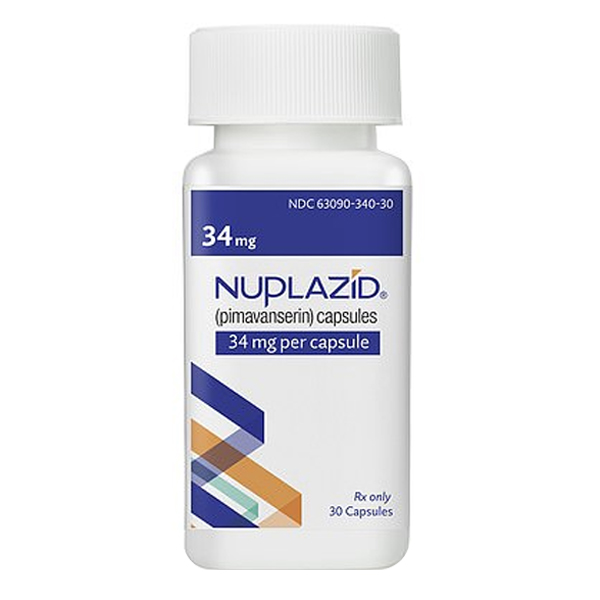
All Names: Pimavanserin、Nuplazid、匹莫范色林
Indications:Adult Parkinson's disease patients (with or without dementia), whose psychiatric symptoms appear after diagnosis of Parkinson's disease and require medication treatment. Not applicable to dementia related psychiatric disorders not related to Parkinson's disease.
Manufacturer:美国Acadia制药
Customs Clearance Procedure:If the customs requires the package for customs clearance, please pay the customs clearance fee according to the content of EMS SMS and customs regulations.
Nuplazid is an atypical antipsychotic drug used to treat hallucinations and delusions associated with Parkinson's disease by selectively acting on serotonin receptors.
1、 Drug name
1. Common name: Pimofonserin
2. Product Name: NUPLAZID ®
3. English name: Pimavanserin
2、 Indications
Used to treat hallucinations and delusions related to Parkinson's disease and mental illness.
3、 Specifications and characteristics
Capsule: 34mg. It is an opaque white and light green capsule with black "PIMA" and "34" markings.
4、 Main components
Active ingredient: Pimofonserin Tartrate.
5、 Usage and dosage
1. Recommended dose: 34mg, taken orally once daily, no dose titration required.
2. Usage: Can be taken with food or on an empty stomach.
6、 Dose adjustment
1. When used in combination with potent CYP3A4 inhibitors: the dose of NUPLAZID should be reduced, and the specific dose reduction should follow the doctor's advice.
2. Combination use with potent or moderate CYP3A4 inducers: Avoid combination use.
7、 Medication precautions
1. Medication timing: Take once a day at a fixed time, both before and after meals.
2. Missing dose: If one dose is missed, it should be taken immediately upon recollection. But if the next dose is approaching, the missed dose should be skipped and the next dose should be taken at the regular time. Do not take double the dose at once.
3. Vomiting after taking medication: If vomiting occurs shortly after taking medication, it is not recommended to take it again as the medication may not have been fully absorbed. You should wait until the next scheduled medication time.
4. Operation warning: Drive or operate machinery with caution during medication.
5. Important warning: Antipsychotic drugs increase the risk of death when used in elderly patients with dementia related psychiatric disorders. This product is only approved for the treatment of hallucinations and delusions related to Parkinson's disease and is not suitable for the treatment of psychiatric symptoms in non Parkinson's disease related dementia patients.
8、 Medication for special populations
1. Pregnant women: There is no data on the use of pregnant women, and it is only used when the potential benefits outweigh the risks.
2. Breastfeeding women: It is not yet clear whether the medication is excreted through human milk, and the pros and cons should be weighed before deciding whether to discontinue medication or breastfeeding.
3. Children: Safety and efficacy have not yet been established.
4. Elderly people (≥ 65 years old): No need to adjust dosage.
5. Patients with renal insufficiency: Mild to severe renal insufficiency or end-stage renal disease (ESRD) patients do not require dose adjustment, but patients with severe renal insufficiency and ESRD should use with caution.
6. Patients with liver dysfunction: No need to adjust dosage.
7. Other populations: Age, gender, race, or weight do not require dose adjustment.
9、 Adverse reactions
1. The most common adverse reactions (with an incidence rate of ≥ 5% and more than twice that of the placebo group) are peripheral edema (7%) and blurred consciousness (6%).
2. Other common adverse reactions (incidence ≥ 2% and ≥ placebo group): nausea, constipation, gait disorders, hallucinations.
3. Adverse reactions reported after listing: rash, urticaria, angioedema like reactions (such as tongue swelling, perioral edema, throat tightness, difficulty breathing), drowsiness, falls, agitation, aggressive behavior, fecal incontinence, etc.
4. Serious adverse reactions:
QT interval prolongation: may increase the risk of arrhythmia.
The mortality rate of elderly dementia related psychiatric patients has increased.
10、 Contraindications
It is contraindicated for patients with a history of allergies to Pimofonserin or any of its ingredients.
11、 Drug interactions
Prohibit/avoid combination use:
1. QT interval prolonging drugs: Avoid combination with drugs known to prolong the QT interval (such as Class IA and III antiarrhythmic drugs, certain antipsychotic drugs, or antibiotics).
2. Strong or moderate CYP3A4 inducers: Avoid combination use.
3. Need to adjust dosage combination: When combined with potent CYP3A4 inhibitors (such as ketoconazole), the dosage of this product should be reduced to 10mg once daily.
4. No clinically significant interaction: No dose adjustment is required when used in combination with carbidopa/levodopa.
12、 Storage method
1. Capsules: Store at 20 ° C to 25 ° C (68 ° F to 77 ° F) and allow for brief storage between 15 ° C to 30 ° C (59 ° F to 86 ° F).
2. Avoid light to prevent the capsules from fading.
13、 Manufacturer
Acadia Pharmaceuticals Inc. (San Diego, California, USA)
Nuplazidinformation