- All Drug Categories
- Home
- Anti-cancer Drugs
- Healthcare Products
- Medical Information
- Statement
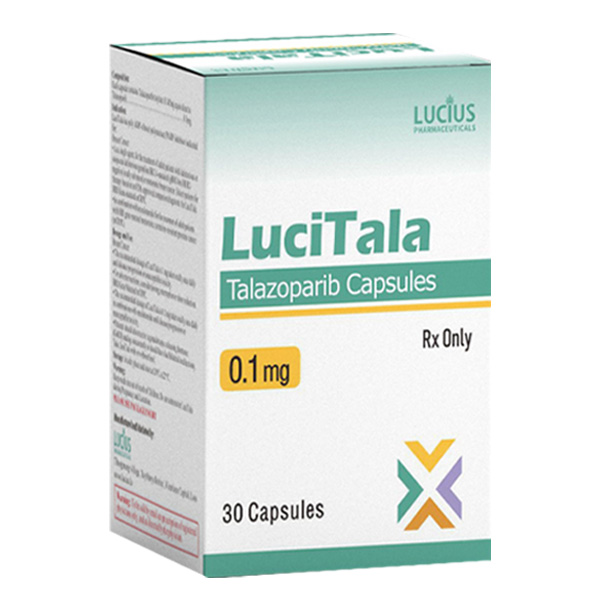
All Names: talazoparib、Talzenna、他拉唑帕利、他拉唑帕尼、他唑来膦、泰泽纳
Indications:It is applicable to adult patients with HER2 negative local advanced or metastatic breast cancer carrying harmful or suspected harmful germline BRCA mutation (gBRCAm), and adult patients with metastatic castration resistant prostate cancer (mCRP) carrying HRR gene mutation.
Manufacturer:LUCIUS PHARMACEUTICAL (LAOS) CO., LTD
Customs Clearance Procedure:If the customs requires the package for customs clearance, please pay the customs clearance fee according to the content of EMS SMS and customs regulations.
Talazoparib is a poly (ADP ribose) polymerase (PARP) inhibitor that interferes with the DNA damage repair mechanism of tumor cells by inhibiting the activity of PARP1 and PARP2 enzymes, leading to cancer cell apoptosis.
1、 Drug name
1. Common name: talazoparib
2. Product Name: TALZENNA
3. Dosage form: Oral capsules
2、 Indications
1. Breast cancer: as a single drug, it is used to treat adult patients with locally advanced or metastatic breast cancer who carry BRCA mutation of pathogenic or suspected pathogenic germline and HER2 negative.
2. Prostate cancer: Combined with enzalutamide, used to treat adult patients with metastatic castration resistant prostate cancer carrying homologous recombination repair gene mutations.
3、 Specifications and characteristics
Specifications: 0.1mg, 0.25mg
Characteristic: Capsule
4、 Main components
Active ingredient: talazoparibtosylate.
5、 Usage and dosage
1. Breast cancer: the recommended dose is 1mg, taken orally once a day until the disease progresses or unacceptable toxicity occurs.
2. Prostate cancer: The recommended dose is 0.5mg, taken orally once a day, in combination with enzalutamide, and GnRH analogs or bilateral orchidectomy is required.
3. Usage: Can be taken with food or on an empty stomach; Capsules should be swallowed whole and should not be opened or dissolved.
6、 Dose adjustment
1. Adverse reaction dose adjustment:
Breast cancer: initial 1mg → 0.75mg → 0.5mg → 0.25mg.
Prostate cancer: starting at 0.5mg → 0.35mg → 0.25mg → 0.1mg.
If more than 3 dose reductions are required, the medication should be permanently discontinued.
2. Hematological toxicity treatment:
When hemoglobin is less than 8g/dL, platelets are less than 50000/μ L, and neutrophils are less than 1000/μ L, medication should be suspended.
After returning to a safe level (such as ≥ 9g/dL, ≥ 75000/μ L, ≥ 1500/μ L), medication can be reduced for recovery.
3. Dose adjustment for renal insufficiency:
Breast cancer: moderate (CLcr30-59mL/min) → 0.75mg; severe (CLcr15-29mL/min) → 0.5mg
Prostate cancer: moderate → 0.35mg; severe → 0.25mg
Combined use of P-glycoprotein inhibitor: if combined use is required (such as itraconazole, amiodarone, etc.), the dose for breast cancer patients should be reduced to 0.75mg; the original dose can be restored after drug withdrawal.
7、 Medication precautions
1. Before and after meals: can be taken with food or on an empty stomach.
2. Missed dose: If missed or vomited after taking the medication, take the next regular dose according to the original plan and do not take additional doses.
3. Monitoring requirement: Conduct a complete blood count test once a month.
8、 Medication for special populations
1. Pregnant women: May cause harm to the fetus, prohibited.
2. Breastfeeding is not recommended for lactating women during treatment and within one month after the last dose.
3. Women of childbearing age: Effective contraceptive measures should be used during treatment and within 7 months after the last dose.
4. Male patients: Effective contraceptive measures should be used during treatment and within 4 months after the last dose.
5. Elderly: No special adjustments required, safety is similar to that of young people.
6. Liver dysfunction: No need to adjust dosage.
7. Renal insufficiency: Reduce dosage according to severity (see "Dose Adjustment").
9、 Adverse reactions
1. Common monotherapy (≥ 20%):
Hemoglobin, neutrophils, lymphocytes, and platelets decrease.
Fatigue, nausea, headache, vomiting, hair loss, diarrhea, decreased appetite.
Elevated blood sugar, AST, ALP, ALT, and decreased blood calcium.
2. Combination therapy is common (≥ 10%):
Hemoglobin, neutrophils, lymphocytes, and platelets decrease.
Fatigue, nausea, decreased appetite, dizziness, and taste disorders.
Blood calcium, sodium, phosphorus, magnesium, and potassium levels decrease, while fractures and bilirubin levels increase.
3. Serious adverse reactions:
Myelodysplastic syndrome/acute myeloid leukemia (MDS/AML).
Bone marrow suppression (anemia, neutropenia, thrombocytopenia).
10、 Contraindications
none
11、 Drug interactions
1. P-glycoprotein inhibitors: may increase exposure to talazoliparib and increase the risk of adverse reactions, requiring dose adjustment.
2. BCRP inhibitors: may increase exposure and require monitoring for adverse reactions.
3. Combined use with enzalutamide: the exposure to talazolparib increases by about 2 times.
12、 Storage method
1. Temperature: 20 ° C to 25 ° C (68 ° F to 77 ° F), with brief fluctuations allowed up to 15 ° C to 30 ° C.
2. Storage requirements: Keep out of reach of children.
talazoparibinformation