- All Drug Categories
- Home
- Anti-cancer Drugs
- Healthcare Products
- Medical Information
- Statement
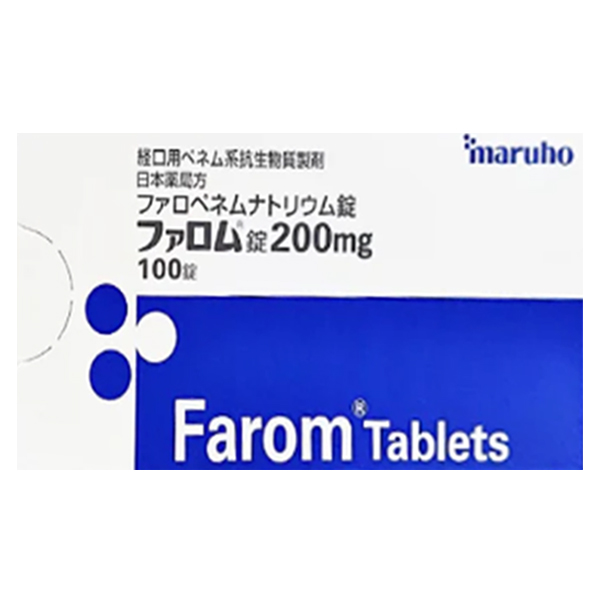
All Names: Faropenem、Farom、法罗培南
Indications:Suitable for adult patients who require treatment for infection with Faropenem sensitive bacteria, and the dosage should be adjusted according to the type of infection and renal function.
Manufacturer:日本Maruho株式会社
Customs Clearance Procedure:If the customs requires the package for customs clearance, please pay the customs clearance fee according to the content of EMS SMS and customs regulations.
Faropenem is produced by Maruho Pharmaceutical Co., Ltd. in Japan and was patented in Japan in 1986. In 1997, its tablets were first approved for sale in Japan under the trade name Farom. In 2006, Faropenem sodium tablets were first approved for sale in China, and Faropenem is classified as a Class B drug under medical insurance in China.
1、 Drug name
Common name: Faropenem Sodium Hydrate
Product Name: Farom Tablets
2、 Indications
This product is suitable for treating various infections caused by Faropenem sensitive bacteria, including:
Skin and soft tissue infections: superficial/deep-seated skin infections, lymphadenitis/lymphadenitis, chronic pyoderma, acne with purulent inflammation, etc.
Surgical and traumatic infections: secondary infections such as trauma, burns, and surgical wounds, mastitis, and perianal abscess.
Respiratory system infections: pharyngitis, laryngitis, tonsillitis, acute bronchitis, pneumonia, lung abscess.
Urinary and reproductive system infections: cystitis, pyelonephritis, prostatitis (acute/chronic), epididymitis, balanitis, intrauterine infections, and pelvic inflammatory disease.
Ophthalmic infections: dacryocystitis, stye, meibomian gland inflammation, keratitis (including corneal ulcers).
Ear, nose and throat infections: otitis media, sinusitis.
Dental and oral surgical infections: Periodontal tissue inflammation, wisdom tooth pericoronitis, and jaw inflammation.
3、 Specifications and characteristics
Specification: Farom tablets 200mg (calculated as Faropenem sodium hydrate).
Appearance: All are white film coated tablets.
200mg tablets: diameter approximately 9.1mm, thickness approximately 4.3mm, mass approximately 291mg, identification code "F20".
4、 Main components
The active ingredient in each tablet is Faropenem Sodium Hydrate (Japanese Pharmacopoeia), with 150mg tablets containing 150.0mg (potency) and 200mg tablets containing 200.0mg (potency).
5、 Usage and dosage
Conventional usage: Oral administration, three times a day.
Conventional dosage:
For skin infections, simple cystitis, some gynecological and ophthalmic infections, etc.: Adults usually take 150mg to 200mg once (potency).
For pneumonia, lung abscess, non simple cystitis, pyelonephritis, prostatitis, otitis media, sinusitis, etc.: Adults usually take 200mg to 300mg once (potency).
It can be adjusted according to age and symptoms.
6、 Dose adjustment
Patients with renal impairment: For patients with severe renal impairment, the dosage interval should be reduced or extended, as this product is mainly excreted through the kidneys, the half-life in the blood will be prolonged, and the blood drug concentration will continue.
Elderly patients: Generally, medication should be administered starting from a dose of 150mg and the patient's condition should be carefully observed. Due to a general decline in physiological function and the possibility of prolonged half-life and sustained blood drug concentration caused by decreased renal function.
7、 Medication precautions
Before and after meals: Food can affect absorption rate (delaying peak time by about 1 hour), but has almost no effect on the highest blood drug concentration, half-life, and area under the drug time curve (AUC). Therefore, it can be taken before or after meals, but attention should be paid to the intervals between taking the following interacting drugs.
Missed dose: It is recommended to follow the usual principle: if it is close to the next dose, skip the missed dose and take the next dose at the normal time, without doubling the dose.
Vomiting: If vomiting occurs shortly after taking medication, it may affect the efficacy of the medication. It is recommended to consult a doctor or pharmacist to see if it is necessary to take additional medication.
Important basic precautions:
In principle, drug sensitivity testing should be conducted and medication should be limited to the shortest period required for disease treatment to prevent the emergence of drug-resistant bacteria.
Before taking medication, full consultation should be conducted to be alert to the occurrence of shock.
May cause elevated levels of AST, ALT, Al-P, and jaundice, and should be regularly checked and fully observed.
The most common side effects are diarrhea and soft stools, which should be discontinued and appropriate measures taken when they occur.
8、 Medication for special populations
Pregnant women: Use only when the benefits of treatment outweigh the risks.
Breastfeeding women: This product can enter human milk, and the therapeutic benefits should be balanced with the benefits of breastfeeding before deciding whether to continue breastfeeding or discontinue the medication.
Children: No clinical trials have been conducted on low birth weight infants and newborns.
Elderly patients: Special attention should be paid to diarrhea and soft stools, which may worsen the overall condition and may lead to bleeding tendencies caused by vitamin K deficiency.
9、 Adverse reactions
Serious side effects (frequency unknown): shock, allergic reactions, acute kidney injury, pseudomembranous colitis and other severe colitis with bloody stools, toxic epidermal necrolysis (TEN), Stevens Johnson syndrome, interstitial pneumonia, PIE syndrome, liver dysfunction, jaundice, granulocytopenia, rhabdomyolysis.
Other common side effects (incidence rate of 0.1-5%): diarrhea, soft stool, rash, itching, nausea, abdominal pain, vomiting, loss of appetite, abdominal distension, eosinophilia, AST/ALT/γ - GTP/Al-P/bilirubin/LDH elevation, BUN elevation, stomatitis, candidiasis, etc.
Symptoms of vitamin deficiency: Symptoms of vitamin K deficiency (such as hypophrombinemia, bleeding tendency, etc.) and vitamin B deficiency (such as glossitis, stomatitis, loss of appetite, neuritis, etc.) may occur.
10、 Contraindications
Patients with a history of allergies to the ingredients of this product are prohibited from using it.
11、 Drug interactions
Medications to be aware of when using in combination:
Sodium valproate: Co administration with carbapenem antibiotics (such as meropenem) has been reported to cause a decrease in blood concentration of valproic acid and recurrence of epilepsy, but the mechanism is unclear.
Furosemide: Animal experiments (in dogs) have reported increased nephrotoxicity, but the mechanism is unclear.
Sitastatin sodium (in combination with imipenem): Animal experiments (in rats) have reported that it may increase the blood concentration of this product, as Sitastatin inhibits metabolic enzymes.
12、 Storage method
Store at room temperature. After opening, it should be stored against moisture. The validity period is 36 months.
Faropeneminformation