- All Drug Categories
- Home
- Anti-cancer Drugs
- Healthcare Products
- Medical Information
- Statement
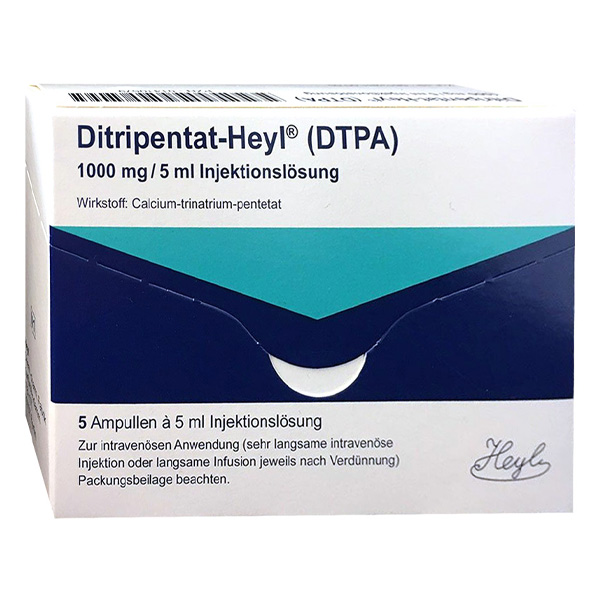
All Names: Ca-DTPA、DTPA calcium trisodium、Pentetate calcium trisodium injection、戊二酸钙三钠盐注射液、三钠钙五乙酸盐注射液、喷替酸钙三钠、DTPA 钙盐
Indications:All individuals with a risk of contamination within radioactive elements or confirmed contamination.
Manufacturer:德国Heyl
Customs Clearance Procedure:If the customs requires the package for customs clearance, please pay the customs clearance fee according to the content of EMS SMS and customs regulations.
Ditripentat HeylAmp. (calcium trisodium glutarate injection) produced by Heyl, a chemical pharmaceutical factory in Germany, is mainly used to treat contamination caused by the ingestion of transuranic radioactive elements such as plutonium (Pu), americium (Am), curium (Cm) in the body.
1、 Drug name
1. Common name: Pentetate Calcium Trisodium Injection
2. Product Name: Ditripentat HeylAmp
3. Common abbreviation: Ca DTPA
2、 Indications
This product is a radioactive isotope chelating agent suitable for treating individuals known or suspected to be contaminated with plutonium, americium, or curium in the body, in order to increase the excretion rate of these radioactive elements.
3、 Specifications and characteristics
1. Specification: 1000mg/5ml (single use ampoule).
2. Appearance: Sterile, colorless, clear, high osmotic (1260mOsmol/kg) solution.
4、 Main components
Main active ingredient: Calcium trisodium glutarate (also known as calcium trisodium diethylenetriaminepentaacetate).
5、 Usage and dosage
1. First administration: Chelation therapy is most effective within 24 hours after contamination in the body. Recommend administering only a single dose of Ca DTPA.
2. Adults and adolescents: single intravenous injection of 1.0g.
3. Children under 12 years old: Single intravenous injection of 14 milligrams/kilogram, with a daily total not exceeding 1.0 gram.
4. Maintenance therapy: If chelation therapy needs to be continued 24 hours after the first administration, it is recommended to use Zn DTPA. If Zn DTPA cannot be obtained, Ca DTPA can continue to be used, but zinc containing mineral supplements should be supplemented at the same time. The daily administration should not exceed once.
5. Administration method:
Intravenous injection: If the route of contamination is unclear or there are multiple routes of contamination, intravenous administration is preferred. It can be directly and slowly intravenously injected (3-4 minutes), or diluted in 100-250 milliliters of 5% glucose injection, Ringer's lactate injection, or physiological saline for intravenous infusion.
Nebulized inhalation: It can be used as an alternative route of administration only if contamination has occurred through inhalation within the past 24 hours. Dilute with sterile water or physiological saline in a 1:1 ratio before use.
6、 Dose adjustment
Patients with renal insufficiency: No need to adjust dosage. But renal dysfunction can reduce the clearance rate of radioactive pollutants. For patients with severe pollution and concomitant renal insufficiency, efficient high-throughput dialysis can be considered, but attention should be paid to the radioactive nature of the dialysate and protective measures should be taken.
7、 Medication precautions
1. Core warning: This product is related to the depletion of trace elements (such as zinc) in the body. The degree of exhaustion increases with increasing dosage, divided administration, and prolonged treatment time. Therefore, only a single initial dose is recommended.
2. Monitoring requirements: During treatment, serum zinc levels, blood cell counts, blood urea nitrogen, creatinine, electrolytes, and urine routine must be closely monitored, and zinc containing vitamin or mineral supplements must be supplemented as needed.
3. Missed/delayed administration: If treatment cannot be started immediately, it should be administered immediately if conditions permit. Even after a period of time has passed since the pollution occurred, the treatment is still effective, although the effect may decrease over time.
4. Diet related: It is recommended that patients drink plenty of water and urinate frequently to dilute the radioactive chelates in their urine and reduce radiation exposure to the bladder.
8、 Medication for special populations
1. Pregnant women: Animal studies have shown teratogenicity and embryotoxicity. Zn DTPA should be the preferred chelation therapy for pregnant women. Only when Zn DTPA or high-dose radioactive contamination cannot be obtained, should a single dose of Ca DTPA be used after weighing the pros and cons, and zinc supplements should be supplemented at the same time.
2. Breastfeeding women: Radioactive substances are known to be excreted through breast milk. Regardless of whether they receive chelation therapy, women suspected or confirmed to be contaminated with radiation should not breastfeed and should handle discarded breast milk with caution.
3. Pediatric medication: The safety and efficacy of intravenous administration are extrapolated based on adult data, and the dosage is adjusted according to body weight. The safety and effectiveness of nebulized inhalation in pediatric populations have not been determined.
9、 Adverse reactions
1. Common/reported adverse reactions: headache, dizziness, chest pain, allergic reactions, dermatitis, metallic smell, nausea, diarrhea, injection site reactions. Nebulized inhalation may cause coughing and/or wheezing, especially in patients with a history of asthma.
2. Serious warning: Nebulized administration may trigger asthma attacks. Long term or repeated administration can lead to depletion of trace elements such as zinc, magnesium, and manganese in the body.
10、 Contraindications
None.
11、 Drug interactions
If the patient is simultaneously contaminated with multiple or unknown radioactive isotopes, additional treatment (such as Prussian blue, potassium iodide) may be required.
12、 Storage method
1. Temperature: Store between 15 ° C and 30 ° C (59 ° F and 86 ° F).
2. Handling: Before administration, a visual inspection should be conducted to check for particles and discoloration. If particles are found after opening the ampoule, a sterile filter can be used for filtration. Ampoules are of the easy to break (OPC) type, with the dot mark facing upwards and the neck broken downwards.
Ditripentat-Heyl Amp.information